Cycling MPH Calculator
Calculate cycling mph from distance and ride time, compare kph and pace, estimate cadence and gear speed, and adjust the readout for bike type, terrain, wind, and climbing.
📌Ride Presets
Presets fill cycling-specific distance, moving time, bike setup, cadence, gear, terrain, wind, and elevation fields.
⚙Calculator
Cycling speed snapshot
Enter ride distance and moving time to calculate cycling mph, kph, pace, and gear speed.
📊Cycling Metrics
📑Reference Tables
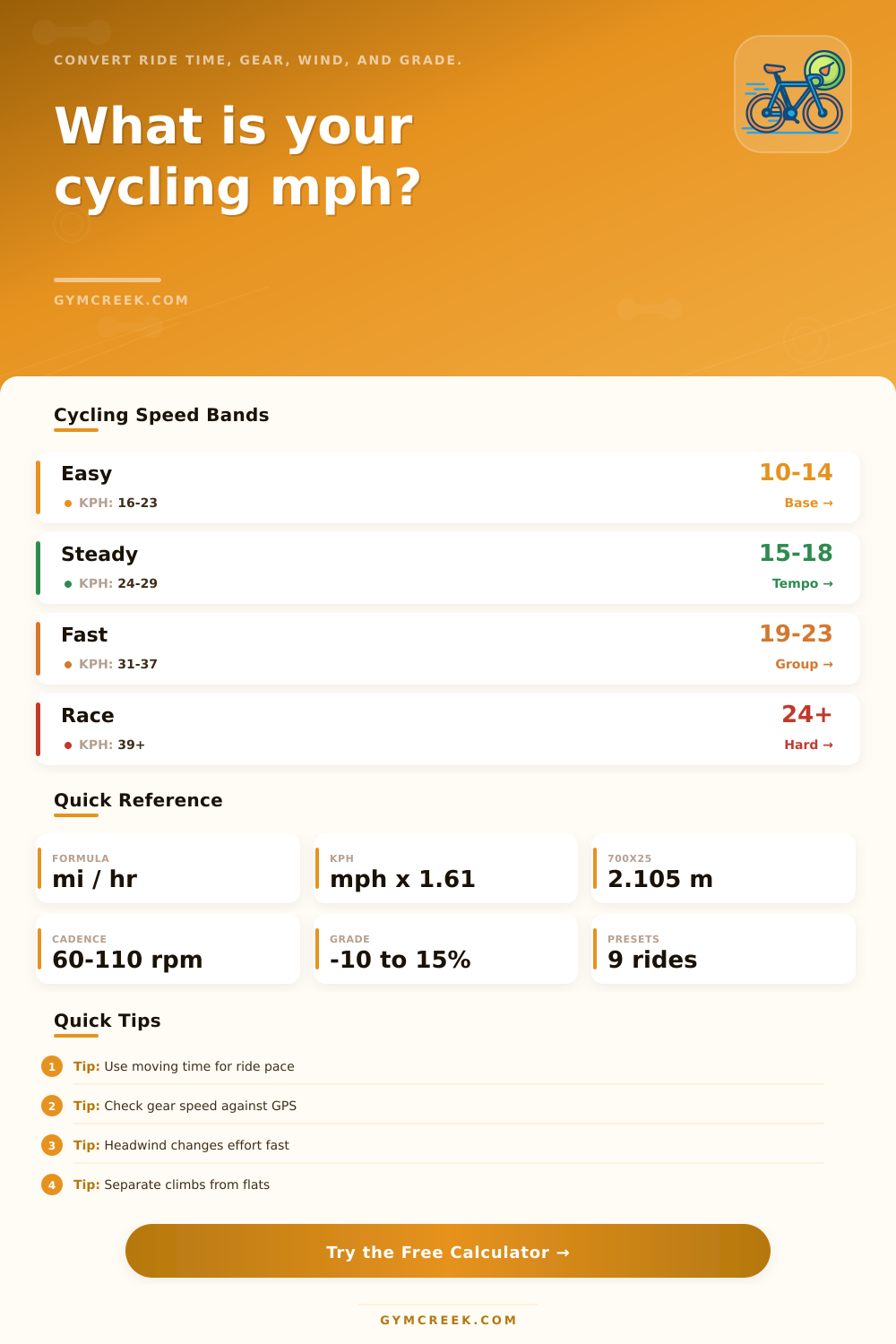
| Band | MPH | KPH | Typical use |
|---|---|---|---|
| Easy spin | 10 to 14 mph | 16 to 23 kph | Recovery, commuting, social riding |
| Steady endurance | 15 to 18 mph | 24 to 29 kph | Base training and longer road rides |
| Fast group | 19 to 23 mph | 31 to 37 kph | Tempo, paceline, strong solo riding |
| Race pace | 24 plus mph | 39 plus kph | Time trials, racing, or very hard efforts |
| Wheel / tire | Rollout | Best use | Gear note |
|---|---|---|---|
| 700 x 23 mm | 2.070 m | Narrow road tires | Slightly lower speed per rpm |
| 700 x 25 mm | 2.105 m | Common road setup | Good default for road bikes |
| 700 x 38 mm | 2.200 m | Gravel and all-road | More rollout per revolution |
| 29 x 2.25 in | 2.320 m | Mountain bikes | Large tire, lower gearing common |
| Factor | Low impact | High impact | Calculator use |
|---|---|---|---|
| Headwind | Light headwind | Strong headwind | Reduces normalized speed |
| Tailwind | Light tailwind | Strong tailwind | Raises normalized speed carefully |
| Surface | Smooth pavement | Trail or loose dirt | Accounts for rolling resistance |
| Grade | Flat or rolling | Long climbs | Uses grade and elevation load |
| Formula | Variables | Output | When to use |
|---|---|---|---|
| Speed = distance / time | Miles and hours | MPH | Primary measured speed |
| KPH = MPH x 1.609344 | MPH | KPH | Metric conversion |
| Gear mph = cadence x ratio x rollout | RPM, teeth, meters | Theoretical speed | Cadence and gearing check |
| Gear inches = wheel inches x ratio | Rollout and ratio | Gear inches | Compare drivetrain feel |
💡Tips
Average speed for cyclists are important for several reasons. First, average speed can help a cyclist understand how long it will take to ride a specific route at a specific effort. Additionally, average speed can help a cyclist understand how much variables impact there speed while cycling.
However, average speed is just one of many metric that cyclists should use. In order to use average speed effective, there are other metric that must be understood. There are two different ways to measure time.
What affects a cyclist’s average speed
Moving time will only calculate the number of minute that a cyclist is actually riding their bike. In contrast, elapsed time will include every single minute during a ride, including any time spent stopped at lights or stores along the way. While elapsed time may be more useful for those cycling to make sure they end their ride before dark, moving time is a more useful metric for determine an actual average speed.
The type of bicycle that a cyclist use will impact their average speed. Road bike have narrow tires that roll more efficient over pavement than other types of bikes. Therefore, a road bike will typically allow a cyclist to achieve a higher average speed.
Bicycles like gravel or mountain bikes has more rolling resistance and an upright position, which makes for a lower average speed. The calculator must account for these variables in order to determine the correct average speed for each cyclist. Another variable that can impact average speed is cadence and the gear of the bicycle.
Cadence refers to the speed at which a cyclist is pedaling. The gearing of the bike can impact cadence. If the theoretical speed that is calculated from cadence is much higher then the actual measured average speed, it is possible that the cyclist is coasting on the bicycle.
If the theoretical and measured average speeds are similar, then cadence and the gearing of the bicycle is working well together. External factors like terrain and wind will also impact average speed. Smooth roads allow a cyclist’s power to turn into speed.
Rough roads will reduce the speed that a cyclist can reach. Similarly, headwinds will reduce the speed at which a cyclist can ride; tailwinds will reduce the amount of effort that a cyclist must put in while riding. The elevation gain while cycling will impact average speed.
When cycling uphill, a cyclist has to use lower gear to gain the necessary power to move forward at a rapid rate. Long and gradual hills will allow a cyclist to maintain a higher average speed. The elevation fields in the calculator will help a cyclist to understand how a certain hill can impact their average speed.
Another metric of interest to cyclists is the pace that they can ride per mile or per kilometer. This can provide context for the average speed metric. For example, a fast pace can be used to describe both a ride that is short and hard to ride, as well as a ride that is of a more moderate difficulty but perhaps of a different type of effort.
By reviewing both the pace and the average speed that a cyclist can achieve, it is possible to understand if the terrain or the efforts of the cyclist caused the difficulty of the ride. There are many mistake that cyclists can make when reviewing their data. GPS files can show inaccurate measurement of speed for some cyclists because the speed metrics may register while the cyclist is coasting.
Other bikes have wheel sensors that can register inaccurate speeds for the same reason that GPS files may register incorrect speeds. Additionally, some cyclists use sensors to monitor their cycling cadence. However, these measurements may be inaccurate due to the lag in the data regarding the cyclist’s cadence.
While the calculator cannot account for these mistakes, it can help show cyclists when the two metric dont match. In order to monitor each of these variables and cycling metric effectivey, cyclists should track certain variables while cycling. The distance that is ridden, the moving time, the average cadence of the cyclist, and the type of terrain and wind while cycling should be recorded for each ride.
By recording these variables, cyclists will begin to notice pattern in their data. These patterns will provide context for cyclists regarding the type of rides that require certain effort versus others. Overall, the metric of speed is a signal to cyclists of the effectiveness of there training and of the way in which they may be cycling against or with the environment.