Moderate Intensity Heart Rate Calculator
Estimate your public-health moderate heart-rate zone, check the talk test and RPE, and see whether your session plan reaches weekly moderate-minute targets.
📌Presets
Each preset fills an age, resting heart rate, average exercise heart rate, talk-test result, session duration, weekly frequency, and existing weekly activity.
⚙Calculator
Moderate-zone snapshot
Enter your profile to estimate the moderate heart-rate range and weekly compliance.
📊Fitness Metrics
📑Reference Tables
| Check | Moderate target | What it means | Calculator use |
|---|---|---|---|
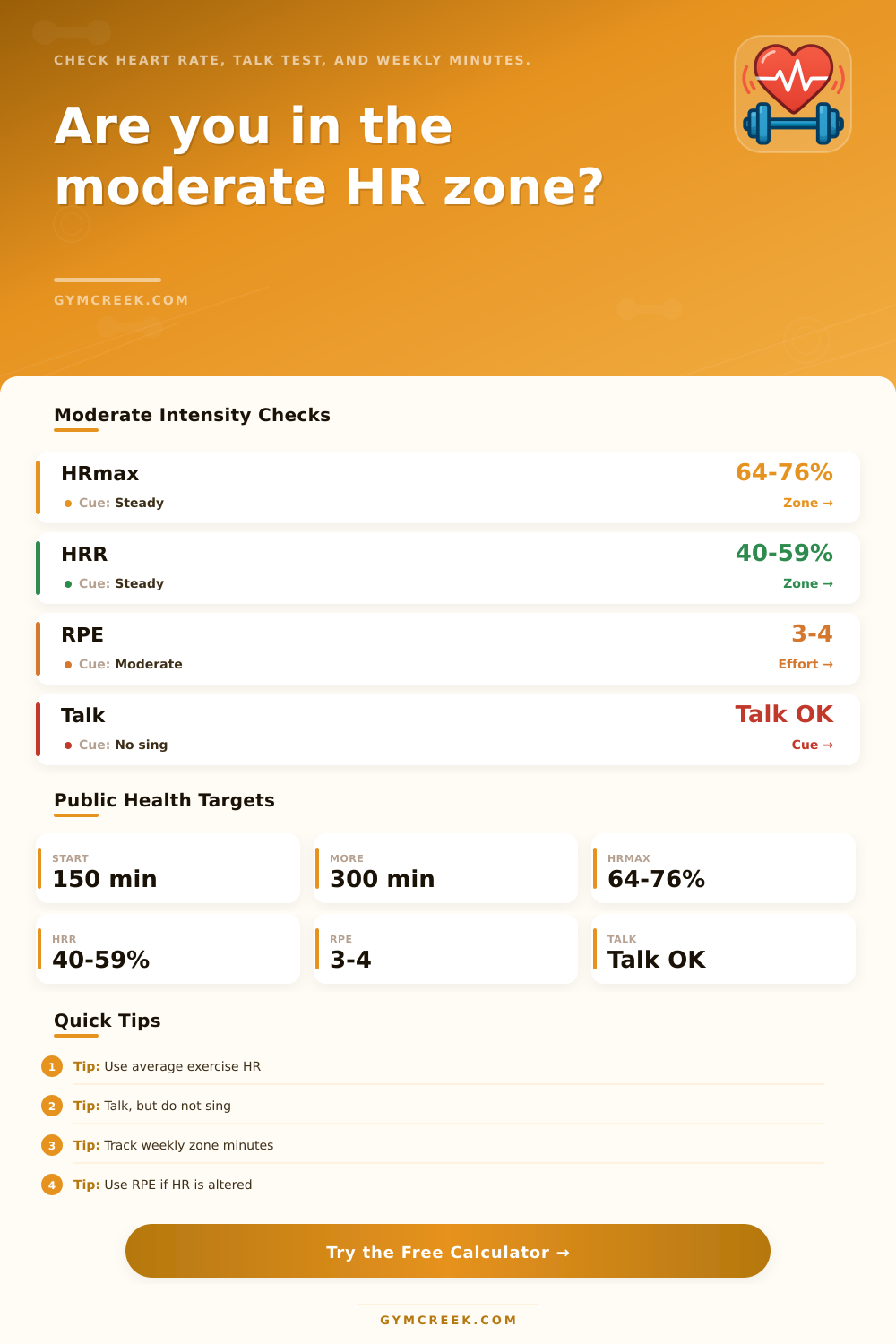
| Weekly minutes | 150 to 300 minutes | Common adult public-health range | Compares your weekly equivalent |
| Talk test | Talk but not sing | Breathing is raised but controlled | Confirms HR with a simple cue |
| RPE | About 3 to 4 of 10 | Noticeable but sustainable effort | Flags too easy or too hard sessions |
| Heart rate | 64 to 76% of max HR | Public-health moderate band | Default zone method |
| Heart rate reserve | 40 to 59% of HRR | Uses resting HR as context | Useful when rest HR is known |
| Method | Formula | Best use | Limit |
|---|---|---|---|
| HRmax moderate | 64 to 76% x max HR | Simple public-health range | Does not use resting HR |
| HRR moderate | Rest + 40 to 59% HRR | Personalized with resting HR | Needs a good rest HR value |
| Conservative lower | 60 to 70% max HR | New or returning exercisers | May undercount fitter adults |
| Blend method | Average of HRmax and HRR | When methods differ a lot | Still an estimate |
| Result | Likely intensity | RPE range | Moderate-minute decision |
|---|---|---|---|
| Can sing | Light | 1 to 2 | Usually below moderate |
| Can talk, cannot sing | Moderate | 3 to 4 | Good moderate confirmation |
| Short phrases only | Upper moderate to vigorous | 5 to 7 | Check HR and symptoms |
| Few words or none | Vigorous | 8 to 10 | Not the moderate focus |
| Plan | Zone minutes | Weekly total | Status |
|---|---|---|---|
| 30 min x 5 | 30 each | 150 min | Baseline met |
| 25 min x 4 | 25 each | 100 min | 50 min short |
| 45 min x 4 | 45 each | 180 min | Baseline met |
| 60 min x 5 | 60 each | 300 min | Additional met |
| Selector | Effect | Best check | Calculator note |
|---|---|---|---|
| No special caution | No adjustment | HR plus talk test | Use displayed zone |
| HR medication | HR may not track effort | RPE and symptoms | Use clinician limits |
| Heat or poor sleep | HR may drift high | Talk test and hydration | Do not chase zone numbers |
| Symptoms | Calculator overridden | Stop if concerning | Seek professional guidance |
| Pregnancy or postpartum | Individualized needs | Symptoms and advice | Use professional guidance |
💡Tips
Moderate intensity exercise is a specific state in which the body performs exercises. Moderately intense exercise occur within a narrow range of effort level for each individual. Many people feels that exercise intensity is a matter of willpower.
However, exercise intensity is actualy a measurement of the effort that an individual exert during exercise. Exercise intensity can be measured using heart rate monitors, the talk test, or the rating of perceived exertion. According to public health guideline, each individual should perform 150 minute of moderate intensity exercise each week.
Moderate Exercise: What It Is and How to Measure It
Performing 150 minutes of moderate intensity exercise provides benefits to the body, these benefits include better cardiovascular health, better insulin sensitivity, and better mood. Performing less than 150 minutes of moderate intensity exercise lead to a decrease in the health benefit. However, performing more than 300 minutes of moderate exercise also leads to health benefits, but the rate of benefits diminish after 150 minutes.
To reach these guideline for health benefits, individuals must ensure that their minute of exercise are within the range of moderate intensity exercise. Intensity can be measured using heart rate. However, heart rate can depend on various factor.
One factor is age, the maximum heart rate for an individual decrease as the age of that individual increases. Another factor is resting heart rate, some individual have higher resting heart rate than others. An individual with a low resting heart rate will have a larger heart rate reserve than an individual with a low heart rate reserve.
Therefore, an individual may feel that a certain percentage of their maximum heart rate is exerting moderate intensity exercise while another individual with a different resting heart rate may feel different. Therefore, method for calculating exercise intensity may use heart rate reserve rather than maximum heart rate for calculation of exercise intensity. Additionally, other factor like the use of medication or dehydration may impact an individual’s resting heart rate, thus impacting the accuracy of that heart rate monitor to indicate exercise intensity.
The talk test is one way to indicate exercise intensity without the use of any exercise equipment. To perform the talk test, an individual should be able to speak in full sentence, but not sing a song. If an individual can speak in full sentence but cannot sing a song, they are performing at a moderate intensity level.
The rating of perceived exertion is another way to determine exercise intensity. For this test, an individual should rate their exertion as between a three and four out of ten rating for moderate intensity exercise. Use of the talk test and the rating of perceived exertion can be used to confirm exercise intensity calculated with the heart rate monitor, especially if the individual was very active before exercise or is dehydrated.
The length and frequency of exercise session will impact the number of minutes of exercise that an individual perform during the week. For instance, 30 minutes of exercise performed five time a week will provide 150 minutes of exercise for that individual during that week. However, if the individual shortens each exercise session to 25 minute five time a week, they will perform 125 minutes of exercise.
In these case, the individual should ensure that there heart rate is within the moderate intensity range during each session of exercise. If the heart rate drop to below the level of moderate intensity during exercise, they will not be able to reach their goal of 150 minutes of exercise that week. However, if the heart rate rise to above the range for moderate intensity, the individual is performing vigorous exercise, and vigorous exercise earn more minute towards exercise goal than does moderate intensity exercise.
While the body weight and activity of the individual during the day does not impact the heart rate range for moderate exercise, the body weight and activity level will impact how the individual feel during exercise. An individual who is more active during the day will reach 150 minutes of exercise with less effort than an inactive individual. Regardless, the number of minute of exercise performed at moderate intensity should be tracked each week to ensure that individual goal are met.
If an individual is not sure that they stayed within the range of moderate intensity exercise, it is better to assume that they did not reach the goal. Thus, it is better to only count a portion of the exercise session than to count the entire exercise period. Finally, the heart rate monitor should be used as the primary means of measuring exercise intensity, while the talk test and the rating of perceived exertion are used as the secondary means for ensuring that exercise intensity is within the goal range.