Endurance Heart Rate Calculator
Set long-run and long-ride heart rate targets using HR reserve, optional lactate threshold HR, aerobic threshold estimates, duration caps, drift, and weekly base goals.
📌Endurance presets
Presets are examples for endurance planning. Replace them with your tested max HR, resting HR, or lactate threshold HR when you have those values.
⚙Athlete and method
📈Session and base targets
Long-session HR plan
Enter your data and calculate to see a focused endurance heart rate plan.
📊Endurance reference metrics
📘Zone and formula references
| Zone | HRR Range | LTHR Range | Endurance Use |
|---|---|---|---|
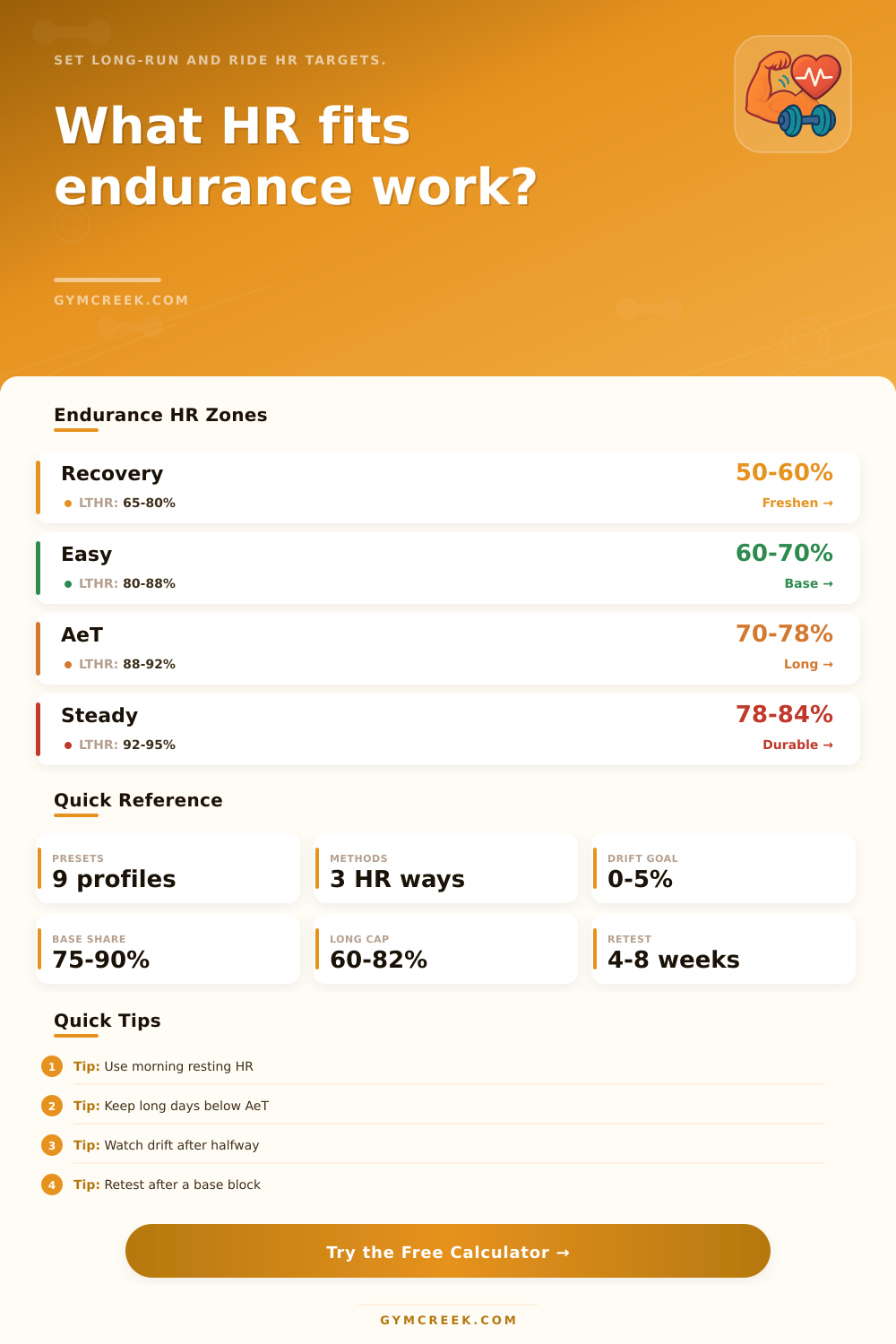
| Recovery | 50 to 60% | 65 to 80% | Short recovery, warm-up, cool-down, low-stress volume. |
| Easy aerobic | 60 to 70% | 80 to 88% | Main base volume when the session should feel conversational. |
| Aerobic threshold | 70 to 78% | 88 to 92% | Upper endurance cap for many long runs and rides. |
| Steady endurance | 78 to 84% | 92 to 95% | Controlled durability work, used sparingly in long sessions. |
| Duration | Suggested Start | Ceiling Cue | Drift Check |
|---|---|---|---|
| 30 to 75 min | Middle of easy aerobic | Brief AeT touches are acceptable | Optional |
| 75 to 150 min | Low to middle easy aerobic | Stay below estimated AeT | Useful |
| 150 to 240 min | Lower easy aerobic | Reduce cap by about 3 bpm | Important |
| 240+ min | Recovery to easy aerobic | Reduce cap by about 5 bpm | Very important |
| Formula | Inputs | Output | Best Use |
|---|---|---|---|
| Tanaka max HR | Age | 208 - 0.7 x age | Fallback when tested max HR is unknown. |
| Heart rate reserve | Max HR, resting HR | Rest + HRR percent | Personalized zones when resting HR is reliable. |
| LTHR percent | Lactate threshold HR | Threshold-based ranges | Endurance athletes with recent threshold data. |
| Cardiac drift | First-half HR, second-half HR | Percent HR rise | Checks whether the target was sustainable. |
| Scenario | Primary Target | Weekly Base Goal | Watch Point |
|---|---|---|---|
| Marathon base | Easy aerobic to AeT cap | 80 to 90% of minutes | Long-run share creeping above 35%. |
| Bike base | Low to middle easy aerobic | 75 to 90% of minutes | Heat and cadence changes raising HR. |
| Ultra preparation | Recovery to easy aerobic | 85 to 90% of minutes | Late-session drift above 5 to 8%. |
| Triathlon durability | Sport-specific easy aerobic | 75 to 85% of minutes | Run HR after hard bike sessions. |
💡Endurance HR tips
Endurance training demand a balance between the physical effort that you expend during training and the physical recovery that you allow your body after training. Heart rate is the metric that demonstrate to you the balance between training and recovery. You must determine whether the effort that you are expending during training is manageable for long periods, and you must ensure that your training wont prevent you from training effective in the future.
Heart rate is an signal of the effort that you are expending during training, but you must understand how to read heart rate during long and steady training sessions. To employ the heart rate calculator, you will have to provide personal data to the calculator to obtain targets for your training. Your age, your resting heart rate, and your maximum or threshold heart rate will be required.
How to Use Heart Rate to Plan Your Training and Recovery
Your resting heart rate is the measurement of your heart rate while you are resting. Your resting heart rate will indicate how recovered your body system is at any given time. Additionally, the lower your resting heart rate, the more farther the distance between your resting heart rate and your maximum heart rate.
You can employ your maximum heart rate with different calculation methods to determine your target heart rate for training. The distance that you will ride and the environment in which you will ride will impact your target heart rate with the heart rate calculator. For instance, riding in hot weather will increase your heart rate even when you dont increase your pace or power.
Therefore, a two hour ride in cool weather will yield different results than a two-hour ride in warm weather. Additionally, your heart rate will change during a session. For instance, cardiac drift occur when your heart rate increases but your pace and power remain the same.
If your heart rate increases during the second half of your training session when your pace remains the same, then your training session was too intense for your body. The number of minutes that you will spend on easy aerobic intervals must be planned for your training. Many athlete spend the majority of their training minutes on easy aerobic intervals.
The number of minutes that you should train at easy aerobic intensities will depend upon your experience level and your goals for your body and endurance. For example, an athlete returning from an extended break in training will need more easy aerobic training than an experienced athlete. The heart rate calculator will use your current number of training minutes each week and the number of training sessions that you performs each week to calculate your target number of minutes for easy aerobic training.
Heart rate zones will change with changes in your fitness level. Your resting heart rate will change with your health and the weather, which will alter your calculation of your heart rate zone targets. Additionally, heart rate targets will differ for different sports.
Running will have higher heart rate targets than cycling targets, for instance. Therefore, if you used cycling targets for running training, you would likely exhaust yourself too quick. The heart rate calculator will ask for your primary sport to calculate your targets for that particular sport.
The effort that you can maintain for thirty minutes may not be the same as your effort after three hours of training. For instance, the conversational test for determining your intensity in training becomes less accurate the longer that you train. After the halfway point of your training session, you should monitor your heart rate to ensure that your intensity is accurate.
If you find that your heart rate has increased during the second half of your training session yet your pace and power remains the same, you should decrease your target heart rate by a few beat per minute for the next training session. The reference tables will demonstrate the relationship between each of the different training heart rate zones. For instance, there will be a table that demonstrates the relationship between recovery, easy aerobic, aerobic threshold and steady endurance ranges for training.
Additionally, you can see the various calculation methods in relation to one another within these tables. However, these tables isnt a replacement for your personal data. These tables can help you to understand whether your heart rate calculations are accurate with the reference tables, yet they can also allow you to adjust your data to better reflect your heart rate target.
Your heart rate targets must be periodically retested to ensure that they correspond to your current fitness. For instance, after performing blocks of training, your resting heart rate will likely decrease and your threshold heart rate will increase. Additionally, a decrease in your resting heart rate and an increase in your threshold rate will increase the width of your aerobic zone.
You can enter these altered heart rate targets into the calculator to adjust your heart rate training zones. Overall, the use of heart rate monitors will allow you to finish each training session with enough energy or reserve to remain productive in your training goals.