Sprint Time Calculator
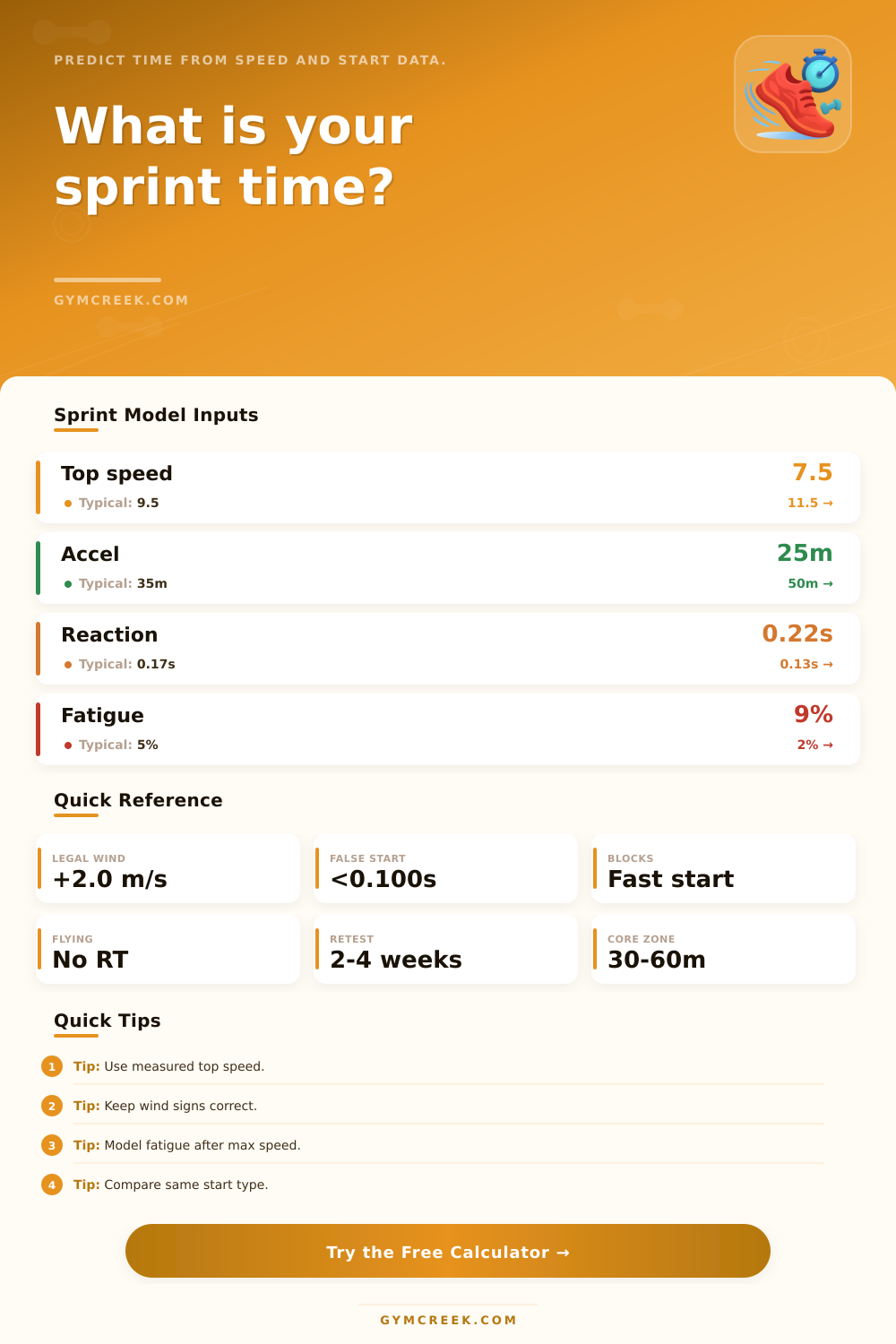
Predict sprint race time from distance, top speed, acceleration phase, reaction time, fatigue dropoff, wind, and start type.
Presets load complete sprint-model profiles. This calculator estimates the race clock from movement physics and conditions, not from pace conversion.
Estimated sprint time
Adjust the model inputs to see how acceleration, top speed, fatigue, wind, and start type change the clock.
| Start type | Reaction | Acceleration | Best use |
|---|---|---|---|
| Blocks | Counted | Strongest | Track races |
| Standing | Counted | Moderate | Practice reps |
| Three-point | Counted | Strong | Field tests |
| Rolling | Usually no | Assisted | Speed tests |
| Flying | No | Already built | Max velocity |
| Relay | No | Rolling | Leg estimate |
| Event | Key zone | Typical accel | Fatigue note |
|---|---|---|---|
| 40 yd | Start | 20-30m | Low |
| 60m | 0-50m | 30-45m | Low |
| 100m | 30-80m | 35-55m | Medium |
| 150m | 60-130m | 40-60m | Medium high |
| 200m | 80-180m | 45-70m | High |
| Top speed | m/s | km/h | mph |
|---|---|---|---|
| Developing | 7.5 | 27.0 | 16.8 |
| School fast | 9.0 | 32.4 | 20.1 |
| College | 10.5 | 37.8 | 23.5 |
| Elite | 11.5 | 41.4 | 25.7 |
| World class | 12.0+ | 43.2+ | 26.8+ |
| Variable | Effect | Raise if | Lower if |
|---|---|---|---|
| Top speed | Biggest | Flying split improves | Timing was optimistic |
| Accel phase | Start shape | Slow build athlete | Quick max velocity |
| Reaction | Race only | Gun start measured | Flying or relay run |
| Fatigue | Late split | 200m or tired rep | Short sprint test |
| Wind | Condition | Tailwind | Headwind |
While it may look simple for a spectator to sit in the stands and see the gun fire and the athletes sprinting away from the starting blocks, several differents variables can affect the sprinters performance. The calculator will calculate the race time based off these variables and save the sprinter from having to guess at their performance based on these different contributing factors. Sprinters often focus on the top sprint speed because of its strong influence on performance.
However, the time that it takes to reach that top sprint speed and the ability of the sprinter to maintain that top speed are often more important than the speed achieved. For this reason, the calculator includes an input box for the acceleration phase of the sprinters race. Shortening the length of this phase indicates that the sprint start with an explosive start into the race, while lengthening this phase indicates that the sprint require more distance to reach its top sprint speed.
What Affects a Sprinter’s Time
Thus, this input ensures that the calculator accounts for the performance of that specific sprinter. Reaction time is another separate category within the calculator. The calculation of performance will factor in the reaction time for sprints that begin with the starting gun, but reaction time dont apply to sprint starts that are flown or to relay exchange.
Thus, an input for the type of start that will be run allows for the calculation to be adjusted accordingly to ensure accuracy of the comparison between sprinters performances. External variables such as wind and the sprinting surface will have an impact upon the sprinters time. Tailwinds can shorten the time that it takes for the sprinter to cover the distance while headwinds can lengthen that time.
Similarly, sprinting on a fast track can allow the sprinter to reach higher speeds then sprinting on grass or turf. Though these impacts upon time may appear to be small, these variables do have an impact upon the time of that sprint. Thus, the inputs for these variables allow the model to account for these factors.
Fatigue dropoff is another variable that many underappreciate. Especially in 200 meter sprints, the athlete may easily exhibit different speeds for the first 100 meters as compared to the second 100 meters of the sprint. The user can set the percentage of dropoff and is best kept low for sprints of short distances and increased for longer sprints.
This percentage is applied to the later distance of the sprint rather than the entire sprint distance to improve the accuracy of the calculation. The reference tables included in the calculator allow for a sprinter or coach to understand the bounds of the various variables. For instance, inputs for the acceleration phase should not be longer than the length of the race; similarly, reaction times should not be lower than the threshold for false starts.
The calculator does not enforce these variables, but the calculator indicates these potential edge cases. Another way in which the calculator is helpful is if the user adjusts the variables to see the potential impact upon the other variables. For instance, increasing the top sprint speed will impact the time after the acceleration phase more than the start of the sprint.
Increasing the percentage for fatigue will impact the second half of a sprint more than the first half of a sprint of the same length. Thus, each of these variables impact each other in ways that are difficult to remember, but the calculator makes them visible. Though the calculator does not account for variables like age or training, those variables will impact the interpretation of the calculations.
Though a 15-year-old and a 25-year-old athlete may have the same speed, the 15 year old may still be developing their strength. Similarly, an athlete of 40 years old may have different physical limits than a young sprinter. Thus, while those variables do not impact the calculations themselves, they help provide context for the interpretations of those calculations.
Though the calculator does not factor in variables like activity level or body weight, those variables can have an impact upon the calculation of performance. For instance, an athlete with more muscular strength can reach higher speeds than an athlete with less strength. Thus, these variables help to provide context for the calculations, but do not impact the calculations themselves.
While variables like sleep, illness, motivation, and other factors can have an impact upon an athlete performance, the calculation of the sprinters potential performance does not account for those variables. These factors are not easily measurable and therefore are not accounted for in the calculation of the sprinter. Though the calculator has limitations, it is helpful in that it can be used to discuss potential performance for sprinters.
For instance, by using a sprinters measured top sprint speed, the coach can adjust the acceleration phase to match the sprinters actual starts and the wind impact can be factored in to provide a more specific discussion of the sprinters potential performance. The fact that these variables may impact the sprinters performance allows for both the predictions of that athletes performance as well as the coaching decisions to be more accurate.