Tinman Training Calculator
Convert one recent race into Tinman-style CV pace, tempo pace, easy pace, workout volume, and phase-specific training targets.
📌Presets
Each preset loads a realistic race result, weekly mileage, training phase, threshold adjustment, and workout volume preference.
⚙Calculator
Tinman-style training snapshot
Enter a race result to estimate training paces and weekly quality volume.
📊Training Metrics
📑Reference Tables
| Zone | Model anchor | Session use | Intensity cue |
|---|---|---|---|
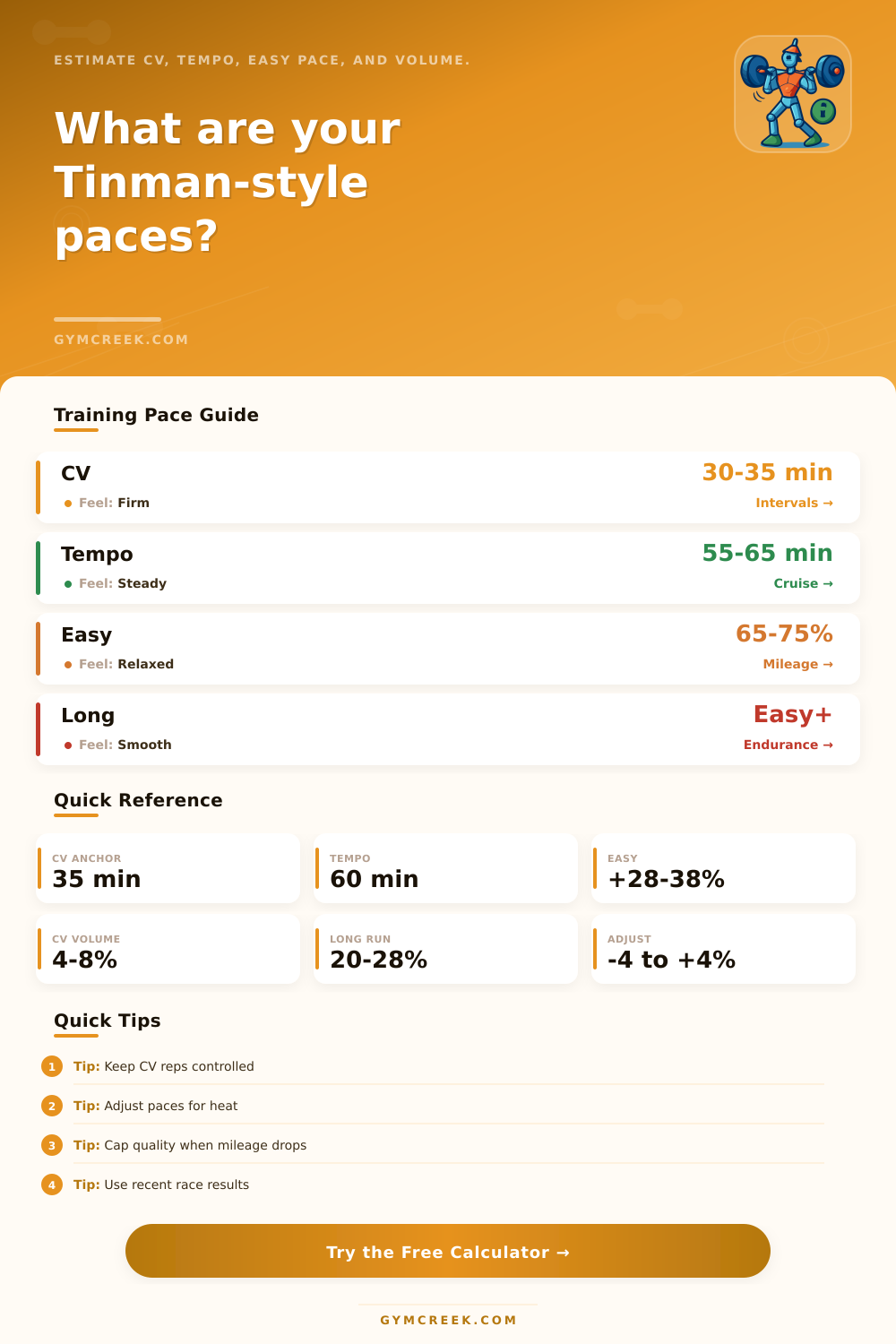
| CV pace | 30 to 35 minute race effort | Short cruise intervals | Firm but controlled |
| Tempo pace | 55 to 65 minute race effort | Steady continuous or cruise work | Comfortably hard |
| Easy pace | 65 to 75 percent of CV speed | Daily aerobic mileage | Relaxed breathing |
| Long run pace | Easy range plus patience | Endurance support | Smooth and repeatable |
| Weekly volume | CV work | Tempo work | Long run cap |
|---|---|---|---|
| 15 to 25 mi | 0.8 to 1.5 mi | 1.5 to 3 mi | 4 to 6 mi |
| 26 to 40 mi | 1.5 to 2.8 mi | 3 to 5 mi | 6 to 10 mi |
| 41 to 60 mi | 2.5 to 4.5 mi | 4 to 7 mi | 9 to 15 mi |
| 61 mi plus | 3.5 to 6 mi | 6 to 9 mi | 12 to 18 mi |
| Phase | Quality share | Best workout | Bias |
|---|---|---|---|
| Base endurance | Moderate | CV plus short tempo | Build durability |
| CV build | Highest | CV reps with relaxed recoveries | Raise aerobic power |
| Race specific | Moderate | CV plus race-pace pieces | Sharpen without forcing |
| Recovery return | Lowest | Light tempo or short CV | Protect consistency |
| Total CV | Rep choice | Recovery | Who it fits |
|---|---|---|---|
| 1.0 to 1.8 mi | 5 x 400m or 4 x 600m | Short jog | Newer runners |
| 1.8 to 3.0 mi | 5 x 800m or 4 x 1K | Easy jog | Most 5K to 10K plans |
| 3.0 to 4.5 mi | 5 x 1K or 4 x mile | Controlled jog | Higher mileage runners |
| 4.5 mi plus | Mixed 1K to 2K reps | Float or jog | Advanced aerobic blocks |
💡Tips
A Tinman training calculator is an tool that allows a person to convert their race results to training paces and training volumes. A person’s race result is a single data point. Based off that result, a person can understand how they should train in the future.
Specificly, a Tinman training calculator can use a person’s race result to calculate the effort levels that person should use during there training program. Thus, the purpose of the Tinman training calculator are to correlate a person’s race result to the training a person should perform each training day. To create the training plan that the Tinman training calculator will recommend to a person, the Tinman training calculator must obtain several data inputs from that person.
How to Use the Tinman Training Calculator
One such input is the persons recent race result. Another such input is the persons weekly mileage. Another such input is the training phase that the person wishes to perform; base training differ from race-specific training.
Additionally, a person can provide volume preference and threshold adjustments to create a more cautious or aggressive plan by entering these data points into the Tinman training calculator; a cautious approach may be used if the person feels they are not recovering well from their races or training, but an aggressive approach may be used if the person feels they are recovering good from their races and training. Additionally, the easy pace bias input allow the Tinman training calculator to determine at what pace the person’s easy runs should be performed. For example, runners who can recover quickly from their most intense training may want to enter a faster pace for their easy runs; runners who require more time to rest may have a slower easy run pace entered into the Tinman training calculator.
Another such input is the long run share setting which acts to ensure that the long run is not too significant to the other distances that the person run each week. These different data inputs are important to account for in the Tinman training calculator so that the training plan that emerges from the Tinman training calculator is neither too demanding of the athlete’s body nor too little to allow the athlete to develop the necessary endurance. The Tinman training calculator creates several different outputs from the calculation that occur within the Tinman training calculator.
For instance, one of the outputs is CV pace which can be used to train the athlete to maintain more effort over longer distance. Another output is tempo pace which is an easier pace than CV pace and used for distances that are either continuous or broken into short distance. Another output is easy pace which comprises the majority of an athlete’s mileage and which should allow for the athlete to hold a conversation while running.
Finally, the Tinman training calculator outputs the volume recommendations for each type of run. Unfortunately, the Tinman training calculator cannot take into account how the athlete feel each day; the Tinman training calculator cannot see the athlete’s body. For instance, an athlete may feel particularly weak or depleted of energy due to stress, lack of sleep, or other physical aches.
An adjustment to the calculated paces allows the athlete to account for these sensations; a negative adjustment to the calculated paces may be used if the athlete feels weak due to stress, lack of sleep, or other physical aches; a positive adjustment to the calculated paces may be used if the athlete feels healthy and strong. Reference tables are also provided for the athlete to understand the logic of the training plan that emerge from the Tinman training calculator. These reference tables provide information regarding the different types of training for each zone.
Additionally, the reference tables provide training volumes for each type of training so that the athlete can compare their volume recommendations to other runner. A person may make mistakes in entering data into the Tinman training calculator; for example, a person may use their most recent race result. However, if that race result is very old, their training plan and paces may be too aggressive because they may have reduce their mileage since their most recent race.
An athlete, therefore, should use a recent race result to ensure that the training plan created by the Tinman training calculator is appropriate for their bodys capabilities. Additionally, another mistake that an athlete may make with the Tinman training calculator is if the athlete is running more weekly mileage than the athlete’s most recent race result suggest. In this case, the athlete may have to manually increase the volume recommendations for quality training that they wish to incorporate into their training program.
In incorporating the Tinman training calculator into their training program, an athlete must also exercise some judgment. For instance, the Tinman training calculator will ensure that the quality training that an athlete performs is no more than a modest percentage of their total mileage; more adaptations occur with easy training. An athlete should not manually increase the percentage of quality training beyond that recommended by the Tinman training calculator; the athlete may otherwise find that they are not recovering from their training program and exhibiting the same consistency in their mileage.
Overall, the Tinman training calculator removes guesswork from an athletes training plan. The Tinman training calculator can calculate the training plan that accounts for the athlete’s race results, their weekly mileage, their preference, and ensures that the quality training is limited to a healthy percentage of the athlete’s total mileage. However, the athlete must use some judgment and attention to the athlete’s body and how each training plan may feel for the athlete to be most effect.
Thus, the best training plan is one that respects the data gathered from the athlete’s race result and the understanding of how a body becomes tired or stressed during long distances or intense training. When the training plan created by the Tinman training calculator appears to fit the athlete’s current season and body, the athlete will find it to be the most consistent with their training goals.