McMillan Running Calculator
Turn one recent race into equivalent race predictions and practical pace ranges for easy runs, tempo work, threshold efforts, intervals, repetitions, and long runs.
📌Runner Presets
Each preset loads a recent race, athlete profile, goal distance, training phase, and body-stat context. Change any field before calculating.
⚙Calculator Inputs
Running pace snapshot
Enter a recent race and calculate equivalent predictions plus training pace ranges.
📊Running Metrics
🏁Equivalent Race Predictions
| Distance | Prediction | Pace | Use |
|---|---|---|---|
| 5K | --- | --- | Speed benchmark |
| 10K | --- | --- | Strength benchmark |
| Half marathon | --- | --- | Endurance check |
| Marathon | --- | --- | Long race estimate |
⏱Training Pace Ranges
| Zone | Range | Km range | Training use |
|---|---|---|---|
| Easy | --- | --- | Daily aerobic running |
| Long run | --- | --- | Durable aerobic work |
| Steady | --- | --- | Moderate aerobic running |
| Tempo | --- | --- | Controlled sustained work |
| Threshold | --- | --- | Strong but repeatable |
| Interval | --- | --- | Fast aerobic repeats |
| Repetition | --- | --- | Short relaxed speed |
📑Reference Tables
| Race | Distance | Model role | Note |
|---|---|---|---|
| 1 mile | 1.609 km | Speed | Less stable for marathon |
| 5K | 5.000 km | Common anchor | Good for short races |
| 10K | 10.000 km | Balanced | Strong all-around anchor |
| Half | 21.098 km | Endurance | Good marathon signal |
| Type | Exponent | Pace cushion | Meaning |
|---|---|---|---|
| Speed | 1.075 | Wider | Short races carry less upward |
| Balanced | 1.060 | Normal | Standard equivalent curve |
| Endurance | 1.045 | Narrower | Long races hold better |
| Newer | 1.085 | Safer | More easy pace margin |
| Phase | Easy | Quality | Best use |
|---|---|---|---|
| Base | Wider | Softer | Aerobic volume |
| Build | Normal | Normal | Race preparation |
| Sharpen | Normal | Sharper | Faster workouts |
| Recovery | Widest | Softer | Return to rhythm |
| Zone | Feel | Anchor | Watch out |
|---|---|---|---|
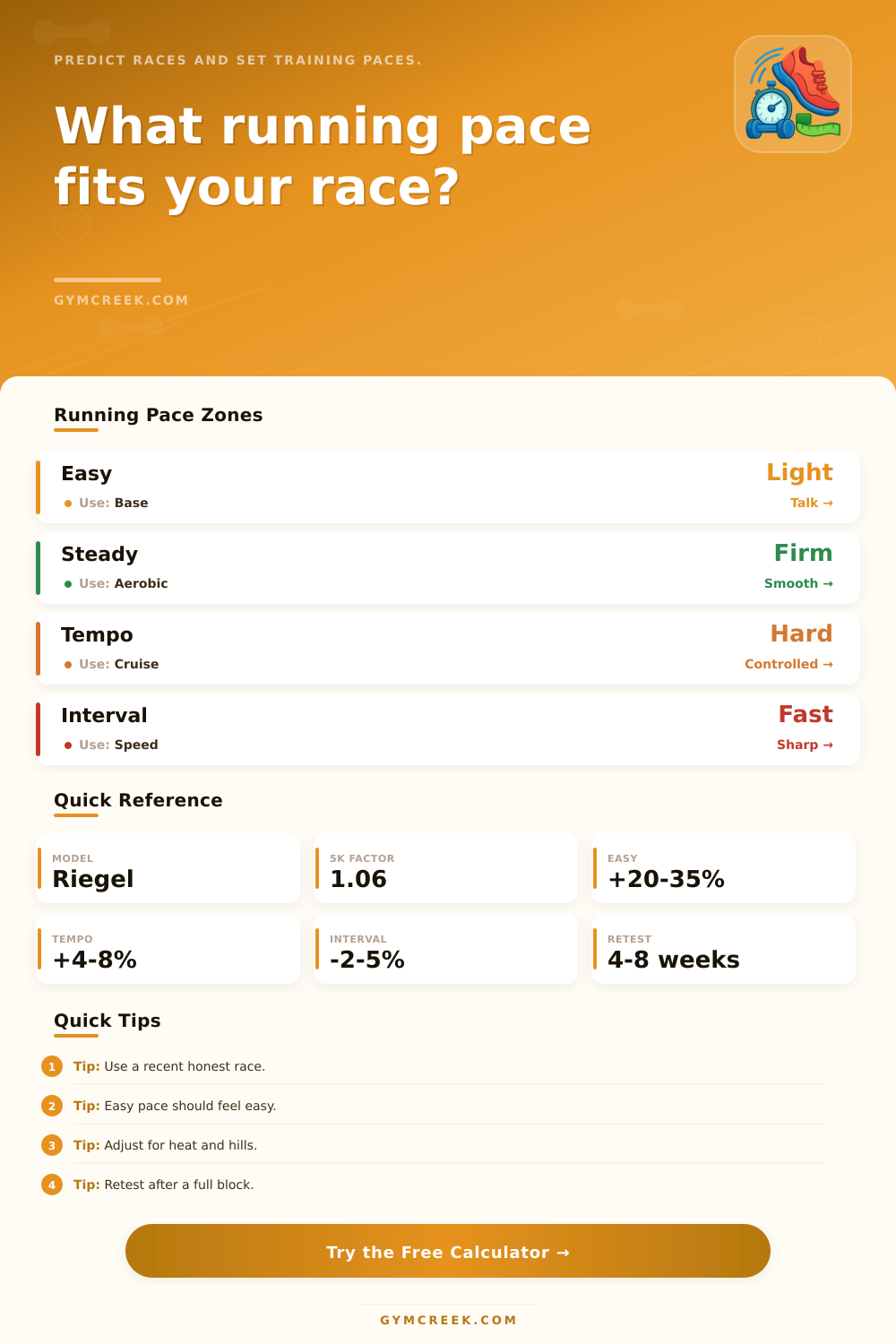
| Easy | Conversational | 5K +20-35% | Running it too fast |
| Tempo | Firm | 10K to half | Turning it into a race |
| Threshold | Strong | 60-min race | Overreaching repeats |
| Interval | Fast | 3K to 5K | Losing relaxed form |
💡Calculation Tips
A running calculator is an tool that takes one running race result and translates that result into predictions for other distances or training paces. A running calculator may use one race result, or what is referred to as an anchor time. This single race result is impacted by many different factors, though.
These factor can include the distance of the race, fatigue levels, training history, and even the way in which the human body change over time. Therefore, such a calculator allows for a person to take that one race result and use the calculator’s mathematics to derive many different data points regarding training. More specifically, the calculator can help a person determine the different paces that they should run during each day to help accomplish their training goals.
How a Running Calculator Works
The mathematical model that exists within a running calculator is based off the idea that the relationship between distance and time can be represented as a power relationship. For instance, shorter distances require more speed from runners, but longer distances require a runner to be able to sustain their pace for long periods of time without experiencing physical breakdown of the body. The exponent within this model can change for different types of individuals based upon whether an individual has more speed at shorter distances, whether an individual is steadier over long distances, or even how durable those individuals are through their training.
Thus, because the exponent can change, each of the times that are represented within the calculator will change as well. The various inputs into a running calculator, such as age, weekly volume, and training phase, are required in order to determine the training paces for that individual. For instance, training phase will determine both how much margin an individual should provide to their easy running distance, as well as how aggressive their quality pace work should be.
For instance, an individual coming off of a particularly high volume of base mileage will be able to take more risks in their training than an individual coming off of an illness. Additionally, a masters athlete will generally require a slower interval running pace than a younger runner, even if the runners are otherwise equal in their current race results. Thus, these various factors help the model to determine the correct training paces for each individual.
Freshness and course are two factors that the model may require to be adjusted in response to the fact that each of the race results are not executed on a neutral course. For instance, if an individual’s race results were executed on a fast and cool course, those results will not be the same as if they ran on rolling roads in the heat. Thus, if those factors are not adjusted, the suggested distances and paces to achieve will be too ambitious for that individual to accomplish.
Therefore, the calculator is unable to gain knowledge of the specific details of the race that are being entered, but does require the individual to enter these details in order to ensure that the numbers is accurate. The training zones can be calculated in the same way that the 5K equivalent distance can be calculated for that individual. The easy zone for that individual will be slower than their 5K equivalent distance because easy zones are used for aerobic development of the body.
The tempo distance will be slightly faster than their easy distance but will have slower speeds than their 5K distance because tempo is used to encourage runners to sustain their pace over longer periods of time. Finally, the interval and repetition distance will be faster than their tempo distance because these distances are relatively short in length so that the body can naturaly eliminate waste products from each race. The long-run guardrail is established as a means of providing a suggestion to the individual of the length of each of their long runs.
The long-run guardrail is based upon the individual’s current volume of their training as well as their training phase. This guardrail is not a hard and fast rule for each individual, but the long runs that an individual sets for themself should not be increasing at a faster rate than the rest of that individual’s training volume for the week. By setting long runs within the suggestion by the long-run guardrail, that individual will experience improved recovery between their training sessions, and their quality training will be able to receive the appropriate amount of attention.
The various reference tables that are provided within the calculator allow for individuals to understand how the calculator works. The reference tables include tables that display how different types of athletes may change the exponent within the model, as well as which training phases will lead to the changes in the ranges of distances within the training plan. Finally, the reference tables also display which distances are the most accurate for determining an individual’s running abilities and which distances will drift from accuracy in the model.
For instance, an individual’s 10K distance is relatively stable within the model for both shorter and longer distances, but an individual’s mile distance may drift if applied to marathon distances. Thus, these tables provide individuals with an understanding of the strength of each of an individual’s race results. Individuals should treat the running calculator as a means of communicating with the model and obtaining recommendations from the model.
For instance, individuals can enter their most recent 10K into the calculator, as well as their half-marathon prediction. If an individual finds that their half-marathon prediction is too optimistic, they may need to adjust their freshness or course factors. Additionally, if an individual finds that their easy running distances are too challenging in the beginning of the training plan, they should adjust the easy distances to the slower end of the suggested range until their body has had time to recover.
Thus, the model should be referenced every four to eight weeks after each race. The model cannot account for the details of training that occur each day. For instance, the model can ignore an individual’s sleep patterns, other deadlines for the week, or back-to-back sessions of intense training, but require adjustments to training plan by the individual.
Thus, while the model removes the arithmetic from the minds of runners, it doesnt eliminate the need for the individual’s training and judgment. Instead, the individual should rely upon the training plan created by the model, but adjust it according to the individual’s experiences during that training plan. Thus, the most important habit that an individual should develop in relation to using the model is to consistently use it.
Each individual should select one race each year or training cycle. As each individual’s fitness increases, that race will be replaced with another race to set the anchor time for that individual’s training plan. Additionally, each individual should retest the calculator after they complete their next race.
Finally, if an individual notices that their training plan is beginning to change according to their increased fitness, the easy distances will be easier to execute, quality training will be able to improve, and that individual will experience increased abilities to complete races at distances and speeds that was once impossible.