Running Splits Calculator
Build a split-by-split running plan from total distance, target time, interval length, pacing strategy, race goal, terrain, elevation, temperature, and current fitness.
🏁Runner Presets
Presets load common race and workout profiles, then recalculate the split table immediately.
⚙Calculator
Running split plan
Enter a distance, finish time, and split interval to build the table.
📊Running Metrics
📋Generated Split Table
| Split | Distance | Split Time | Cumulative |
|---|---|---|---|
| -- | -- | -- | -- |
📑Reference Tables
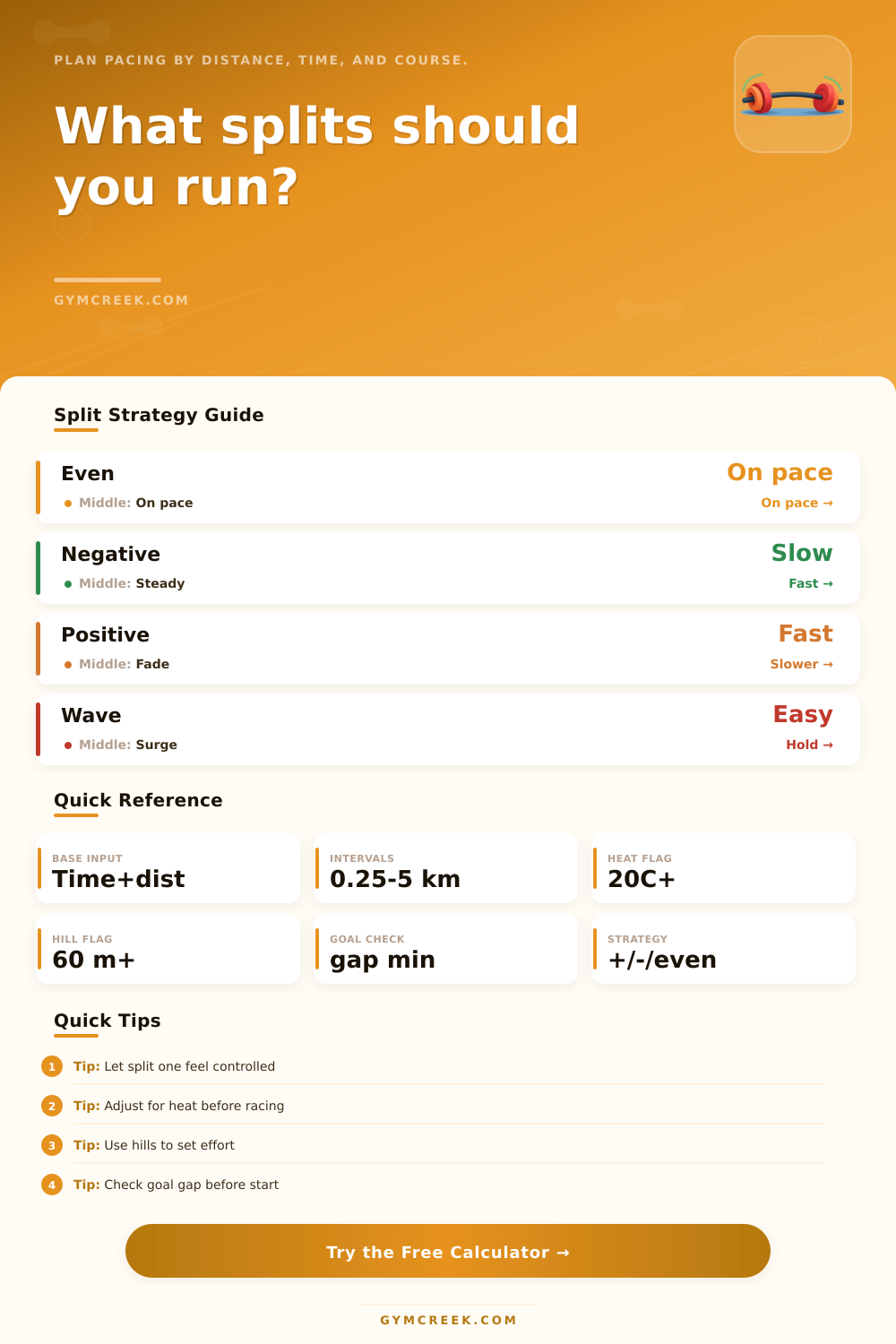
| Strategy | Opening | Middle | Closing |
|---|---|---|---|
| Even splits | 100% pace | 100% pace | 100% pace |
| Negative split | 2% slower | On pace | 2-3% faster |
| Positive split | 2% faster | On pace | 2-3% slower |
| Conservative | 3% slower | 1% slower | Faster close |
| Factor | Low effect | Higher effect | Calculator role |
|---|---|---|---|
| Terrain | Track or road | Trail or tech | Surface multiplier |
| Elevation | Under 60 m | 100 m plus | Climb penalty |
| Heat | 10-20°C | 24°C plus | Pace slowdown |
| Wind | Calm or mixed | Exposed head | Resistance factor |
| Race type | Metric interval | Imperial interval | Best use |
|---|---|---|---|
| Track mile | 0.4 km | 0.25 mi | Lap pacing |
| Short road | 1 km | 1 mi | Clear checks |
| Half or full | 5 km | 3.1 mi | Fewer marks |
| Ultra route | 5-10 km | 3-6 mi | Aid timing |
| Formula | Inputs | Output | Use |
|---|---|---|---|
| Average pace | Time / distance | Pace | Base split math |
| Riegel | Race result | Prediction | Fitness check |
| Mifflin-St Jeor | Age, size, sex | BMR | Energy context |
| Run kcal | kg x km | kcal | Effort estimate |
💡Pacing Tips
Split distances for a race are the individual segment into which a race can be divided. Because split distances are important, split distances determines how a runner will use their energy throughout the race. For instance, a runner can use the average pace for the race as a starting point for their pace for each segment of the race.
However, the average pace does not account for the different variables that may affect the runner’s pace throughout the race. Thus, runners have to use running splits to account for these different variables. One of the most important variables that determine how much effort is required for each split for a runner is terrain.
How to plan your race split times
For instance, if a runner is on a flat road, they will require less effort to run each kilometer of the race then if the runner was on a technical trail or a series of climbs for that portion of the race. The calculator accounts for these changes in terrain to provide each runner with an appropriate split for the race. If a runner ignores the impact of terrain on their performance, they might find themselves starting the race too fastly for the first split and then experiencing fatigue later in the race due to starting too fast.
Another variable that runners should consider for split distances is the impact of temperature. For instance, warmer air will increase the heart rate of a runner even at the same rate of their running. Thus, a pace that a runner can complete for a half marathon in temperatures of 25 degrees might become much more difficult for the same runner to complete at the same pace for a half marathon in temperatures of 35 degrees.
Humidity has a similar impact on runners. The humidity impact the rate at which a runner can sweat so that the runner does not overheat during the race. The split calculator for running distances accounts for these impacts so that runners have a realistic view of the distance they can run.
Another consideration for runners is their pacing strategy for the race. For instance, runners can decide to even splits for each split distance or take on a strategy of negative splits. A strategy of even splits means that the runner decides on a pace for each split distance and adheres to that pace for each split.
Negative splits, on the other hand, means that the runner plans to start the race at a slower pace and run the remaining splits at a faster rate. This strategy can help to conserve the glycogen stores in the body. Positive splits mean that a runner starts at a fast pace and ends at a slower pace for the race.
This is a strategy that is not generally recommended for runners. Other factors to consider for runners are their training and test distances. For instance, if a runner has not run any distances of this length in recent days, it is unlikely that they will be able to complete the race with such an estimated time for completion of the distance.
The Riegel prediction for distance and time can help runners to estimate whether or not their goal is realistic for their current training. This information allows runners to ensure that they are properly training for the distance that they want to complete. Additional factors to consider are the energy demands for the race.
For instance, a runner who weighs more than others will burn more fuel for each kilometer that they run. Thus, a runner who weighs 160 lbs will burn more fuel for each kilometer than a runner who weighs 140 lbs. The same is true for the amount of clothing that a runner puts on for the race.
The split calculator for running distances incorporates these and other factors to determine the total energy that will be required for each split during the race. One of the common mistakes that runners make is racing the first split of the race too fast. For most runners, the runner will complete the first split of the race at a faster rate than the runner intends for the first split due to the extra energy that their fresh legs can generate.
However, racing too fast for the first split can strain the runner later in the race. The split calculator for running distances incorporates adjustments for this mistake for the runner so that they do not strain themselves too much during the race. Another mistake is to ignore the difference between the goal time and the adjusted time for each split.
If the adjusted time for the splits is significantly slower than the goal time for each split, then runners should adjust their goal time for the race. Runners should make this adjustment before the race instead of attempting to adjust the runner’s expectations in the middle of a race. The value of using a split calculator for running distances forces runners to consider all of the different variables that will impact their performance in each split in the race.
These variables can include distance to be ran, time to complete each split, terrain, temperature, and various other variables. These variables are incorporated into the split calculator so that runners can determine their splits for each portion of the race. The output of the calculator will provide each runner with a checklist for each split of the race.
These check marks will provide the runner with signals as to whether or not they should be adjusting the pace at which they are running. A split calculator that accounts for each of these specific variables will provide runners with an understanding of the various decisions that they should make during the race to ensure that they are competing in the race in the best fashion possible.