Tempo Run Calculator
Build a tempo workout from a recent race or time trial, threshold pace, session type, reps, terrain, heat, elevation, weekly mileage, and training pace zones.
📌Tempo Session Presets
Presets load complete runner profiles and recalculate tempo pace, rep pacing, adjusted conditions, weekly load, and pace zones.
⚙Runner, Test, And Workout Inputs
Tempo workout target
Enter a recent test and session details to calculate threshold pace and tempo targets.
📊Pace Zone Metrics
📑Reference Tables
| Session type | Main purpose | Typical dose | Pace target |
|---|---|---|---|
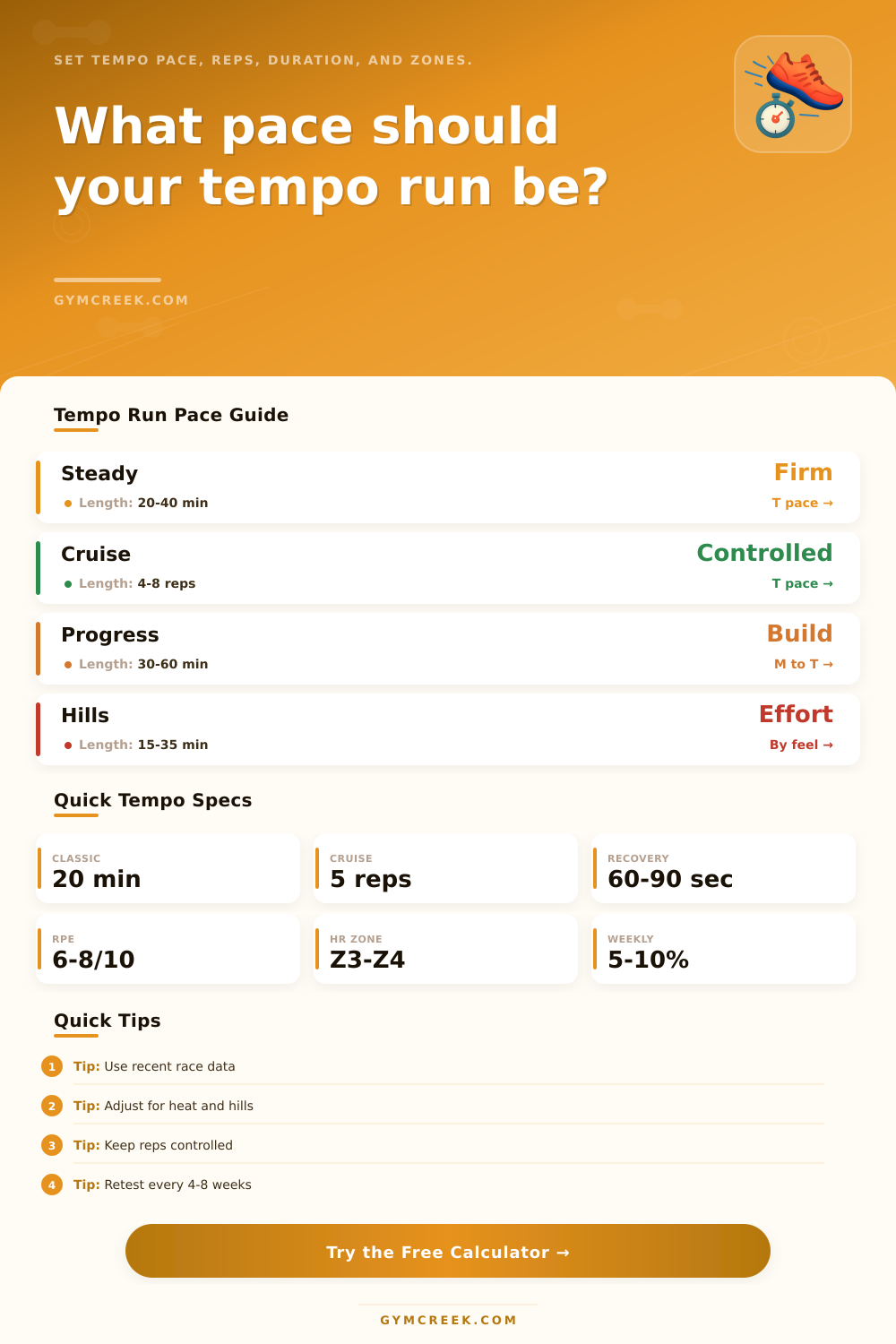
| Continuous tempo | Stamina and lactate control | 20 to 40 minutes | About threshold plus a small buffer |
| Cruise intervals | More total quality with control | 4 to 8 reps of 5 to 10 minutes | Near threshold with short recovery |
| Progression tempo | Finish strong without forcing | 30 to 60 minutes | Steady to tempo by thirds |
| Marathon steady | Long aerobic strength | 25 to 70 minutes | Slower than threshold |
| Rolling hill tempo | Effort control on changing grade | 15 to 35 minutes | Use adjusted pace and RPE |
| Pace source | Input | How it is used | Best practice |
|---|---|---|---|
| Recent 5K | Fast race or time trial | Slows race pace toward threshold | Use when rested and evenly paced |
| 45-60 minute effort | Race effort near one hour | Close threshold anchor | Best single race input |
| 20 minute trial | Hard solo test | Adds a small durability buffer | Warm up first and avoid sprinting |
| Known threshold | Lab, coach, or prior test | Overrides or blends with race estimate | Retest after a training block |
| Condition | Adjustment | Why it matters | Training cue |
|---|---|---|---|
| Heat and humidity | Slower target pace | Raises cardiovascular strain | Trust effort before pace |
| Rolling hills | Slower average pace | Grade disrupts rhythm | Hold effort over crests |
| Trail surface | More conservative pace | Footing increases cost | Compare by route, not only pace |
| Low readiness | Reduce pace or volume | Tempo should not become a test | Finish able to repeat the work |
| Formula | Variables | Output | Use inside calculator |
|---|---|---|---|
| Riegel scaling | Distance and time | Equivalent endurance pace | Projects race effort toward threshold |
| Tanaka HRmax | Age | Estimated max heart rate | Builds HR context for tempo work |
| Mifflin-St Jeor | Weight, height, age, gender | BMR and TDEE context | Shows training load background |
| Weekly load ratio | Tempo distance and mileage | Quality share | Flags overly large tempo sessions |
💡Tempo Run Tips
A tempo run is a form of exercise that fall somewhere in between an easy run and race effort. A tempo run is more difficult than an easy run, but less difficult than a race effort. The goal is to find a pace that is challenging yet allow a runner to complete the portion without feeling too exhaustion.
Because the runners are supposed to control tempo runs, it is difficult for them to find the perfect tempo by feel alone. The threshold pace that a runner should maintain during a tempo run can change. A runner may feel they have a high level of fitness when they compete in a race.
How to Find the Right Pace for Tempo Runs
However, that level of fitness may not be present three month later. Additionally, a runner may have high fitness level, but there threshold pace may change due to weather pattern. The threshold pace calculator take the runner’s test result and current conditions to determine a target tempo.
The target tempo will account for heat, hill, and the runner’s feeling of recovery from other races. Many runners make the mistake of running too fast during a tempo run. Many runners overestimate their ability to run at a specific pace for twenty or thirty minute.
Therefore, they may start too fast. However, if a runner begin too fast, it isnt a tempo run. The threshold pace calculator accounts for this.
For instance, a continuous tempo may have a slower target than cruise intervals because a continuous tempo allow for no break. Therefore, the continuous tempo would require a slower pace so that the runner does not lose their running form. Additionally, the terrain and the weather can further adjust the target pace.
For instance, if an individual is to run on hills or gravel the effort that is required increase. The calculator can provide an additional percentage to the target pace to account for this effort so that the runner feels as if they are maintaining the same target effort regardless of the terrain change. The same can be said for heat and humidity level.
Percentages of moisture in the air can create strain on the cardiovascular system. The calculator accounts for both the temperature and the dew point to provide a slower target for runners in hot and humid weather so as to protect the quality of the running session. The calculator also accounts for the weekly mileage that the runner put into their training program.
A tempo run should only be a portion of a runners total mileage. A runner who runs forty mile a week should be able to run a longer tempo run than an individual who only runs twenty-five mile per week. However, neither should run a tempo run that is the majority of their weekly mileage.
Therefore, the calculator will flag any session that may be too high of a percentage of total mileage so that the runner can adjust their plan for that particular week. The calculator also accounts for pace zones. Tempo runs use the same threshold pace as other efforts such as easy run and steady-state run.
For instance, if the threshold pace is four minutes fifty-five second per kilometer, then the easy run will be slower than that pace. The goal is to ensure that easy runs do not become tempo run effort. Additionally, steady state runs fall somewhere in between easy and tempo run and are used for long run.
Using the calculator can help a runner to make decision regarding their running prior to the beginning of that particular run. The calculator allows a runner to determine a target pace prior to the beginning of the run. If a runner select low level of readiness, they will be provided with a slower target pace.
If a runner select high level of readiness, the target will be slightly faster. The runner makes the decision prior to the run so that it is less likely they will turn a tempo run into an unplanned race. There are different format for running tempo run.
The reference table included in the article indicates these. For instance, continuous tempo run allow a runner to clear lactate from the body over long distance. Cruise interval allow for more time to run at the same effort because the runner take short break during the session.
Progression tempo allow a runner to finish a race with strength so they do not tire out during the session. However, they do not require a high level of strength during the beginning of the session. No particular session is better than the other as the best format for a runner will depend upon the need of their training schedule.
Finally, the calculator cannot account for every element that can affect a runner. For instance, the calculator cannot account for sudden headwind, obstacle, or other diversion from the runner’s focus. The calculator will determine a target pace for a runner to follow.
However, the decision to follow that target or to change a runner’s pace during the session is up to the runner. Overall, if a runner can find a pace during a tempo that is difficult enough to challenge themselves but not so difficult as to leave them exhausted and unable to maintain their good running form for the entire session, then that is the goal for that type of session.