Half Marathon Training Calculator
Build a race-specific half marathon plan from current weekly mileage, long run, easy pace, goal time, training days, weeks available, injury risk, progression, deloads, and taper logic.
📌Training Presets
Each preset loads a complete runner profile and recalculates peak mileage, long-run ramp, deload weeks, taper, intensity mix, and race-readiness score.
⚙Runner And Race Inputs
Half marathon plan
Enter your current training and goal to generate a safe progression.
📊Training Metrics
🗓Week-By-Week Build
| Week | Focus | Mileage | Long Run | Key Session | Notes |
|---|---|---|---|---|---|
| Calculate to generate a week-by-week training plan. | |||||
📘Reference Tables
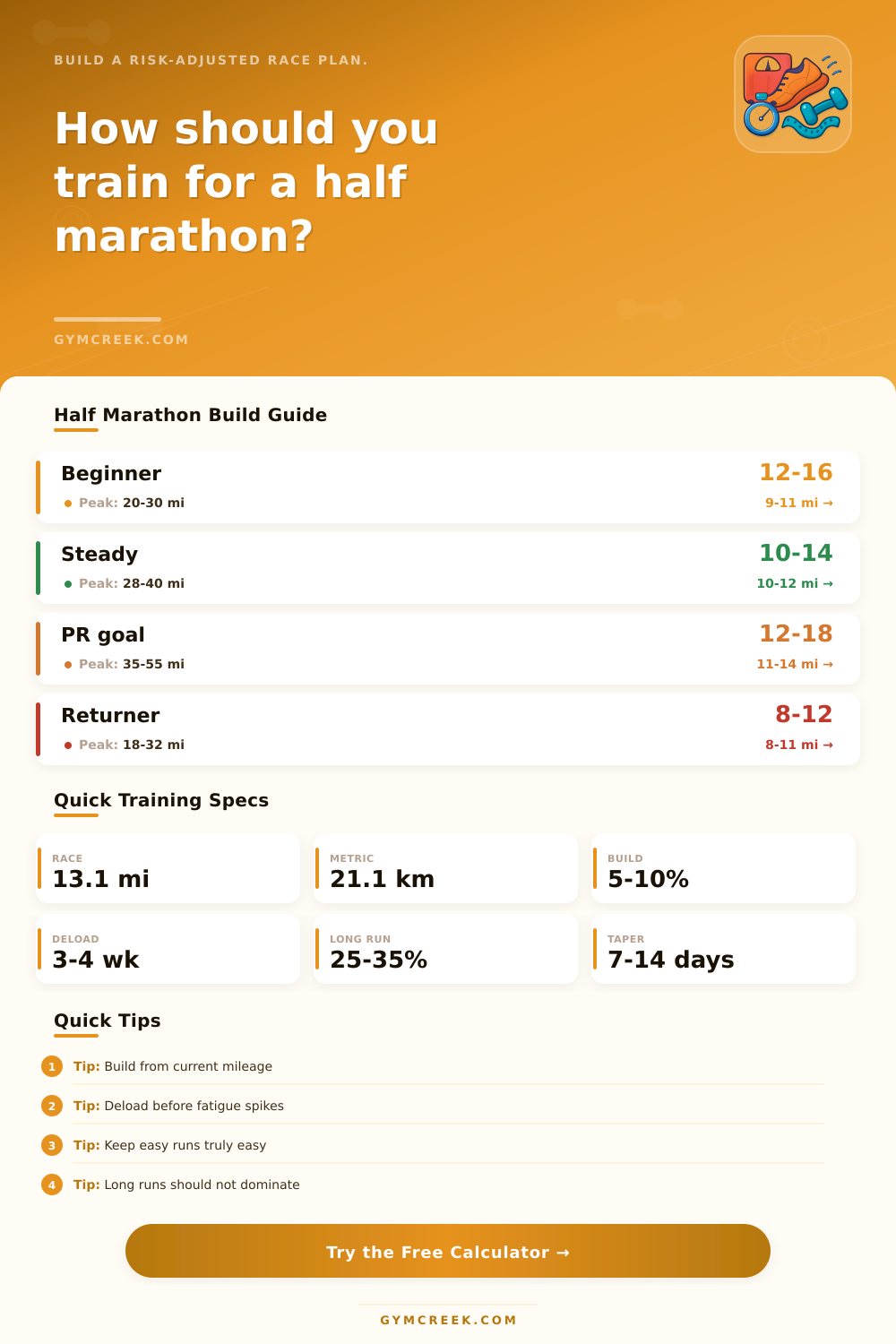
| Runner Type | Weekly Base | Peak Week | Long Run |
|---|---|---|---|
| First-time finisher | 10-18 mi / 16-29 km | 20-30 mi / 32-48 km | 9-11 mi / 14-18 km |
| Steady recreational | 18-28 mi / 29-45 km | 28-40 mi / 45-64 km | 10-12 mi / 16-19 km |
| PR-focused runner | 25-40 mi / 40-64 km | 35-55 mi / 56-89 km | 11-14 mi / 18-23 km |
| Returning runner | 8-22 mi / 13-35 km | 18-32 mi / 29-51 km | 8-11 mi / 13-18 km |
| Risk Profile | Weekly Build | Deload Rhythm | Long-Run Cap |
|---|---|---|---|
| Low risk | Up to 10% | Every 4-5 weeks | About 35% of week |
| Moderate risk | About 7% | Every 4 weeks | About 33% of week |
| High risk | About 5% | Every 3 weeks | About 31% of week |
| Recent pain | About 3% | Every 3 weeks | About 29% of week |
| Output | Formula | Inputs | Use |
|---|---|---|---|
| Goal pace | Goal time / 13.109 mi | Finish time | Race target |
| Build week | Prior week x build factor | Mileage, risk | Volume ramp |
| Deload | Prior week x 0.78-0.86 | Risk, rhythm | Recovery week |
| Long run | Min(target, weekly cap) | Weekly miles | Durability check |
| Mifflin BMR | 10W + 6.25H - 5A +/- sex | kg, cm, age | Energy context |
💡Training Notes
Training for an half marathon requires a training plan because a training plan will help you avoid injury and fatigue. Many peoples attempt to train for a half marathon without a plan. Training without a plan can lead to injuries or a lack of fitness.
A training plan that incorporate a progression of running distances will allow the training to match your current level of fitness and the amount of time you have available to train. To determine a training plan for a half marathon, you must first determine you level of current running. Your weekly mileage and the length of your longest recent run are two of the most important factors to consider.
How to Plan for a Half Marathon
For example, if you can only manage fifteen miles per week with your longest run being six miles, you should not attempt to train to run thirty mile per week. Your increased mileage and the increased length of your longest run too quickly can lead to injuries. A training calculator will determine the best way to increase your mileage based off these two factors.
Your durability in relation to distance and volume of running is another determining factor for a training plan. Some people are durable in there ability to run long distances and for extended periods without fatigue, while others are not as physical durable as others. A training calculator can also program this factor into a training calculator that will create a plan for your training that reflect your physical limits.
The number of days per week that you plan to train will also impact the structure of your training plan. Training for a half marathon three days per week will have a more different structure than a training plan that incorporates five or six training days per week. A person that trains three days per week will not be able to run as much total distance than a person that trains six days per week.
The training calculator will incorporate your training days in its plan for your training schedule. A person that train fewer days per week can incorporate the same number of training miles but with a more careful adjustment in the number of sessions per week. Another factor that you can incorporate into your training plan is your goal time.
This is not your projected time to complete a half marathon but something that can be used to calculate the best race pace to incorporate into your training. The training calculator can compare your goal time to your current easy running pace. A significant gap between the two times indicate that you need to increase your fitness level.
A narrow gap indicates that your easy pace is already close to your race goal time. Training calculators create training plans that includes deload weeks and a taper for a variety of reasons. Your body needs time to recover from the training and sleep debt that you accumulate while training.
Your connective tissue need time to recover from the physical stress of running. A training calculator will incorporate deload weeks into your schedule automatically. A taper schedule will be created for the weeks before your half marathon to allow your body to train to the starting line.
Training plan software can incorporate a variety of reference tables to show the training distance that different types of runner complete during a typical week. A first-time half marathoner may run a maximum of twenty-five miles per week. A more seasoned runner that completes a half marathon every year may run up to thirty-five miles per week during their training schedule.
These reference tables will provide insight into the total distance that you should run during your training program to ensure that you are not overtraining or undertraining for your goal race. Using a training calculator allow you to see the tradeoffs for various training decisions. For example, adding one quality training session to your training week will improve your speed but reduce your easy miles to allow your body to recover.
Increasing the length of your long run will allow your body to become more durable but increases the risk of injury if your total mileage for the week is too low. These tradeoffs will give you an idea of what decisions you can make during your training season that will impact your training schedule. Finally, the best training plan will be one that matches the specific athlete that you are designing the plan for.
Training plans reward the runner that can consistently adhere to the training schedule that the training calculator provides. By adhering to the schedule created by your training calculator, you will reduce the need to make training schedule adjustment and ensure that you can complete your half marathon sucessfully.