10K Pace Calculator
Calculate your 10K finish pace, adjust for heat, hills, terrain, target effort, and split strategy, then compare it with a recent race or time trial.
🏁Runner Presets
Choose a preset or enter your own goal time, recent race result, course profile, weather, and desired effort.
⚙Calculator
10K pace snapshot
Enter your target and current fitness to calculate a practical 10K pace.
📊Running Metrics
📑Reference Tables
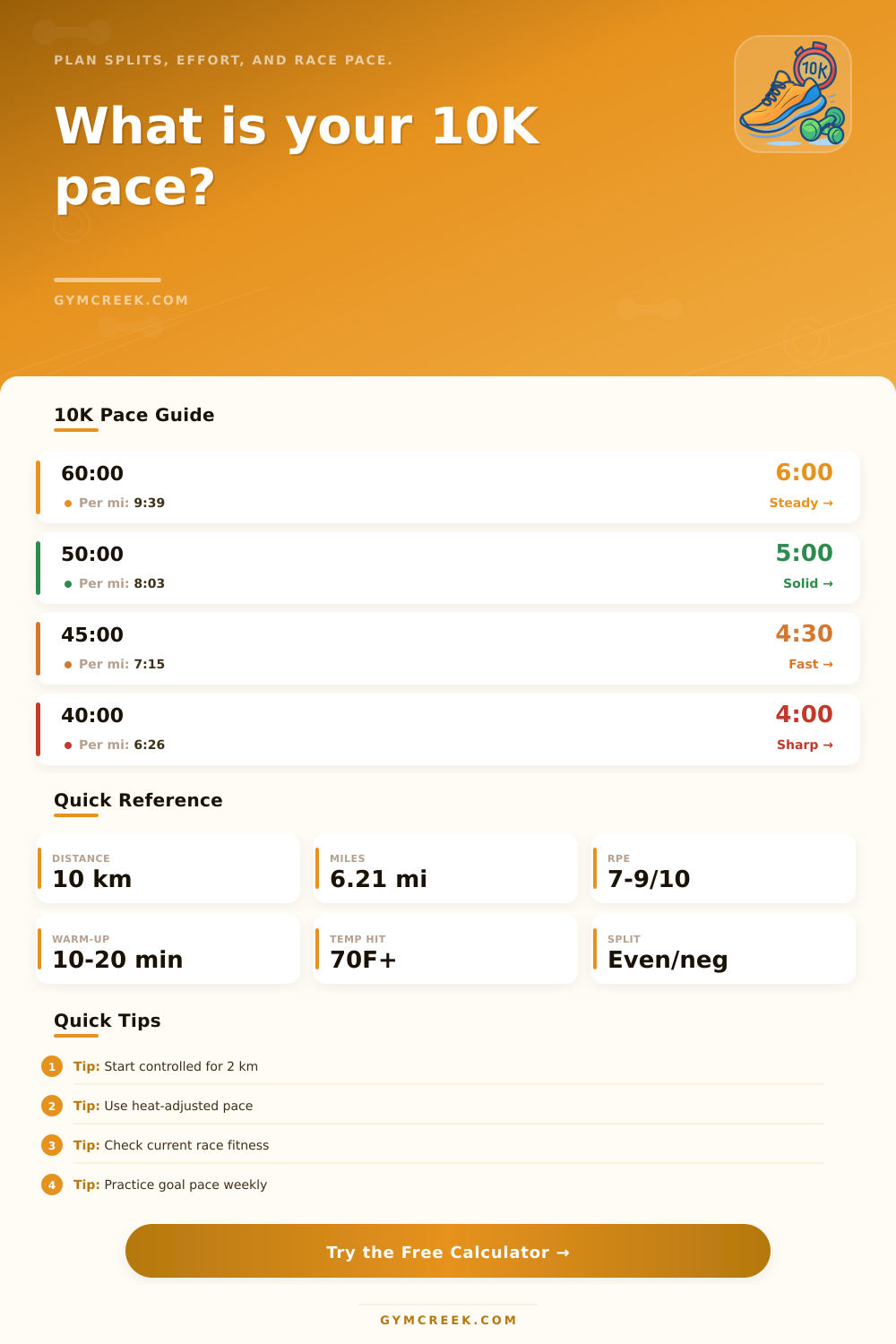
| Finish time | Pace per km | Pace per mile | 5K split |
|---|---|---|---|
| 60:00 | 6:00 | 9:39 | 30:00 |
| 55:00 | 5:30 | 8:51 | 27:30 |
| 50:00 | 5:00 | 8:03 | 25:00 |
| 45:00 | 4:30 | 7:15 | 22:30 |
| 40:00 | 4:00 | 6:26 | 20:00 |
| Factor | Small effect | Moderate effect | Calculator use |
|---|---|---|---|
| Heat | 16-22°C | 23°C plus | Adds slower seconds per km |
| Elevation | 20-60 m gain | 100 m plus | Applies climb penalty |
| Terrain | Track or road | Trail or technical | Changes surface factor |
| Wind | Mixed breeze | Exposed headwind | Adds resistance factor |
| Strategy | First 2K | Middle 6K | Final 2K |
|---|---|---|---|
| Even | Goal pace | Goal pace | Goal pace |
| Negative | 2% slower | On pace | 3% faster |
| Conservative | 3% slower | 1% slower | 2% faster |
| Fast start | 2% faster | On pace | 2% slower |
| Formula | Input | Best use | Note |
|---|---|---|---|
| Riegel | Time x distance ratio | 5K to 10K checks | Uses exponent 1.06 |
| Goal pace | 10K target time | Race planning | Simple even pace |
| Condition factor | Heat, hills, surface | Course planning | Adjusts finish time |
| RPE factor | Target effort | Training workouts | Scales pace by purpose |
💡Pacing Tips
A 10K race is a distance between shorter and longer races. A 10K race is long enough to make a person suffer from running at the wrongly pace, but it is short enough for a person to be able to maintain a high level of effort over the entire distance. To run a 10K race, a runner must prepare for the demand of the 10K race distance.
A runner may begin a race with a target time to complete the race. However, that target time may need to change based off the weather, the terrain of the race route, or the condition of the runners legs at the start of the race. A 10K race calculator can help a runner to account for these different variables.
How to Use a 10K Race Calculator
The calculator collect several race variables from a runner to create a plan for the race. The terrain of the race is one of the variables that the calculator collects. For example, a runner may have more energy after running on a road than on gravel or a trail.
The effect of these different terrain types may not be recognized during the individual kilometer of the race, but the runner will recognize the total effect over the ten kilometers. The other terrain variable is the elevation gain that the runner will need to account for during the race. For example, if the runner will need to gain elevation during the race, that runner will need to change they stride.
Such a change in stride will lead to the runner having a higher heart rate during the race. Thus, the calculator must make an adjustment for elevation gain by the runner so that the runner doesnt treat a race with elevation gain as if it were a flat distance. The temperature and humidity during the race is other variables that the calculator should know.
If the temperature is too high for the runner, their body will pay a price for that high temperature. If the temperature is above twenty degrees Celsius, the runner will begin to feel the effects of high temperatures. If the temperature is above twenty-four degrees Celsius, the price that the body will pay for high temperatures will be greater.
Humidity can make a hot temperature feel worse than it may otherwise be. A runner may experience high temperatures during a race, but may not recognize it until after they begin to run the first few kilometer of a race at too fast of a pace. Thus, the calculator will allow a runner to enter the temperature and humidity variables in order to see what they will be able to run in the race.
Finally, the calculator will ask for the runners wind speed. If the runner is running in a tailwind, the runner may feel that the effort required to run the race is easy. However, if the runner is encountering headwinds, the runner may feel effort in running the race is difficult.
Thus, the calculator must account for both headwinds and tailwinds. The effort that the runner will need to exert during the race is another variable. For example, an RPE of eight out of ten may be the effort of a trained runner to run ten kilometers at once.
However, an RPE of nine out of ten indicate a runner that has high levels of fitness. Thus, the calculator asks for the effort level that the runner will use during the race so that it may make adjustments to the target time of the runner. The training goal for the runner is another variable.
For example, if the runner is completing the race as part of a threshold training goal, the target speed for that runner will be slower then for a race. Thus, the goal for the runner will change the target pace for each variable of the calculator. The strategy that the runner will use for the race is another variable.
For example, even splits is a common race strategy so that runners do not use up all of their energy during the beginning of the race. If runners use negative splits, they will begin at a slower pace and end the race at a faster pace. Conservative starts are used for runners who are preparing to run in warm weather, or who are preparing to race against other fast runners.
Thus, the calculator asks for which split strategy will be used during the race. The current fitness of the runner is one of the variables of the calculator. For example, if the runner has recently run a race, their time can be used to determine how fast they can run a 10K race.
This time can be entered into the calculator along with the goal time that they wish to achieve. If the time that is calculated based upon their most recent race is similar to their goal time, the goal is realistic. However, if there is a difference between the calculated time and the goal time, the goal is a target that the runner will need to work harder to achieve.
The other two variables are of how often the runner works out each week, and how long is their longest run in recent memory. If they run alot each week, they may be able to take a more aggressive approach to their goal for distance. If they do not run as much, they will need to use a more conservative approach to their goals for distance.
The tables provided for runners are only for orienting themselves within the calculator. They dont take the place of the calculator itself. The tables show the pace in which runners will finish a 10K race at different times (per kilometer, per mile).
These tables also show how many minute the effect of heat, elevation, and terrain will take from a runners time. Thus, these tables allow a runner to get a feeling for how fast they will be able to run based upon the conditions within the race. The calculator cannot capture the feeling of a race, such as nerves or the effect of a crowd.
For instance, a crowd may make a runner feel that they can begin at a faster rate than their time trials with no crowds indicate. However, a crowd may also make a runner feel as if they must begin the race at a slower rate to prepare for the effect that the other runners will have upon them during the race. Thus, the calculator establishes a baseline for the runner.
They may adjust that baseline based upon how their warm-up feel relative to how they feel after running the race. One of the main values of using the calculator is that it removes the guesswork that may be used during the race. When using the calculator, a runner will know their target pace for the first two kilometers of the race, their target pace for halfway through the race, and their target pace for the final two kilometers.
Thus, they will be able to focus upon the race of the next kilometer rather than having to calculate the math for the remainder of the race. While such calculations is an effort that the runner should of put in place prior to the race, the calculator will support that effort.