DOTS Calculator Powerlifting
Calculate a DOTS powerlifting score from bodyweight, sex, squat, bench, and deadlift, then compare it with class context and score bands.
📌Presets
Presets load complete powerlifting profiles so you can see how bodyweight, sex, lift balance, and class choice change the DOTS score.
⚙DOTS Scoring Form
DOTS score snapshot
Enter bodyweight and the three lifts to calculate a score.
📊Score Comparison
📑Reference Tables
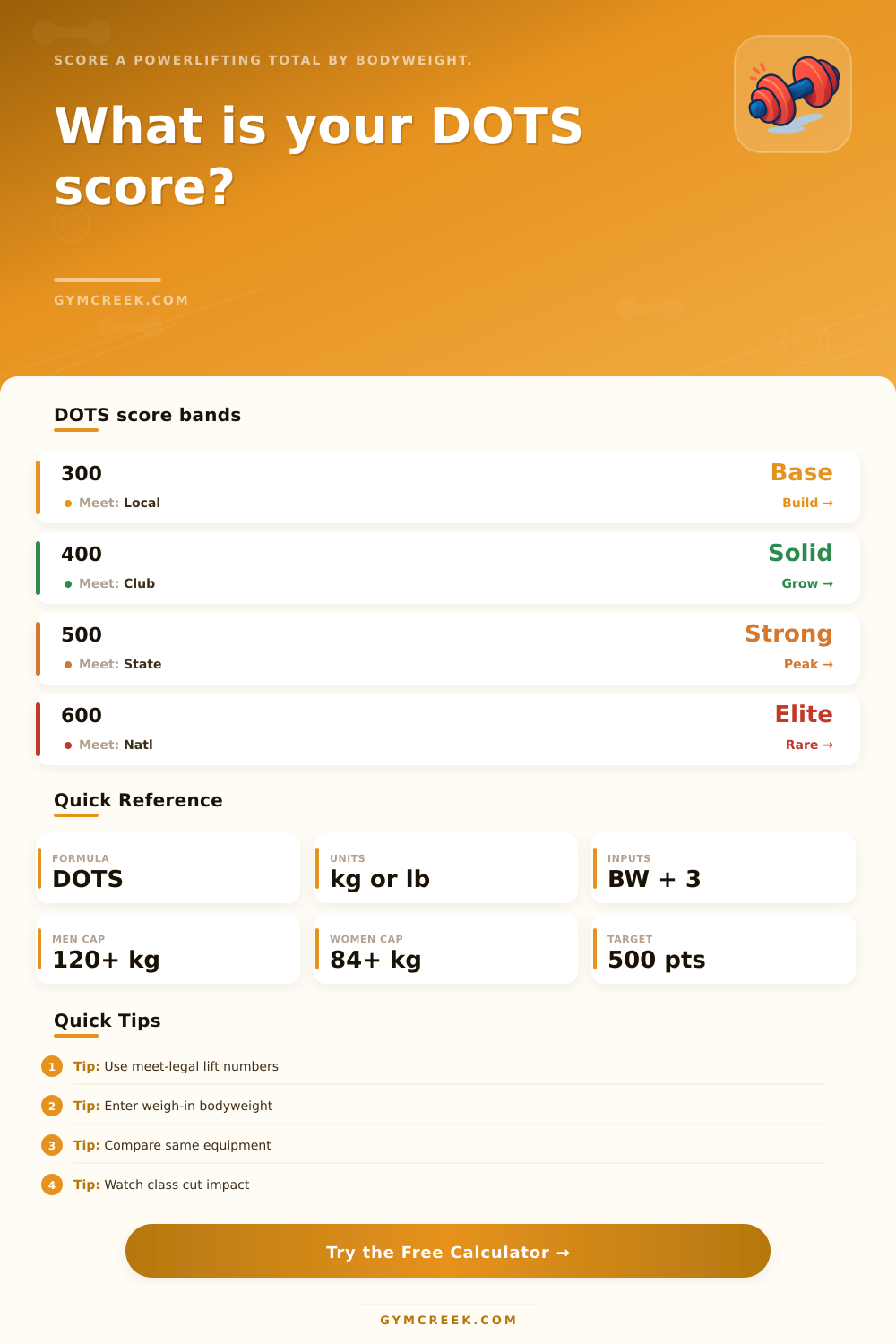
| DOTS | Band | Typical meet read | Planning use |
|---|---|---|---|
| Under 300 | Base | New or local lifter | Build total |
| 300 to 399 | Developing | Competitive base | Add lift volume |
| 400 to 499 | Strong | Solid meet score | Class strategy |
| 500 to 599 | High | Podium contender | Peak carefully |
| 600+ | Elite | Rare top score | Fine margins |
| Sex | IPF classes | Plus class | Class note |
|---|---|---|---|
| Female | 47, 52, 57, 63 | 84+ kg | Lower caps matter |
| Female | 69, 76, 84 | 84+ kg | Use weigh-in BW |
| Male | 59, 66, 74, 83 | 120+ kg | Middle classes dense |
| Male | 93, 105, 120 | 120+ kg | Heavy classes vary |
| Formula part | Male coefficient | Female coefficient | Role |
|---|---|---|---|
| A | -0.000001093 | -0.0000010706 | BW fourth power |
| B | 0.0007391293 | 0.0005158568 | BW cube |
| C | -0.1918759221 | -0.1126655495 | BW squared |
| D | 24.0900756 | 13.6175032 | BW linear |
| E | -307.75076 | -549.814659 | Constant |
| Metric | Formula | Output | Use |
|---|---|---|---|
| Total | S + B + D | kg or lb | Meet score |
| DOTS | Total kg x 500 / coeff | Points | Compare sizes |
| Ratio | Total / BW | Multiplier | Strength context |
| Target total | Target x coeff / 500 | kg or lb | Goal setting |
💡Tips
Powerlifting often lacks fair comparisons between lifters because two powerlifters might have the same total for their three lift, yet one lifter weighs thirty kilograms less than an other. Although the heavier lifter may have moved more total weights through space, the lighter lifter has moved more force relative to the lifter’s body frame. Thus, without some shared yardstick by which to compare powerlifting performance, it is dificult for an individual to determine which lifter performed better relative to the other lifter.
A standardized scoring system for powerlifting allows individuals to compare the performance of a lighter lifter with a heavier lifter by calculating a single number that accounts for the lifter’s total and there body weight. While the system does not provide the same feeling as lifting heavy weights, the system allow individuals to determine whether their total is competitive within their body weight class or whether they should attempt to cut body weight to compete within a more higher class. In order to calculate the score for an individual powerlifter, several inputs are required.
How Powerlifting Scores Work
The bodyweight of the lifter is one input for the calculation. The sex of the lifter is another input for the calculation, as the coefficients differ for men and women due to differences in leverage; the three lift totals is third inputs for the calculation. Additionally, the official competition can enter the total as a field that overides the calculation of the total of the three lifts.
The equipment type for the lifts is not an input into the calculation, but the calculation outputs the total of raw, wraps, and equipped lifts. The age of the lifter is an input into the calculation, as the score differ for different age divisions. The target score for an individual is another field within the calculation system.
Another field within the system is one that displays to the individual powerlifter in which weight class the lifter is currently competing, as well as what their margin is within that class. In addition to requiring each of these inputs, the system outputs several different scores that provide information about the performance of the powerlifter. The main score output provide the total score of the powerlifter.
The band label provides the strength of the powerlifter within the competition. The weight-class line indicates within which weight class the powerlifter is competing and the margin that they have within their weight class. The gap calculation between the powerlifter’s current score and the target score provide a target for the powerlifter to work towards.
Finally, the lift balance output indicates whether the powerlifter is better at performing one type of lift relative to the other lifts. While each of these outputs has a specific value associated with the performance of each powerlifter, each of these scores can be useful as a means of initiating a conversation regarding the performance of that lifter. For instance, having a high score does not ensure that the powerlifter will be able to place on a national competition podium, but it does indicate that their strength is sufficient to compete at a national level.
Similarly, having a score that falls into a lower band than the goal of the powerlifter does not mean that the powerlifter has wasted their training, but it does mean that they need to lift more total weight to increase their score. Additionally, while the target score and gap are similar in that they provide a target score for the powerlifter to work towards, the target score provides the target for the total lifted, while the gap score indicates the amount of additional total weight that the lifter should compete in their current body weight. For many powerlifting competitors, increasing their score is correlated with increasing the total weight of the three lifts that they perform.
However, cutting body weight to increase the total for strength calculations can reduce the ability of the lifter to recover between sets. Additionally, while many powerlifters may find benefit in increasing their total weight by competing in a higher weight class, the increased total weight that is required for those higher classes can help to offset the effects of the body weight reduction on the total score. While the score increase tool cannot make a decision for the powerlifter as to which competition division and body weight class is best for the lifter, it can calculate the total weight for each option so that the lifter has a decision based off data rather than guesswork.
Many of the features of the competitions that the powerlifiters enter can introduce factors that are outside of the calculation of the score. For instance, the number of seconds that an official takes for pauses in Bench Press competitions, the depth of the squat, and the grip of the bar for Deadlift competitions can all affect the legality of those sets. Additionally, the type of equipment that the powerlifter uses for the competitions can have an effect on their score; raw powerlifting competitions differ from equipped competitions.
Thus, an official score comparison may use the same calculation, but the individuals should understand the difference in potential between raw and equipped powerlifting competitions. Mistakes are often made with the bodyweight field. For instance, an individual may use their body weight in the morning, or they may enter an estimated total of their lifts rather than their actual competition lifts.
Additionally, ignoring the margin within their weight class could result in a body weight cut that is too aggressively for the performance of the powerlifter. While these mistakes cannot be prevented, the inclusion of the field for the class margin will make these mistakes more visible to the individual. Another of the common oversights with this scoring system is of the potential change to an individual’s score if their body weight changes or if they compete within a different age division.
Competitors who periodically check their score will have a better understanding of whether they are lifting weights that provides the intended training benefits. The reference material included at the bottom of the score calculation fields may be helpful for those who perform periodic checks of their powerlifting score. For instance, the score bands show the number of competitors of similar total strength to the entering lifter who compete in local, state, and national powerlifting competitions.
Additionally, coefficient tables indicate the reasons for the differences between men and women and between light and heavy weights within each sex. Finally, class tables provide an overview of the divisions within powerlifting and the weights of competitors within each division. This reference material does not substitute for coaching for a powerlifter, but it does allow the powerlifter to reduce the amount of mental calculations that they have to perform when planning their season.
The value of the standardized scoring system for powerlifting competitions is that it allows the competitor to track their performance relative to other powerlifters. While the competitor is still required to perform the training necessary to increase their strength, the score allows them to track their relative strength. Thus, if the score is increasing relative to the competitor’s goal, the competitor can continue to train to maintain the increases in strength.
If the score is not increasing, however, the breakdown of the total, the class margin, and the gap can help the powerlifter to determine where the training efforts should of been adjusted.