Powerlifting Diet Calculator
Plan a meet-phase diet from bodyweight class, target rate of gain or cut, weigh-in timing, training days, calorie cycling, and macro timing around heavy sessions.
📌Meet Phase Presets
Presets load realistic meet situations with different class margins, weeks out, training days, weigh-in windows, and weekly rate targets.
⚙Calculator Inputs
Meet diet snapshot
Enter your meet bodyweight target and training week to calculate.
📊Diet Metrics
📑Reference Tables
| Meet phase | Bodyweight aim | Diet emphasis | Watch point |
|---|---|---|---|
| Base build | Slow gain or hold | More food on hard weeks | Avoid rushing class jumps |
| Strength block | Hold or gentle cut | Fuel heavy volume | Do not chase scale noise |
| Peak block | Stable or small cut | Carbs near heavy singles | Protect bar speed |
| Meet week | Make class calmly | Simple, familiar foods | No new diet experiments |
| Weekly rate | Best use | Strength cost | Calculator note |
|---|---|---|---|
| -0.5% to -1.0% | Normal cut phase | Moderate | Plan early |
| -0.25% to -0.5% | Peak block trim | Low | Often smoother |
| 0% | Meet performance | Lowest | Stable class |
| +0.2% to +0.5% | Fill class slowly | Usually low | Use trend weight |
| Window | Carb share | Protein cue | Use |
|---|---|---|---|
| Pre-lift | 25% to 35% | Small to moderate | Session fuel |
| Post-lift | 25% to 35% | Anchor serving | Recovery |
| Rest of day | 30% to 50% | Even spread | Adherence |
| Post weigh-in | Fast refill | Normal serving | Only if tested |
| Window | Best margin | Diet style | Risk cue |
|---|---|---|---|
| 2-hour | 0% to 1% | Arrive close | Recovery time is short |
| 24-hour | 0% to 2% | Small final margin | Practice the refill |
| Big cut | Over 3% | Coached only | Strength can drop |
| Class fill | Under cap | Slow surplus | Do not miss cap |
💡Practical Tips
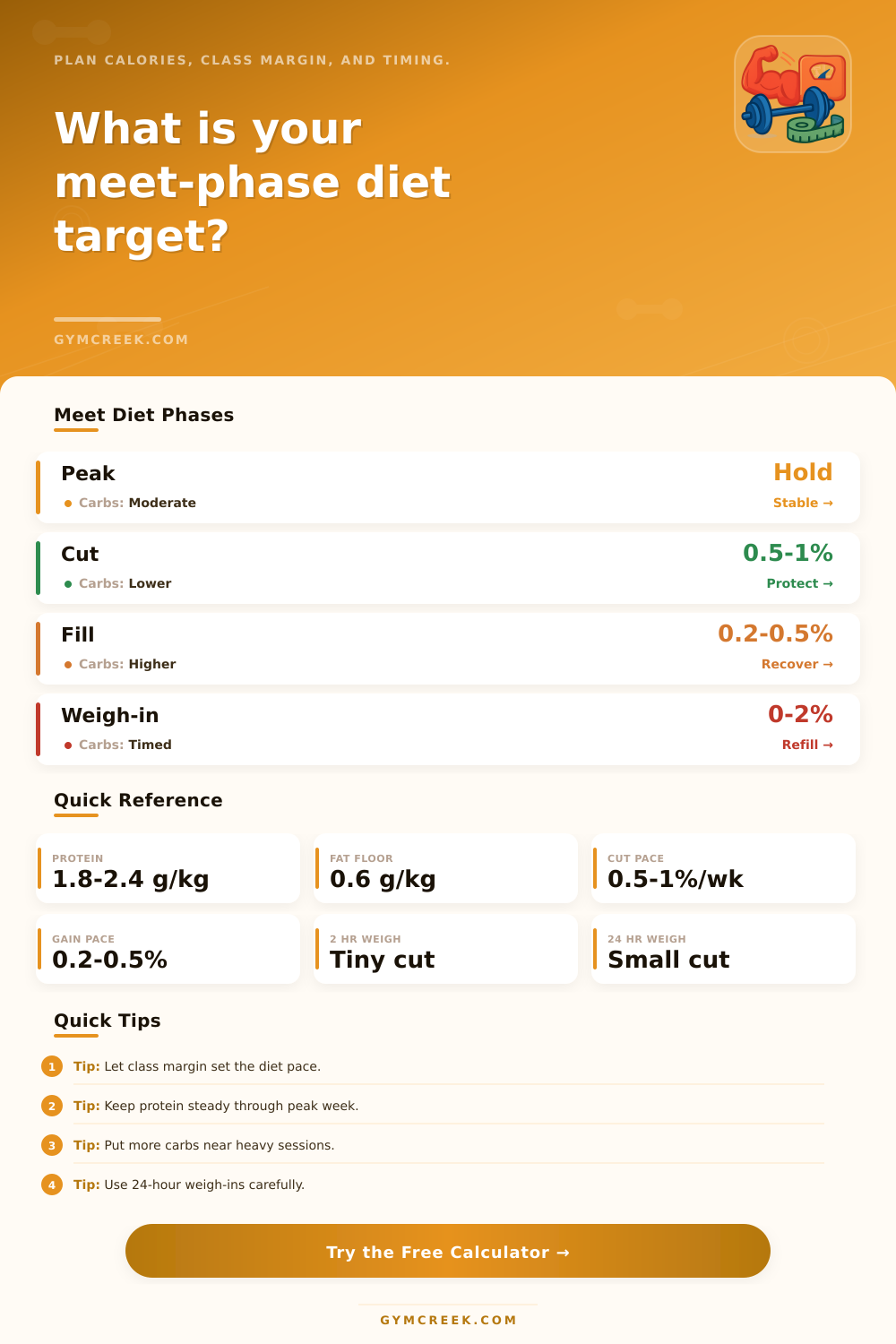
Use the bodyweight class margin to decide the diet speed. A small early cut is usually easier than trying to rescue the scale in meet week.
Keep daily protein steady, then move more carbohydrate to heavy squat, bench, and deadlift sessions instead of cutting training-day fuel first.
Powerlifting is a sport in which an individual must compress months of training into one day, and there food intake in the weeks leading up to the competition will have a direct impact on how they feel on the platform. An individual may require reaching a certain weight class. At the same time, they needs to maintain the strength they have trained into there bodies.
Many powerlifting athletes adjust their diet guessing at how many calorie they need to consume to reach there goal. Guessing at the diets of powerlifting athletes often leads to problem. The calculator allows an individual to input there current weight, their target weight class, and the number of week they have before the competition.
Powerlifting Weight Cut Calculator
Small changes in the weight lost per week can have a drastic impact on the strength that an athlete feels on the day of the competition. While aggressive diet are common in the sport, losing weight slow allows for the muscle groups to adapt to the diet without losing strength. The calculator will perform the math for the individual once they input there body weight, the weight class they are targeting, and the number of weeks they have until the competition.
This removes the need to calculate how many calories is required for the individual to lose weight at the rate that they would of like to see results. An individual’s training schedule will also have an impact on the diets that they consume during these last few week before a competition. The body burns carbohydrate differently during heavy training days compared to light training days.
By adjusting the carbohydrates that an athlete consumes to fit the days in which they perform the most strenuous training, that individual can maintain their strength. The calculator can take into account the number of training and heavy training days that an individual perform each week. An individual must also consider the timing of there weigh-in.
With a two-hour time window to show up for the competition, there is very little margin for error. In contrast, with a twenty-four-hour window, an athlete has time to rehydrate and refuel there glycogen stores. By accounting for the time in which an athlete must weigh in, the calculator can provide an adjustment to the suggested pace at which the athlete should lose weight.
A modest target for weight loss may appear okay on paper but could pose risks if an athlete weighs in within a short time window. The calculator will inform the athlete of these risks so that an athlete does not encounter such risks on the night before the competition. The amount of protein that an athlete consumes should remain relatively the same throughout the competition.
However, the split between carbohydrates, fats, and protein can change. An athlete should set a floor for the amount of fat that they consume as low levels can impair the athlete’s strength and recovery. The remaining calories should be assigned to carbohydrates that can be consumed around training sessions.
By leaving the protein fields separate from fat and carbohydrate fields, the calculator allows an individual to see how each category will affect the total calories consumed on training days or non-training days. The difference between the athlete’s weight and the weight they need to reach will determine the feasibility of the diet that the calculator calculates. For athletes close to the top of there weight class with only a few weeks remaining, the weekly weight loss will have to be extreme high.
For athletes with space in there weight class, they have the opportunity to lose weight slowly or to hold there weight within there competition category. The calculator will show the class margin to inform the athlete of the feasibility of the diet within the weight class that they are competing in. Many powerlifting athletes make mistake in the last few weeks prior to there competition.
One of the most common mistakes is focusing solely on the weight they need to reach and ignoring the strength that they exhibit. Another mistake is mimicking the diet of another powerlifting athlete who succeeded in there competition with the same diet. While the calculator does not provide the all-knowing advice for nutrition needs, it removes the complications of the mathematics for each athlete.
Body composition is more important than the weight on the scales alone. An athlete with more lean mass can take a higher percentage of weight loss without losing as much strength as an athlete with less lean mass. The body fat percentage input will help to contextualize the protein target that the calculator calculates for each athlete.
Furthermore, it will give the athlete an idea of the amount of there weight that are muscle mass. This will help to inform the athlete of the feasibility of the diet within there body composition. During the last few weeks leading up to the competition, simplicity in diet is the beneficial choice for most athletes.
Introducing new foods or changing the sodium content of an athlete’s diet at this stage can cause problem. An athlete will do better with a diet that consists of the foods that there body can best tolerate. While perfection of the diet is not the goal, an athlete will benefit from having strength and energy on the platform.
The numbers provided by the calculator will give an athlete insight into the direction of there diet. However, the movement of the bar during the competition will measure the outcome of there diet.