Powerlifting Macros Calculator
Set powerlifting macros around bodyweight, meet phase, weight-class pressure, weekly training frequency, calorie target, protein, fat, carbs, and lift-day carb bias.
📌Powerlifting Presets
Presets load complete meet-aware macro setups instead of generic diet examples.
⚙Calculator
Powerlifting macro snapshot
Enter bodyweight, class target, phase, and macro settings to calculate meet-aware intake.
📊Powerlifting Metrics
📑Reference Tables
| Phase | Calorie bias | Carb cue | Powerlifting use |
|---|---|---|---|
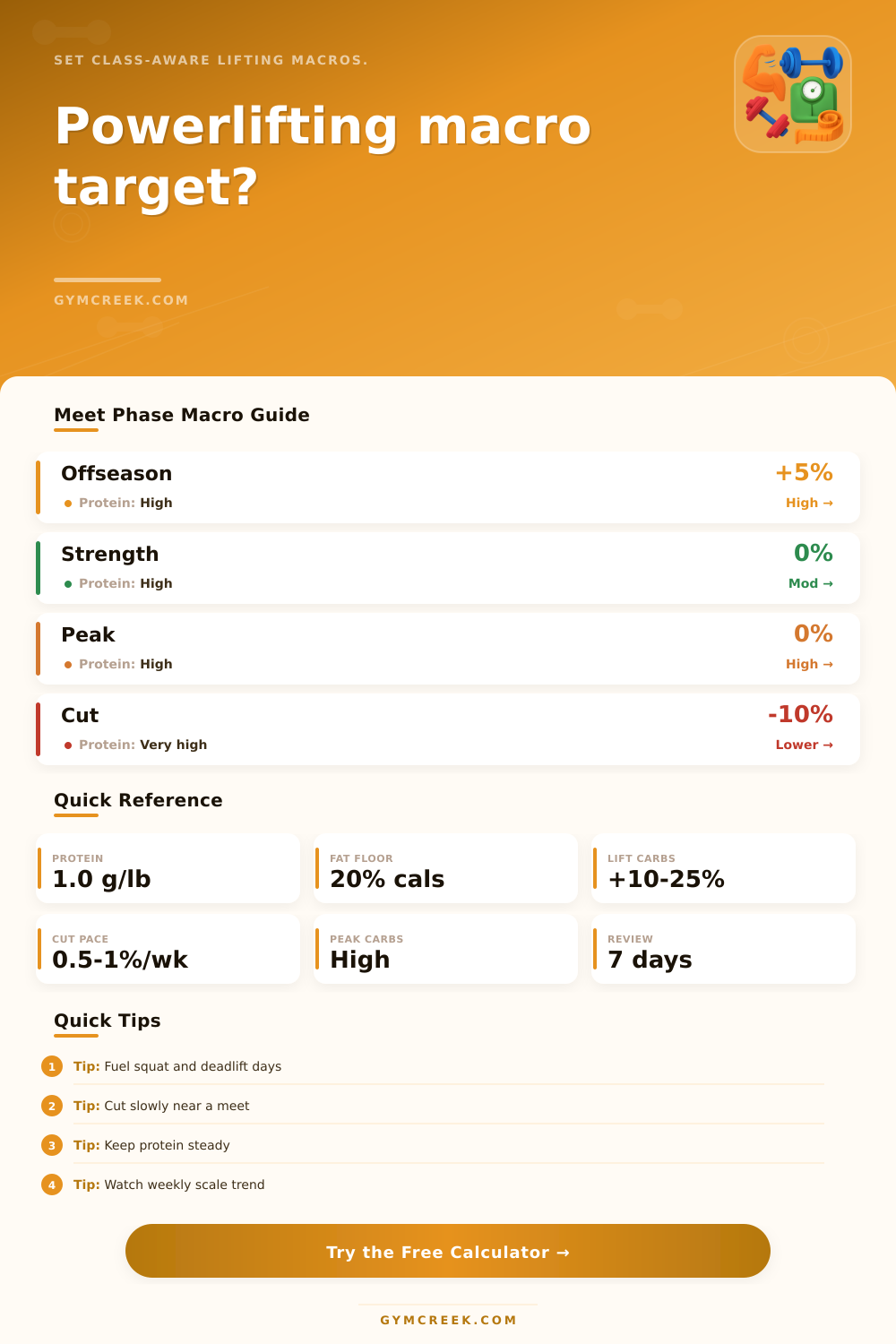
| Offseason volume | +5% to +8% | High | Build work capacity and size |
| Strength block | 0% to +3% | Moderate high | Support heavy volume without rushing gain |
| Meet peak | 0% to +2% | High on heavy days | Hold bodyweight while keeping bar speed |
| Weight-class cut | -8% to -15% | Protected around lifts | Make class with less training drop-off |
| Macro | Typical target | Calculator role | Watch point |
|---|---|---|---|
| Protein | 0.8 to 1.2 g/lb | Set first from bodyweight | Higher during cuts |
| Fat | 20% to 30% calories | Set second from calories | Avoid very low fat |
| Carbs | Remainder | Fuel heavy sessions | Lower rest days if needed |
| Fiber | Stable daily | Bodyweight consistency | Avoid late peak surprises |
| Weekly move | Bodyweight % | Risk read | Macro response |
|---|---|---|---|
| Maintain | 0% to 0.25% | Low | Keep carbs high |
| Slow cut | 0.25% to 0.75% | Moderate | Small deficit |
| Hard cut | 0.75% to 1.25% | High | Protect protein |
| Too fast | Over 1.25% | Very high | Recheck class plan |
| Formula | Variables | Output | Why it matters |
|---|---|---|---|
| Mifflin-St Jeor | Sex, age, weight, height | BMR | Resting calorie base |
| TDEE | BMR, activity, sessions | Maintenance | Powerlifting calorie anchor |
| Macro budget | Cals, protein, fat | Carbs | Shows training fuel left |
| Weekly gap | Class target, days | Pace | Flags class-cut pressure |
💡Tips
Powerlifting is a sport in which bodyweight is relate to barbell weight, and in which bodyweight is directly involved in the performance of the lifts. Because powerlifters are able to train at high levels of intensity and to recover from those intense workouts, lack of progress is often due to a lack of apropriate intake of food to support the specific training phase in which the powerlifter is currently completing there workout. The lack of alignment between training stress, bodyweight targets, and total caloric intake can lead to difficulties in meeting the goals that each individual powerlifter desires to accomplish.
Macronutrients is important to incorporate into an athlete’s diet due to the fact that macronutrients determine the limit of the accomplishments that an athlete can make during their training. Protein is an essential macronutrient for those who are attempting to limit thecaloric intake of there diet because protein supports muscle recovery and helps to keep muscle mass intact. Carbohydrates is important for those powerlifters who wish to increase the availability of glycogen for there workouts.
How to Eat for Powerlifting
Fats are an essential component of the diet of powerlifters because fat intake supports the health of the athlete’s hormones and increases the feeling of satisfaction after meal. Each of these macronutrients has different relationships to the goals that an athlete may have. The calculator that is provided can take an athlete’s current body weight, training frequency, and timeline until their next meet to calculate the athlete’s nutritional need.
This nutritional need includes both the total number of calories that the athlete should consume each week, as well as the distribution of carbohydrate throughout the athlete’s training period. A carbohydrate distribution that distinguishes between heavy training days and light training days will provide more glucose to those heavy training sessions (such as squats or deadlifts) while reducing the amount of glucose needed for light training sessions (such as bench pressing). This allows for athletes to maintain there total weekly carbohydrate intake while providing more energy for there heavy training sessions.
Body weight goals and target weight class goals add another layer of complexity to an athlete’s nutritional needs. For those who are above there target weight class and who have a weigh-in approaching, the number of days until the athlete’s meet will determine whether the weekly weight loss target is too aggressive to be met. As such, the calculator will indicate if such a rapid loss of weight is too fast for the athlete’s body.
A slow and steady loss of weight is usually the best approach for athletes due to there ability to maintain there physical performance. The training frequency and the number of heavy training session that an athlete performs will have an impact on the athlete’s nutritional requirements. Those who perform heavy squat and deadlift sessions three times per week will require different nutritional needs than those who perform such squat and deadlift sessions only once per week.
Your activity level outside of the gym will also have an impact on your energy requirements. A person who has a desk job requires less energy than a person who is active throughout the day. These details is important to know about lifters because two lifters can have the same body size yet have different requirements for the number of calories they consume due to these differences.
The training phase that an athlete chooses will impact the calories and macronutrients that they consume. During the offseason phase, lifters should consume small surplus calories to encourage the growth of muscles and tissues. During the strength phase, maintenance calories should be consumed to encourage the lifters to increase the intensity of their workouts without significantly increasing there body weight.
During the peaking phase, available carbohydrates should be consumed to allow the lifters to maintain there bar speed during there heavy lifts. During the weight-cutting phase, protein should be high in the diet of the lifters to protect there muscles and carbohydrates should be taken around there heavy training sessions. The input for training phase within the calculator will allow an athlete to adjust the bias towards calories and carbohydrates according to there training phase.
Protein targets will be high within each training phase to avoid the muscle loss that can occur within the body. The target for grams of protein per pound of body weight can be adjusted according to the degree of which an athlete will cut there weight. Fat will be calculated as a percentage of the total number of calories consumed so that the fat does not take up too much of the diet of an athlete if they have low total calories requirements.
The remaining calories will be allocated to the carbohydrate budget of the athlete. The calculator will redistribute the carbohydrate budget so that athletes consume more carbohydrates on there heavy lifting days. Many lifters make mistakes with the macronutrients in there diets.
For example, some lifters keep there macronutrient intake the same throughout the training cycle. This is a mistake because there training volume will change throughout the training cycle. For example, another mistake is to reduce carbohydrates equally throughout the week.
This is a mistake because there energy will be reduced during there heavy lifting days. Small adjustments should of been made to the diets of lifters instead of making large and sudden changes to there diets. The purpose of this calculator is not to allow lifters to consume the perfect amount of macronutrients for there body.
Instead, this calculator will allow them to have a reference point for there body. If an athlete’s body weight is changing at a faster rate than they would like, they can use this calculator to ensure that there calorie target is correct. If an athlete’s heavy lifting days are failing, they can use this calculator to ensure that there carbohydrate intake is higher on heavy training days than on there rest days.
By using this calculator, lifters will be able to consistently track these variables. Over time, these lifters will become accustomed to meeting there bodyweight and training requirements with there diet.