Concrete Dumbbell Weight Calculator
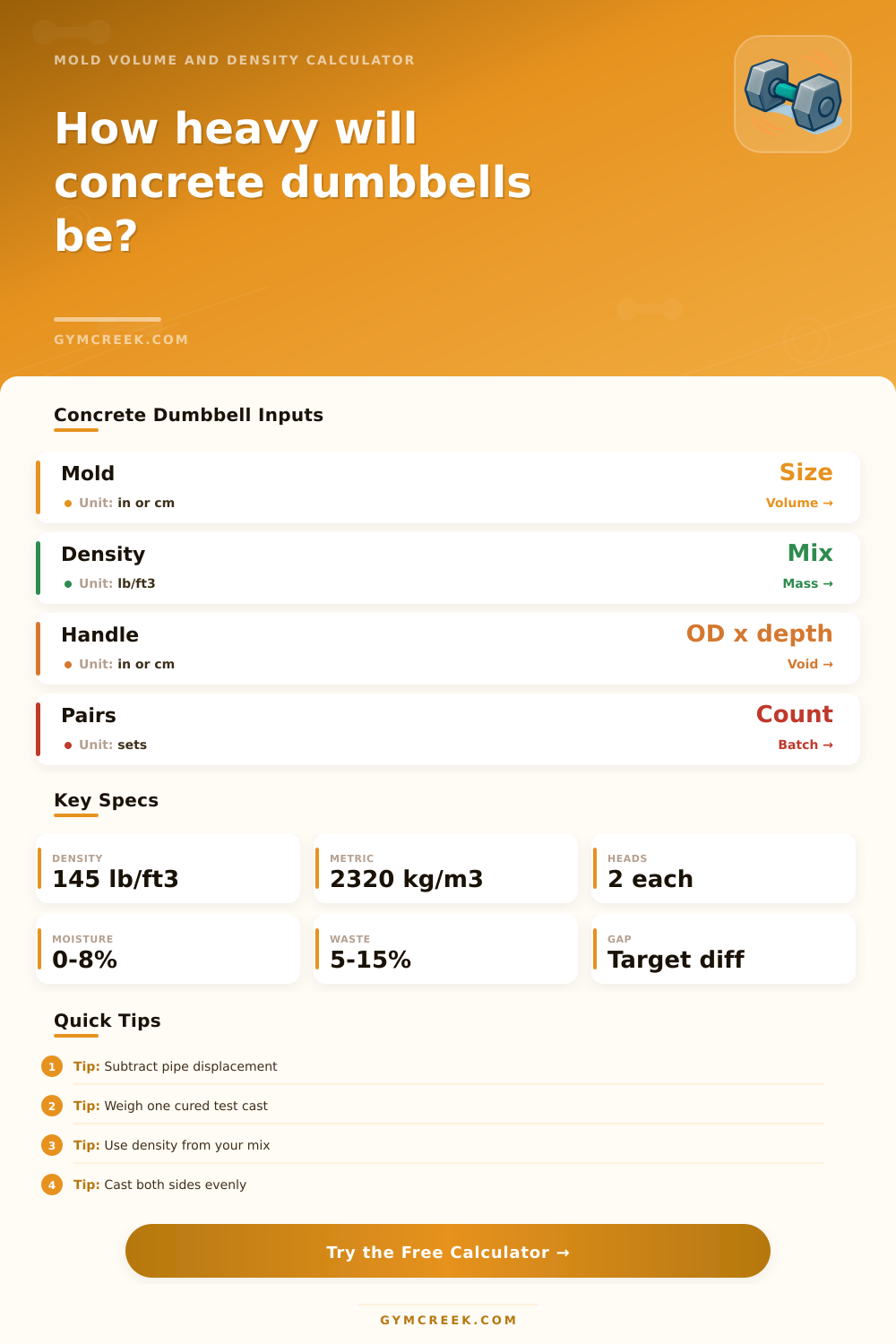
Estimate the finished weight of homemade concrete dumbbells from mold dimensions, concrete density, handle and insert displacement, moisture adjustment, pair count, and target weight gap.
📌Presets
Each preset changes the mold shape, dimensions, density, pipe displacement, insert volume, moisture factor, pair count, and target gap. The goal is casting math, not strength programming.
⚙Calculator
Concrete dumbbell casting snapshot
Enter mold dimensions, density, displacement, moisture, and target weight.
📊Casting Metrics
📑Reference Tables
| Mold shape | Volume formula per head | Best for | Common check |
|---|---|---|---|
| Round cylinder | pi x radius x radius x thickness | Cans, buckets, pipe forms | Measure inside diameter, not outside container size |
| Rectangular block | Width x height x thickness | Wood boxes and square molds | Use filled concrete depth after leveling |
| Hex-style end | Width x height x thickness x 0.827 | Flat-sided homemade heads | Approximation for trimmed or hex-like faces |
| Chamfer allowance | Gross volume x reduction percent | Rounded edges and uneven fills | Small molds can lose several percent |
| Material or mix | Approx density | Metric equivalent | Use in calculator |
|---|---|---|---|
| Normal concrete | 140 to 150 lb/ft3 | 2240 to 2400 kg/m3 | Default homemade casting estimate |
| Mortar-heavy mix | 120 to 135 lb/ft3 | 1920 to 2160 kg/m3 | Use if mix has more sand and paste |
| Pea gravel dense mix | 145 to 155 lb/ft3 | 2320 to 2480 kg/m3 | Use for compacted stone-heavy ends |
| Lightweight mix | 85 to 115 lb/ft3 | 1360 to 1840 kg/m3 | Use only if lightweight aggregate is known |
| Input | What it subtracts | What gets added back | Why it matters |
|---|---|---|---|
| Handle outside diameter | Cylindrical void through concrete | Actual handle weight | Pipe volume can remove meaningful concrete |
| Embed length | Handle length inside each head | Steel already included in hardware field | Longer embed lowers concrete volume |
| Extra insert displacement | Caps, washers, sleeve plugs, rebar voids | Only if included in hardware weight | Prevents overestimating concrete mass |
| Moisture factor | None; it adjusts mass after density | Retained water or dry-down estimate | Cured casts can differ from fresh casts |
| Metric | Formula | Inputs | Output |
|---|---|---|---|
| Gross volume | One head volume x heads per dumbbell | Mold dimensions and head count | Total mold space before voids |
| Net concrete volume | Gross volume - chamfer - displacement | Mold volume, edge percent, inserts | Concrete volume per dumbbell |
| Concrete mass | Net volume x density x moisture factor | Volume, density, moisture | Concrete weight before hardware |
| Finished weight | Concrete mass + handle hardware | Concrete and hardware | Estimated dumbbell weight |
| Target gap | Finished weight - target weight | Target and finished weight | How close the mold is to goal |
💡Tips
When you cast your own dumbbell molds, you may find that the resulting dumbbell isnt of the expected weight. A mold that is designed to create twenty-five pound of concrete, for instance, may come out with a dumbbell that weighs several pounds less than twenty-five pounds. There are several reasons for this weight difference: the handle that you will use to grip the dumbbell takes up some of the space in which the concrete will be poured into the mold; the corners of the mold may not be completely filled with the poured-in concrete; and the moisture contained in the poured in concrete will evaporate over time as the concrete cure.
A calculator can help you to determine the expected weight of your finished dumbbell by accounting for each of these variable. The weight of a dumbbell is based off the volume of the concrete that is used to create the dumbbell. The calculator determine the volume of the mold in which the dumbbell will be poured; it also asks for the number of dumbbell head that you would like to create.
How to Find the Weight of Your Concrete Dumbbells
The calculator also asks for the volume of the handle that will be embedded into the heads of the dumbbell and subtracts it from the total volume of the mold. The volume of any insert (such as metal inserts for the handle) are also asked for and subtracted from the total volume. The calculator also asks for the density of the concrete to be use to create the dumbbells.
The calculator multiplies the density of the concrete by the total volume to find the total weight of the concrete. The calculator also asks for the moisture content of the concrete. The moisture content can be positive to account for the water that remains in the concrete or it can be negative to account for the water that evaporates from the fresh concrete over time.
The result of the calculation will also include the weight of the steel hardware that will be used in the dumbbell. The density is a very important factor in creating the dumbbell that is of the correct weight. The density of the concrete will affect the weight of the same volume of concrete.
It is surprising how specific changes in the ingredient in the concrete can change the density of that concreting mixture. For instance, if the concreting mixture contains a lot of pea gravel, it will have a different density then a concreting mixture that contains a lot of sand. It is necessary, therefore, to include the specific density of the concreting mixture that is to be used in the dumbbell.
Another of the factors in the calculation of the weight of the dumbbell is the concept of displacement. Displacement occurs when the handle (or any inserts) takes up some of the volume within the mold. Displacement reduces the amount of concreting mixture that can be poured into the mold.
The volume of the round handle, for instance, is based upon the radius of the handle. Any increase in the diameter of the handle will create a large amount of displacement of the volume that can be taken by the concrete. Therefore, the calculator automatically subtracts the volume of the handle from the total volume of the mold once you enter the diameter and length of the handle.
Any washers or plugs that are also poured into the mold in addition to the concrete can also be added into the calculator so that the total amount of displacement is accounted for. The third factor to consider is the concept of moisture content. Freshly poured concreting mixture contains water.
Over time, the water will evaporate from the concreting mixture. The moisture content that is entered into the calculator will account for the amount of moisture in the concreting mixture at the time that it is pour into the molds. This value will have a positive impact on the calculated weight if the moisture content is positive (to account for the water that remains in the concreting mixture); if the moisture content is a negative value, then some of the water has evaporated from the poured concreting mixture.
This value is entered after the density and before the weight of the hardware is accounted for in the calculation. After you enter all of the variables into the calculator, it will provide you with the estimated weight of each of your dumbbells. Furthermore, it will provide you with the total volume of the concreting mixture necessary to create your dumbbells.
The calculator also calculates the difference in the weights of each of the dumbbells that are to be matched together to form each dumbbell pair. If the difference between the calculated weights of each of the dumbbells is above the tolerance that you select, the calculator will indicate that the dumbbells may need to be recast or the differences may need to be accepted. The shape of each of the molds in which the dumbbells will be poured will also impact the calculation that must be performed to determine how much concreting mixture will be necessary for each pair of dumbbells.
If each mold is a round cylinder, then the calculator will ask for the diameter of the mold and the thickness of the mold. The volume of a cylinder is based upon its radius and its thickness. If the mold is a rectangular or a hexagonal mold, however, then a second width dimension will be asked of the molds.
When the user chooses a mold of a different shape, the calculator will automatically change the volume equation that is used so that the user cannot enter in any incorrect dimension manually. In addition to the variables that are asked of the users, it is also important for the users to account for the amount of waste that will occur in the pouring of the molds. It is common for many people to add extra concreting mixture to the molds to account for any concreting mixture that may spill during the process of pouring into the molds.
The calculator will ask the user the percentage of how much extra concreting mixture should be added. This percentage will be multiplied by the total volume of the molds that will be used for the dumbbells. This will ensure that the user will have enough concreting mixture to fulfill the demand of the molds.
To use the calculator, the user will need to follow a few simple step. First, the dimensions of the molds will need to be measured. Second, the user will enter the dimensions of the molds, the density of the concreting mixture, and the features of the dumbbell handles into the calculator.
Third, when all of the parameter have been entered, the calculated weight of each of the dumbbells can be viewed. The calculated weight can be compared to the expected weight of the dumbbell to determine whether the thickness or the density of the concreting mixture should be changed. Due to the various variables that may affect the final weight of the dumbbell, the calculator will only provide an estimate of that weight.
The ambient temperature at which the dumbbell is prepared may affect the evaporation of the moisture from the concreting mixture. Furthermore, any vibration of the molds will affect how well the concreting mixture fills each of the corner of the molds. To account for this variable, it may be advantageous to also pour a single test piece of the concreting mixture into a mold.
The weight of this test piece may help to confirm that the density of the concreting mixture that is entered into the calculator is correct. Overall, the use of this calculator will help to ensure that each of your dumbbells will be of the correct weight when the casting process is complete.