Dumbbell Strength Calculator
Estimate per-hand dumbbell strength from load, reps, bodyweight, sex, age, exercise type, and unilateral balance. Compare left and right sides, see an estimated 1RM, and classify your strength level.
📌Presets
Each preset changes load, reps, demographics, exercise type, and comparison mode so the estimated level is driven by strength inputs rather than dumbbell setup math.
⚙Calculator
Dumbbell strength level
Enter per-hand loads, reps, bodyweight, and exercise type to estimate your level.
📊Dumbbell Strength Metrics
📑Reference Tables
| Exercise | Novice | Intermediate | Advanced | Elite |
|---|---|---|---|---|
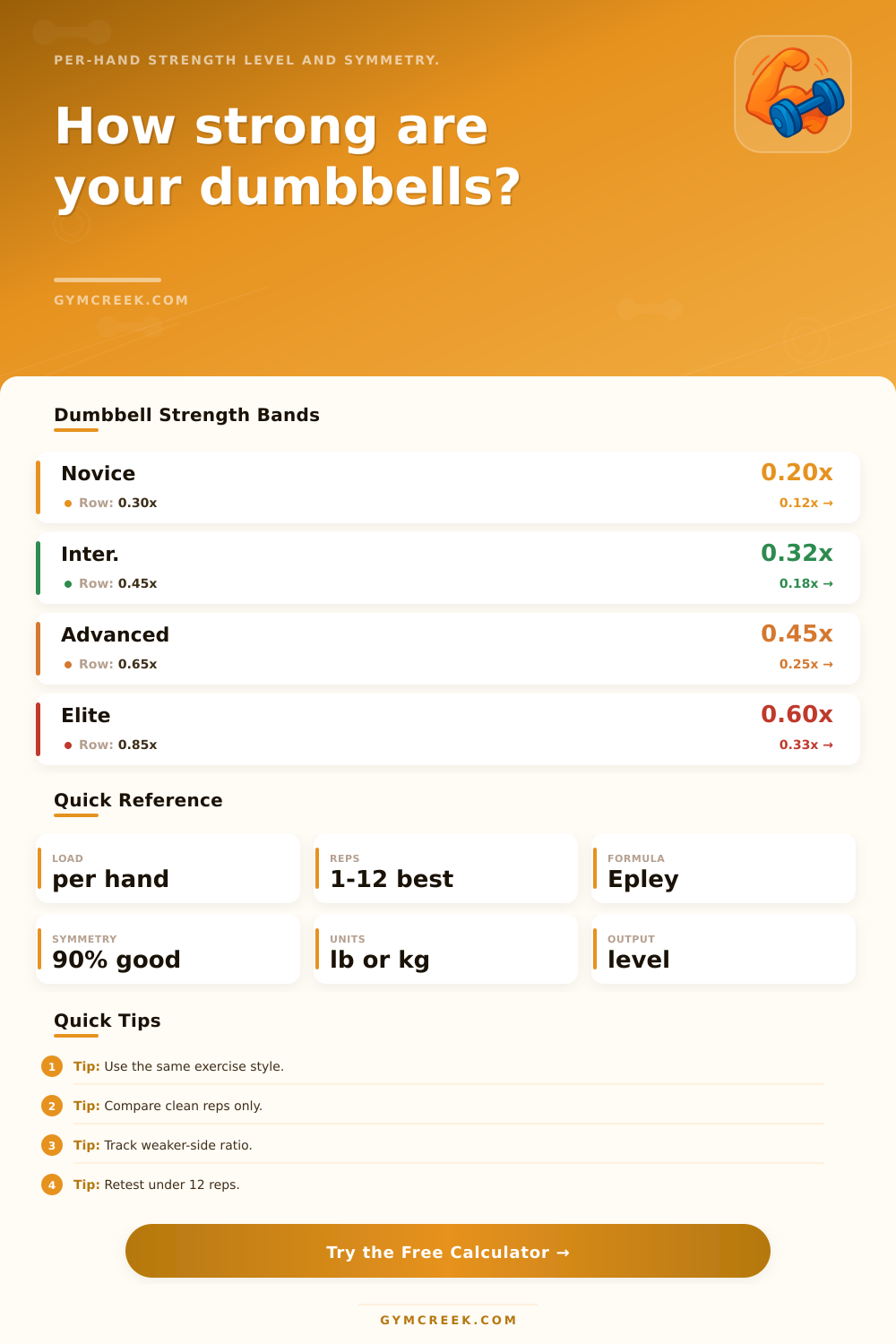
| Press | 0.20x BW | 0.32x BW | 0.45x BW | 0.60x BW |
| One-arm row | 0.30x BW | 0.45x BW | 0.65x BW | 0.85x BW |
| Curl | 0.12x BW | 0.18x BW | 0.25x BW | 0.33x BW |
| Goblet squat | 0.35x BW | 0.55x BW | 0.75x BW | 1.00x BW |
| Split squat or lunge | 0.22x BW | 0.35x BW | 0.50x BW | 0.65x BW |
| Farmer carry hold | 0.40x BW | 0.60x BW | 0.80x BW | 1.00x BW |
| Exercise | Novice | Intermediate | Advanced | Elite |
|---|---|---|---|---|
| Press | 0.12x BW | 0.20x BW | 0.30x BW | 0.42x BW |
| One-arm row | 0.20x BW | 0.32x BW | 0.48x BW | 0.65x BW |
| Curl | 0.07x BW | 0.11x BW | 0.16x BW | 0.23x BW |
| Goblet squat | 0.25x BW | 0.40x BW | 0.60x BW | 0.82x BW |
| Split squat or lunge | 0.14x BW | 0.24x BW | 0.38x BW | 0.52x BW |
| Farmer carry hold | 0.28x BW | 0.45x BW | 0.65x BW | 0.85x BW |
| Metric | Good range | Watch range | How this calculator uses it |
|---|---|---|---|
| Side balance | 95% to 100% | Under 90% | Weak e1RM divided by strong e1RM |
| Per-hand ratio | Exercise specific | Below novice | Average e1RM per hand divided by bodyweight |
| Paired ratio | About 2 x per-hand | Large side gap | Left plus right e1RM divided by bodyweight |
| Training max | 85% to 92% | Lower after breaks | Rounded per hand from estimated 1RM |
| Set volume | Trend over time | Not a max score | Load x reps x active hands |
| Item | Formula | Best range | Use |
|---|---|---|---|
| Estimated 1RM | Load x (1 + effective reps / 30) | 1 to 12 reps | Main strength estimate |
| Effective reps | Reps + reps in reserve | RPE 7 to 10 | Adjusts submaximal sets |
| Per-hand ratio | Average e1RM / bodyweight | All exercises | Estimated level |
| Balance score | Weak side / strong side | Left-right tests | Symmetry result |
| Age factor | Ratio / age curve | Adult lifters | Masters context |
| Scenario | Input style | Best comparison | Result to watch |
|---|---|---|---|
| Pair pressing | Same load both hands | Bilateral pair | Average per-hand e1RM |
| One-arm row | Test each side | Unilateral | Weak side gap |
| Curl testing | Strict reps | Unilateral or alternating | Clean rep quality |
| Goblet squat | Single central load | Single dumbbell | Single-load ratio |
| Carry hold | Timed or rep proxy | Bilateral pair | Paired ratio and symmetry |
💡Tips
Dumbbells give direct feedback about your training. Dumbbells dont provide the same level of stability as a barbell and dumbbell exercises dont have the same fixed path as a gym machine. Because of these factor, dumbbells allow you to see how well you can control a load and how balanced each of your sides is and how well your strength match your physical goals.
Many people want a way to measure there dumbbell workouts as dumbbell workouts can give them a clear picture of there physical progress. The calculator will take the numbers from your dumbbell training and place them into a structured picture for you to see your progress. This calculation will use the load of each of the dumbbells that you used, the number of repetitions that you perform and your body weight.
Measure Your Dumbbell Strength and Balance
Additionally, the calculator will use your background in terms of your training and information regarding the specific exercise that you performed to calculate your one-rep maximum for each of your hand. This calculation will also provide you with an estimated one-rep maximum as well as a strength level that considers your age and your sex. The calculator will also provide you with information regarding how close each of your sides are to one another and it will calculate your training max that you can use during your training.
Body weight is one of the most important factor to consider with dumbbell strength calculations. A press of 60 pounds will be different from an individual that weighs 140 pounds compared to an individual that weighs 220 pounds. The calculator will use the ratio between the strength that you calculated and your body weight to place you into a category that define your strength from novice to elite.
This ratio can be useful to compare your strength to the standards for each strength level. Age is another important calculation to be made by the calculator. As individuals age, there strength declines.
The strength of an individual will typically peak between their twenties and thirties and will begin to decline after that peak. By adding this factor to the calculation, the calculator will allow you to see your potential max strength without comparing yourself to other individuals of the same age yet with similar strength characteristics. The age factor additionally accounts for the natural decline in strength that occurs as the individuals age.
The type of exercise that you performed will change the outcome of your strength calculation. Exercises like one-arm rows will allow for more weight to be placed in each of your hands compared to strict curl exercises as row exercises work different muscles in your body different than strict curls. A goblet squat exercise can be performed in different ways than a one-arm row exercise and a goblet squat exercise can be performed differently from a strict curl exercise.
The calculator makes allowances for each exercise so that the strength level that is calculated for you fits into the parameters of the exercise that you performed. Side to side balance is provided in the calculator as a means of demonstrating the strength of each side of your body compared to the other. Your side to side strength comparison will show whether or not each of your sides are equally strong.
It is common for individuals to find that one side of their body is stronger than the other. If the difference between the two sides is stronger than 10%, this could be a result of an old injury to that side. The calculator will automatically calculate this for you.
In the case that your strength levels for each side of your body are not equal, your training for the following period should focus on your weaker side to even out the strength of each side of your body. The experience level of the individual and the quality of the repetitions can factor into your calculated strength level. Individuals who have been lifting weights for four years, for example, may have a higher score than an individual that has just begun to lift weights.
The repetitions that are performed with control are more likely to earn a higher strength level calculation than a set of grindy repetitions. The calculator makes provisions for the quality of the repetitions so that the strength level that is calculated by the calculator is not based on an assumption that each of the repetitions for that set of exercises were performed to the same standard. By using the calculator every six to eight weeks, you can determine your progress in terms of each of your sides strength and whether or not your balance from one side to the other is better than it was before.
Using the calculator on a regular basis will allow you to see if your per-hand strength levels is increasing or decreasing as part of your training program and whether or not your side imbalances are improving over time. One of the most common mistake with this type of strength calculator is attempting to lift the maximum weight possible during your test. Many lifters will use additional body movement or shorten the range of motion for which they lift weights.
These actions will not provide accurate results for your tests. The calculator rewards individuals for using clean inputs as these are the most accurate measurements of an individuals strength level. Another of the most common mistake is to only test one side of your body.
While it is true that many individuals find that their strong side is stronger than their weaker side, it is important to address this imbalance. One way to address the imbalance is to perform exercises with the weaker side of the body using lower loads so that the stronger side does not become overtrained and to perform extra repetitions with the weaker side so that it catches up to the strong side of the body with time. The tables within the calculator are provided for the benefit of individual of each strength level for each exercise.
These tables are not meant to be competed, but may be used to determine if your training efforts are working or not. The numbers provided by the calculator allow individuals to speak the language of their training. It is more specific than saying that there pressing movements are strong or weak.
The numbers allow individuals to understand their specific ratios of strength and balance between each side of their body. Strength levels in dumbbell exercises can be increased through consistent training with the weights and through providing enough food to the body to allow for adequate recovery. Conversely, a decline in strength can be noted after changes to the exercises that are performed or a drop in the sleep hours of the individual.
By logging into the calculator after each training period, the individual can follow there changes to their bodys strength over time. After each set of pressing or row exercises, individuals should of plug their numbers into the calculator so that they can have a clear picture of their current strength levels.