Squat Level Calculator
Estimate your squat one-rep max, bodyweight ratio, level, training max, and age-adjusted comparison from real squat inputs.
⚡Real Squat Presets
📋Squat Inputs
📊Current Metrics
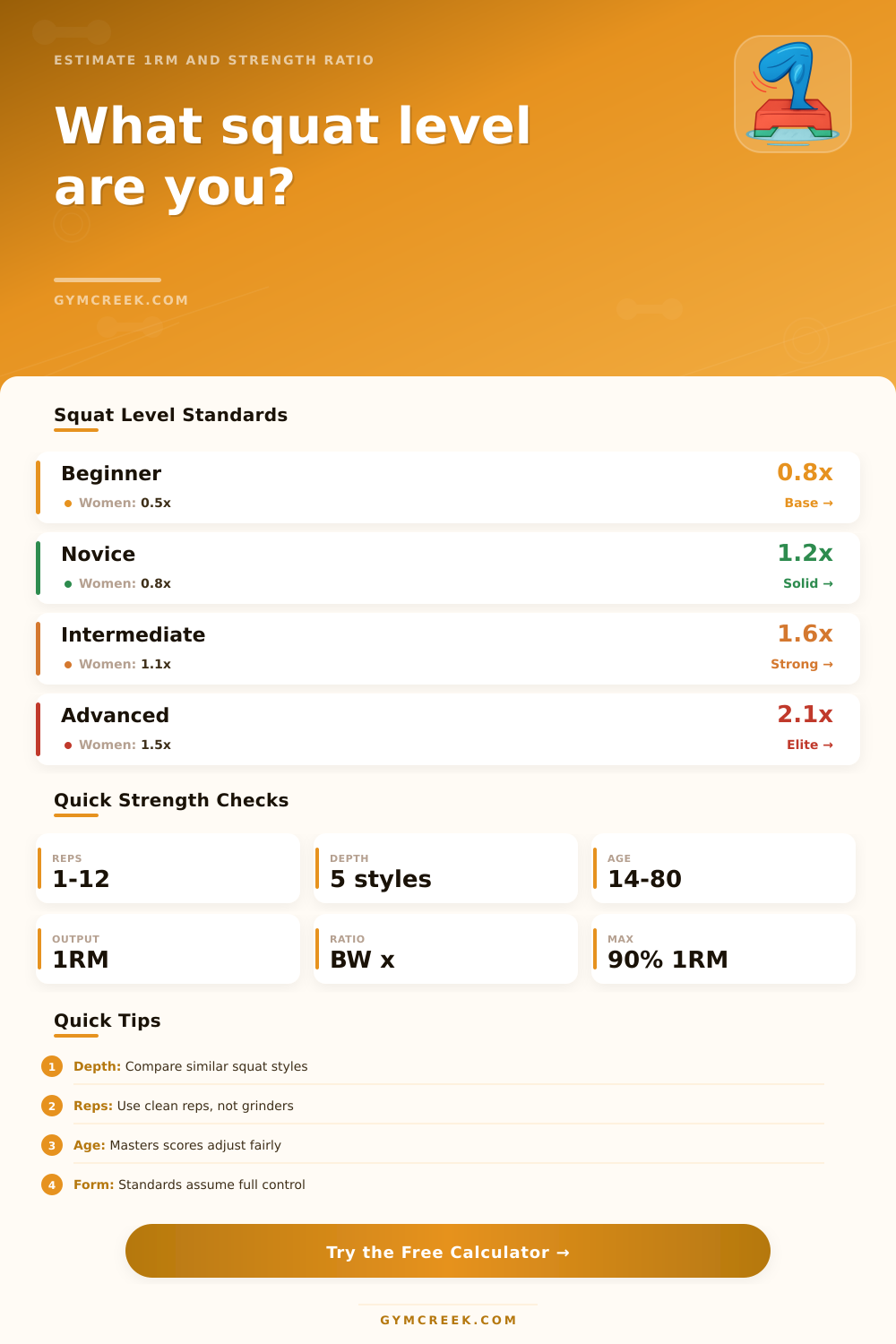
🎯Bodyweight Ratio Standards
| Level | Men Back Squat | Women Back Squat | What It Usually Means |
|---|---|---|---|
| Untrained | Under 0.80x | Under 0.50x | Learning bracing, balance, and repeatable depth. |
| Beginner | 0.80x-1.19x | 0.50x-0.79x | Can train the lift consistently with basic technique. |
| Novice | 1.20x-1.59x | 0.80x-1.09x | Strength is clearly above casual gym exposure. |
| Intermediate | 1.60x-2.09x | 1.10x-1.49x | Solid trained standard for many recreational lifters. |
| Advanced | 2.10x-2.59x | 1.50x-1.89x | Requires years of focused squat practice. |
| Elite | 2.60x+ | 1.90x+ | Competitive strength relative to bodyweight. |
⚙Style and Depth Factors
| Input Choice | Factor | Why It Matters | Calculator Use |
|---|---|---|---|
| Low-bar back squat | 0.96 | Often allows heavier loads through leverage. | Reduced slightly for high-bar comparison. |
| High-bar back squat | 1.00 | Baseline back squat standard in this tool. | No style correction. |
| Front squat | 1.18 | Front squat is usually lighter than back squat. | Raised to a back-squat equivalent. |
| Safety bar squat | 1.08 | Torso position often limits load for many lifters. | Raised moderately for comparison. |
| Partial depth | 0.85 | Shorter range usually inflates load. | Discounted for full-depth standards. |
📝Rep and Formula Reference
| Input | Formula / Rule | Best Range | Notes |
|---|---|---|---|
| 1 rep | Actual load | Heavy singles | Most direct if depth and judging are consistent. |
| 2-8 reps | Epley: load x (1 + reps / 30) | Main estimate | Reliable for clean strength sets near failure. |
| 9-12 reps | Blended Epley-Brzycki | Higher reps | Softens overestimation from endurance-heavy sets. |
| RIR adjustment | Reps plus reserve reps | Submax sets | Converts a non-max set into a probable max-rep set. |
| Training max | Adjusted 1RM x 90% | Programming | Useful for conservative percentage work. |
💪Age and Experience Context
| Factor | Typical Range | Calculator Role | Interpretation |
|---|---|---|---|
| Age 18-39 | 1.00 | Baseline | No age correction is applied. |
| Age 40-49 | 1.04-1.08 | Masters adjustment | Compares output with a small age allowance. |
| Age 50-59 | 1.10-1.16 | Masters adjustment | Useful for fairer relative ranking. |
| Age 60+ | 1.18-1.30 | Masters adjustment | Shows how the lift compares in later training years. |
| Experience | Beginner-Elite | Expectation check | Flags whether level is ahead of typical time trained. |
💡Calculation Tips
A squat level calculator are a tool that you can use to measure your squat strength. The tool collects data about your body and your squats to make a report of your strength as compared to your bodyweight and experience. Additionally, the tool can compare one squat session to another individual’s strength levels.
Your inputs into the squat level calculator is important to your result. Your sex will influence the report outcome, as men and women has different strengths. Your age will impact your results, as older individuals have less strength in their connective tissue than younger individuals.
How to Use a Squat Level Calculator
Your bodyweight is required to calculate your strength to bodyweight ratio, which is the single most important strength measurement. Finally, your training experience will allow the calculator to understands how to compare your results with those of others with similar experiences; new lifters have less strength than those who have trained for years. Factors like your squat style and depth will alter the outcome of the calculator.
Low-bar back squats allows for lifting of more weight than squats of any other type. Front and goblet squats will provide lower results than back squats. Additionally, the calculator applies small corrections for difference in squat depth; it aims to be fair to all user.
The calculator will provide several different results. The calculator will display your one-repetition maximum; this represents the maximum weight that you can lift for one repetition of a squat. The bodyweight ratio will tell you how your strength compare to others of the same bodyweight.
Your strength level will show a term like beginner, intermediate, or elite, based on your bodyweight ratio. The training maximum is a weight you can use to program your workout. Finally, the age-adjusted comparison will provide you with an idea of whether your strength level are high or low for an individual of your age.
The bodyweight ratio is the most important and more useful value provided by the calculator. A squat of 300 pounds is more impressive for a 150-pound individual than it is for a 220-pound individual. By removing the advantage of weight, the bodyweight ratio provides a more accurate comparison of strength between individuals of all size.
The conditions of your training are different than those of the calculator. The calculator does not account for factors like fatigue, sleep, or even the condition of the gym. Therefore, it is only beneficial to use the calculator every few month to monitor your development.
One of the most common mistake with the calculator is using numbers from different types of squat sessions to compare them. High-bar squats will always produce lower numbers than low-bar squat sessions. Both types of squat are valid for those of different strength levels; however, they do not measure the same strength.
To produce the most honest results, stick to one type of squat. Another common mistake is treating the one-repetition maximum as an absolute fact. The formula used calculate one-repetition maximums for sets of two to eight repetitions.
Twelve repetitions will always produce an inaccurate result from the calculator, as they require a level of endurance that is different than the strength required for sets of eight repetitions or less. The calculator makes an adjustment for reps in reserve, but only if you can provide an honest answer to how many more repetitions you could of performed. The tables to the side of the calculator will provide you with context for your results.
These tables includes the strength levels for men and women and for the different types of squats. These tables will help you understand the factors that influence your result. The experience level will act as a reality check for your results.
An individual with six months of experience will not receive a result of “advanced” strength level; they should review their input for accuracy. Age adjustment are used for those of different ages because the strength of an older individual is not to be compared with that of a younger individual; the bodys connective tissues naturaly weaken as the individual age. An older individual with a novice strength-to-bodyweight ratio indicate different levels of effort than a younger individual with the same ratio.
The outputs from a squat level calculator help an individual make better programming decision for their training. The training maximum will allow you to program your training with an understanding of the maximum strength that you can safely produce. Additionally, the target for the next level will provide you with a goal that you can strive to achieve.
The target will help structure your training goals for the upcoming training season. The most important outcome of utilizing the squat level calculator is becoming familiar with your training data. Over time, you will be able to recognize the effect that change in your squat style and depth have on your results.
Additionally, you will recognize the difference between a modest result and one that indicates real and significant progress in your squat strength. While the standards for strength levels are a point of comparison to the strength of others, the calculator will allow you to see how strong you are. You are the individual who make the training decisions, not the calculator.