Weight Training Load Calculator
Estimate weekly tonnage, hard-set exposure, effort-adjusted workload, tempo time under tension, and recovery demand from sets, reps, load, RPE, tempo, and training frequency.
📌Presets
Each preset uses a real training scenario with different loading, RPE, tempo, weekly frequency, and lift type so the workload profile changes meaningfully.
⚙Calculator
Training load snapshot
Enter your work sets to estimate weekly training load.
📊Load Metrics
📑Reference Tables
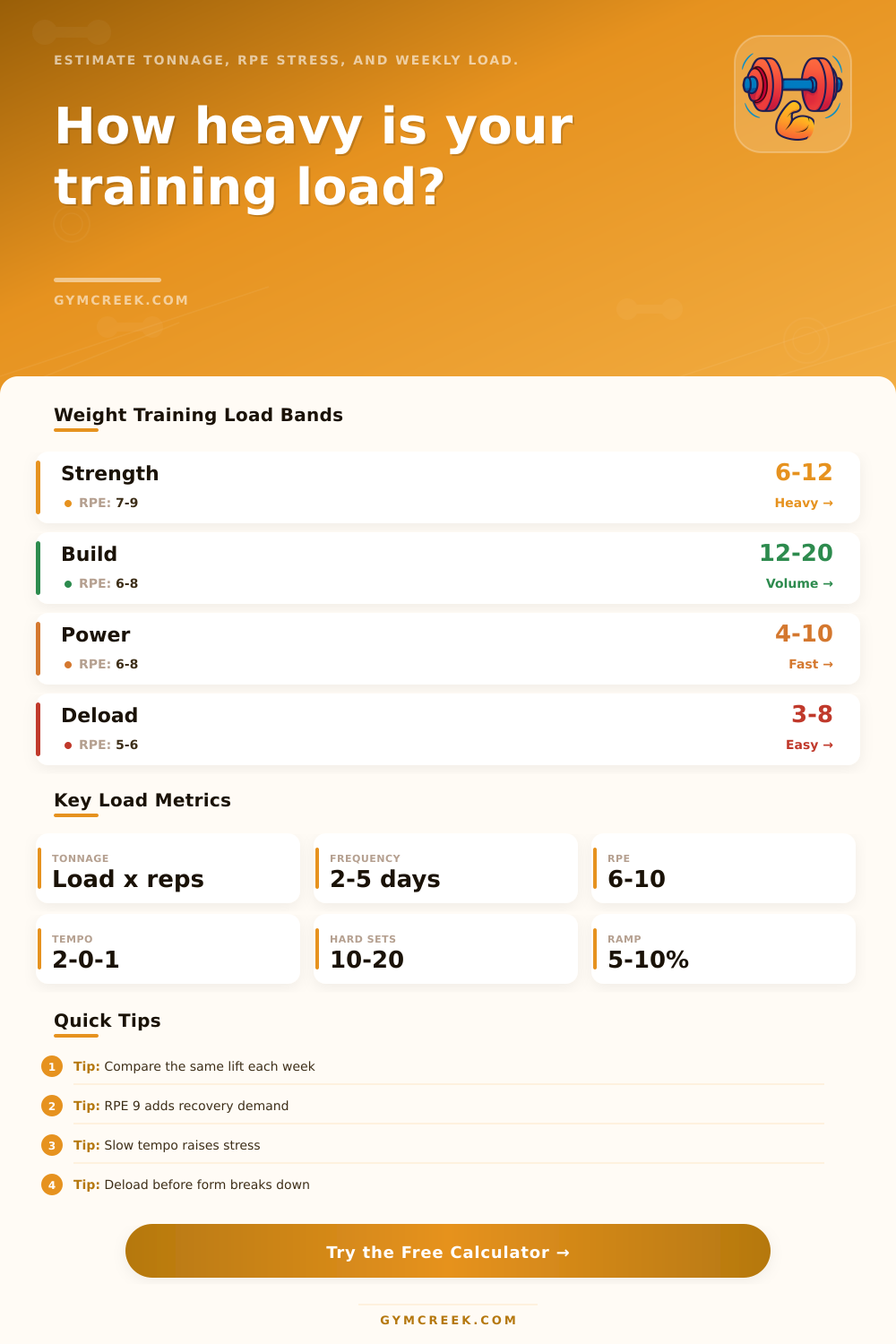
| Goal | Typical hard sets | Average RPE | Use |
|---|---|---|---|
| Strength | 6 to 12 per lift | 7.5 to 9 | Heavy practice with recoverable volume |
| Hypertrophy | 10 to 20 per muscle | 6.5 to 9 | Enough volume near failure to grow |
| Power | 4 to 10 per lift | 6 to 8 | Fast reps with low fatigue |
| Deload | 3 to 8 per lift | 5 to 6.5 | Keep pattern, reduce stress |
| RPE | Approx RIR | Stress multiplier | Training meaning |
|---|---|---|---|
| 6 | 4 reps | 0.88 | Technique or speed work |
| 7 | 3 reps | 0.96 | Recoverable working sets |
| 8 | 2 reps | 1.04 | Productive hard work |
| 9 | 1 rep | 1.14 | High fatigue, plan recovery |
| 10 | 0 reps | 1.25 | Maximal effort |
| Tempo style | Rep seconds | Multiplier | Best use |
|---|---|---|---|
| Explosive | 1 to 2 sec | 0.90 to 0.96 | Power and speed |
| Standard | 2.5 to 4 sec | 1.00 to 1.08 | General strength |
| Controlled | 4.5 to 6 sec | 1.10 to 1.20 | Hypertrophy focus |
| Slow | 6 plus sec | 1.22 plus | Low-load tissue stress |
| Metric | Formula | Inputs | Purpose |
|---|---|---|---|
| Tonnage | Load x reps x sets x slots | Load, reps, sets | Mechanical volume |
| Weekly tonnage | Session tonnage x frequency | Tonnage, sessions | Weekly load trend |
| Epley 1RM | Load x (1 + reps / 30) | Load, reps | Intensity anchor |
| Adjusted load | Tonnage x RPE x tempo x lift | All inputs | Stress comparison |
| TDEE | BMR x activity | Body size, age | Recovery context |
💡Tips
The training load for an individual lifter is often difficult to measure, yet training load is important to track in that the training load for a given training sessions will determine how much fatigue the lifter feels after those training sessions. A lifter may feel that they had a succesful training session, but they may also feel uncertain about whether the training session justified the fatigue that they feel two days later. A training load calculator allow for an individual lifter to calculate their weekly tonnage, effort, and recovery demands, and it can mathematically calculate those values once the lifter enters the number of sets, reps, the load that was used during the training sessions, the RPE utilized during the sessions, the tempo for each exercise, and the frequency of those training sessions.
Thus, by using the calculator, the lifter dont have to guess at their training load calculations. \par While many lifters utilize the load of the weights that they lift as well as the number of reps that they lift, those two value are often insufficient in determining total training load over time. Using only the weight and reps values is difficult to implement for lifters due to the different costs of systemic loads that different lifting exercises place upon the body, the different levels of stress that the lifts can place upon the nervous system, the different lengths of rest periods that lifters utilize, and the different ratings of perceived exertion that they can utilize during their training.
How a Training Load Calculator Helps Lifters
For instance, an individual may perform one type of bench press with a certain RPE and three-second lowering phase, but feel that performing a different type of bench press of the same load but with a different RPE and tempo may have placed more or less stress upon their body than the first type of bench press. \par The calculator utilizes several different input fields to reflect the different factors that contribute to the load that an individual lifter places upon their body. The body weight and body height fields are used to determine the recovery demands of the lifter; lifters with a larger frame or who are of an older age may require more recovery after performing the same amount of tonnage as lifters with smaller frames or younger ages.
The training goal fields are used to indicate whether the lifter is pursuing a strength program, a hypertrophy program, an endurance program, or a power program; each program has a different value of the number of sets of heavy lifting that is performed compared to programs that focus upon lower weights and higher reps. Finally, the lift patterns that are entered into the program are used to reflect the fact that different lifts have different multipliers; lifts that utilize more body mass, such as deadlifts and squats, have higher multipliers than lifts that utilize less body mass, such as bicep curls or lateral raises. \par Additionally, the tempo at which the sets of weights are lifted is another field that is used within the load calculator; tempo impacts the amount of fatigue that is placed upon the body.
For instance, lowering the weight three seconds before lifting it may add fatigue to the body even if the tonnage that is lifted is the same as weights that are lifted with a normal tempo. The number of times that an exercise is performed each session is another field in the program; for instance, lifting twice each session twice a week may place different stress upon the body than lifting four times once each week. \par The outputs of the calculator can be used to determine a variety of different calculations for the lifter.
One output field calculates the tonnage that is lifted each week; this value can be used to determine trends in the amount of tonnage that the lifter lifts over time. Another output calculates the load score for the lifter, which considers the effort, tempo, and lifts that are performed each week to calculate the total amount of training stimulus that is placed upon the body during that period of time. Additionally, two other metrics calculate the number of sets that are included in a lifter’s training program and an index that rates how much fatigue should be experienced by the lifter after training; both of these metrics can provide the lifter with a decision as to whether they should take a deload period for their training program.
A deload period can be taken before an individual’s form or motivation begins to decline with their lifting program. Thus, although the outputs of the calculator do not replace the lifters feelings after training, they do provide an external reference for the lifter if they often feel differently after training than they should due to sleep or other life stresses. \par Additionally, many lifters may become enmeshed in attempting to increase their tonnage without considering the effect that increasing RPE or changing tempo has upon training stress.
For instance, lifting a set of weights to an RPE of nine with a three second lowering phase may be more stressful on the body than lifting two sets of the same weight to an RPE of seven. Thus, the calculator makes this type of effort visible to the lifter, which allows for the lifter to make adjustments to any of those variables rather than solely to tonnage. Another common mistake that lifters can make is treating all lifting exercises as if they are the same; the calculator does not treat all types of lifts as the same.
For instance, an individual may increase the number of sets performed for rows and isolation exercises while keeping the number of sets for deadlifts the same; the lifter may then wonder at a later date why their recovery from those training sessions is more difficult. Thus, the calculator’s use of different stress multipliers according to exercise type makes sure that the body’s fatigue and recovery demands are accurately reflected in the calculator’s different output fields. \par Finally, the recovery context of an individual lifter is another important factor in their training program; thus, fields for activity level outside of training and age are included in the calculator.
The level of fatigue that an individual feels after training can differ according to the activities that the individual performs outside of the gym; for instance, an individual that sits at a desk for most of their waking hours and whose sleeping cycles are normal may have a different level of fatigue after performing the same amount of training than an individual that works shift jobs and has young children to care for at the same hours as the individual’s sleeping cycles. Thus, while the calculator does not know the specific nutrition and sleeping habits of the lifter, it does provide an individual a starting point to evaluate whether the training program fits the individual’s lifestyle. \par Additionally, the reference tables located on the calculator allow for the lifter to review additional information regarding the lifter’s goals for training and the RPE that they desire to utilize when lifting.
The reference tables provide information regarding the tons of the typical number of sets of each exercise that are performed by lifters with different training goals; thus, each lifter can use these tables to ensure that their training goal is met with their current training program. Additionally, the reference tables also provide information on how RPE maps to the reps in reserve that an individual can perform in their training as well as the stress multipliers that their body may place upon their body during that period of time. These two reference tables provide an individual lifter a way of determining whether their RPE and sets are appropriate for their training goal.
\par Another use of the calculator is in being able to compare the same type of lifting exercise within two different weeks; squats can be compared to other squats, or bench presses can be compared to other bench presses. Additionally, those comparisons can utilize any of the output fields to determine whether the lifter needs to change any of the variables related to their lifting program. For instance, if the adjusted load score increases but the lifter feels no difference in their performance of the indicated type of lifting, then the lifter can decide to adjust the load that is lifted, the number of times that the exercise is performed within each session, or the tempo at which the sets are lifted.
Thus, the use of such a calculator allows for an individual to recognize when the program’s inputs are not matching the programs outputs (how the lifter feels after performing the programs exercises). Thus, recognizing this difference helps to inform the lifter as to when their training program is finished or when they may need to adjust any external factors regarding their training program.