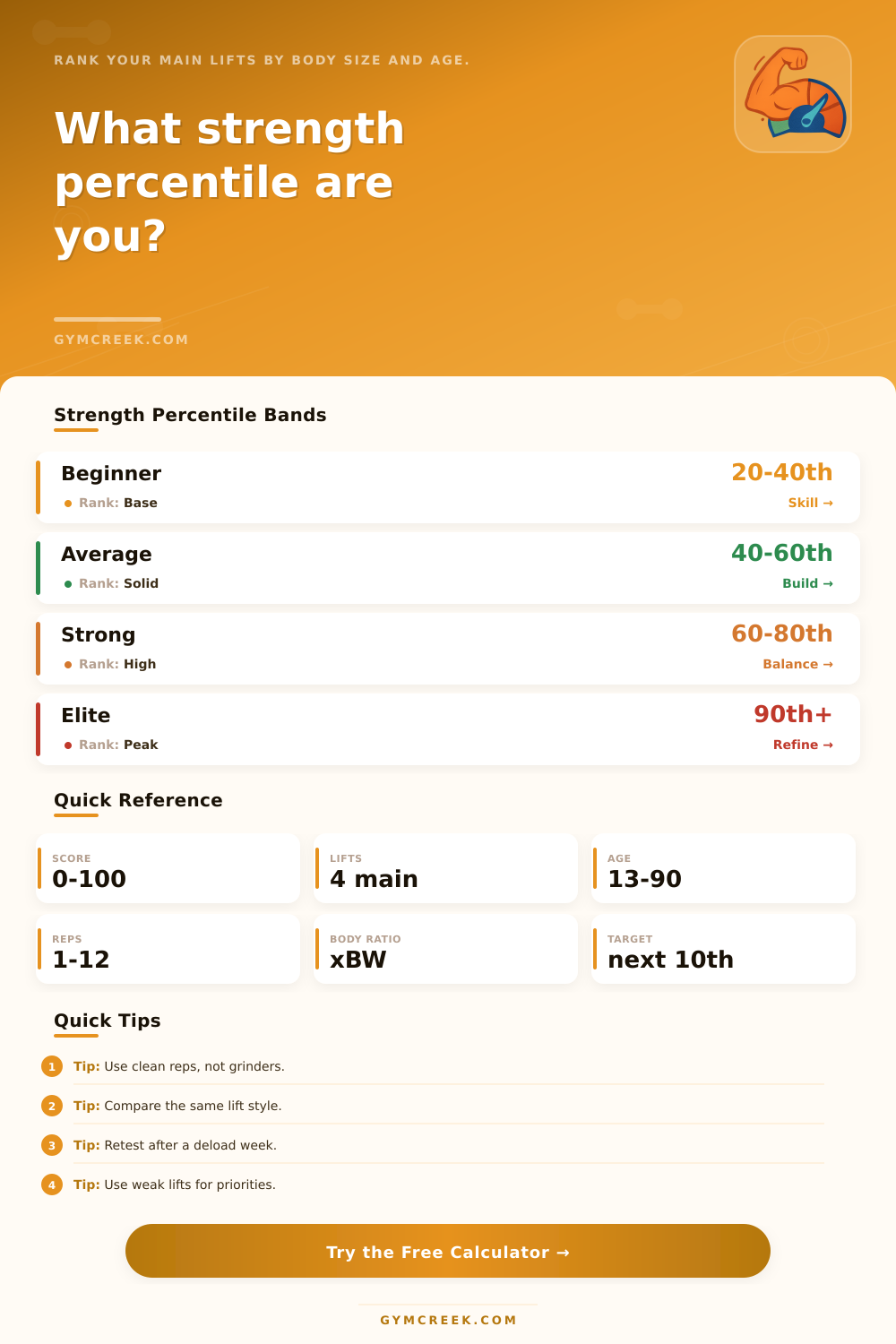
Strength Percentile Calculator
Compare squat, bench press, deadlift, and overhead press strength against body-weight-based standards, then see an estimated percentile, strongest lift, weak point, and next target.
📌Presets
Each preset loads a complete body size, demographic, lift set, rep range, and comparison population so the percentile shifts in a realistic way.
⚙Calculator
Strength percentile snapshot
Enter your lifts to estimate an overall strength percentile.
📊Strength Metrics
📑Reference Tables
| Lift | Novice | Intermediate | Advanced | Elite |
|---|---|---|---|---|
| Squat | 0.9x BW | 1.4x BW | 1.9x BW | 2.4x BW |
| Bench press | 0.7x BW | 1.0x BW | 1.4x BW | 1.8x BW |
| Deadlift | 1.1x BW | 1.7x BW | 2.3x BW | 2.8x BW |
| Overhead press | 0.45x BW | 0.65x BW | 0.90x BW | 1.15x BW |
| Lift | Novice | Intermediate | Advanced | Elite |
|---|---|---|---|---|
| Squat | 0.55x BW | 0.95x BW | 1.35x BW | 1.75x BW |
| Bench press | 0.35x BW | 0.60x BW | 0.90x BW | 1.20x BW |
| Deadlift | 0.75x BW | 1.25x BW | 1.75x BW | 2.20x BW |
| Overhead press | 0.25x BW | 0.40x BW | 0.60x BW | 0.80x BW |
| Band | Percentile | Composite score | Training meaning |
|---|---|---|---|
| Developing | Under 40th | Below 40 | Build repeatable technique first |
| Average | 40th-60th | 40-60 | Solid recreational strength |
| Strong | 60th-80th | 60-80 | Above typical gym baseline |
| High level | 80th-95th | 80-95 | Advanced relative strength |
| Elite range | 95th+ | 95+ | Rare strength profile |
| Item | Formula | Best range | Why it matters |
|---|---|---|---|
| Estimated 1RM | Load x (1 + reps / 30) | 1-10 reps | Converts top sets to maxes |
| Relative strength | e1RM / body weight | All lifts | Normalizes body size |
| Age factor | Ratio / age curve | Adult lifters | Adjusts expectation by age |
| Balance index | Weak score / strong score | 4-lift profile | Flags uneven development |
💡Tips
Strength is the measurement of how much weight a persons can move. People can recognize strength in their daily lives when they find themself struggling to perform tasks like carrying groceries. Strength is an important concept to understand because recognizing how strong a person is allow them to understand if they need to increase the practice of certain movements.
A person can use a strength calculator to determine how strong they are in comparison to other individual that have similar body sizes, ages, and strength training histories. By comparing an individual’s strength to others, that individual can understand if their strength are developing at a normal rate. To determine an individual’s strength, the strength calculator will require that person to input a few different parameters.
How to Use the Strength Calculator
Those parameters include the individual’s lift numbers, body weight, age, and sex. Additionally, those individuals must also select their training experience level and the group of strength athlete that they wish to compare themselvess to. The calculator will use body weight to normalize the individual’s lift numbers, allowing individuals that weigh more to not be automatically consider stronger than those individuals that weigh less.
Age will be used to factor in the normal age-related decline of strength, as strength typically decline after age fifty. Sex will factor into the calculation to account for differences in muscle mass between men and women, as well as differences in the ratio of an individual’s upper body strength to their lower body strength. Finally, the individual’s training experience and the type of strength athletes that they are comparing themselvess to will factor into the calculation of their strength; those who train in commercial gyms typically have more higher strength than powerlifters, for example.
The output of the strength calculator will provide several different form of information about the individual’s strength. The output will include information regarding the individual’s overall percentile for strength, their strength score, their strongest lifts, their weakest lifts, and the target lift that they should aim for in improving their lifts. These interpretations of the individual’s strength can help to provide information regarding the balance of their training program.
For instance, if the individual has a high percentile but their single lowest lift score is relatively low, it indicates that their training program is unbalanced. Another example would be if the individual’s percentile is relatively low but their lifts are all even in strength, which would indicate that they are making steady, even improvements to their strength. Another value provided by the calculator is the balance index, which provides a measure of the spread between the individual’s different lifts; maintaining balance in strength is important to avoid potential injury to that individual.
The reference tables include information regarding body-weight ratios for individuals of each strength category; those strength categories include novice, intermediate, advanced, and competition strength athletes. These tables are created based off data from thousands of strength athletes from different age groups, sexes, and backgrounds. For example, men who can perform bench presses at the rate of 0.9 times their body weight are considered to be novice athletes.
Men who can perform bench press exercises at rates of 1.4 times their body weight are considered to be intermediate athletes. These reference tables allow for athletes to understand the different strength thresholds in each category, which can allow for those athletes to create goal for themself. Based on the individual’s strength scores, the individual can determine where to direct the individual’s training efforts.
For instance, if the individual’s overhead press score is lower than their scores for other lifts, the individual should focus more on their overhead press strength. Additionally, individuals who have taken a lay off from their strength training can use the strength calculator’s “returning” experience to adjust the calculation for any decline in strength that the individual may have experienced during their lay off from training. Additionally, the individual may have made some error in their self-assessment of their strength; some of those errors include comparing strength exercises of different conditions.
For instance, comparing a competition bench press exercise score to a gym bench press exercise may inflate their numbers; they may also use different strength-equipment like a belt or knee wraps. Additionally, their number of repetitions of their bench press exercises may also impact the individual’s score; the strength calculator uses a formula to calculate an individual’s one-repetition maximum from a set number of repetitions, but that formula is best used within a narrow range of repetitions; using numbers outside of that range of repetitions may introduce error to the individual’s calculation of their strength. Another factor that can influence the individual’s strength score is their age.
For example, while an individual may have a relatively low overall score for the number of pounds that they can lift in exercises like the deadlift, a 55-year-old individual who can lift 1.6 times their body weight is performing well compared to other individuals of the same age. An older age group has lower requirement for their strength scores; maintaining their strength as an adult requires more effort than young children, for instance. Thus, the age factor is incorporated into the calculation of an individual’s strength score.
Other factors that may impact an individual’s strength levels include height. Individuals of greater heights require more absolute strength because they have longer lever with which to perform their exercises. Thus, height is another factor that can be incorporated into an individual’s calculation of their strength.
Finally, body mass index is related to an individual’s strength because an individual’s height and weight influence their body mass index; an individual with a high body mass index may be able to lift more weight than an individual with a low body mass index, but that individual may have lower relative strength to their body weight. The numbers provided by the strength calculator are estimations only, and are not to be used as medical advice for those individuals. The numbers provide a map for an individual’s training efforts, but do not provide a specific route to follow.
Instead, using the strength calculator, the individual should retest their strength every few months, and ensure that their percentile and balance index are increasing as intended by the individual. Thus, changes to an individual’s absolute strength are more important than knowing their strength score on one particular day. Additionally, the strength calculator helps to remove the need for an individual to perform the calculations themselves; the calculator provides for those individual calculations to occur automatically, allowing the individual to focus upon what the scores mean for their training program.