RPE Calculator
Estimate reps in reserve, effective set intensity, target training weight, session RPE load, and readiness-adjusted effort from your set details and daily recovery markers.
📌Presets
Presets load realistic RPE, reps, load, duration, heart rate, soreness, fatigue, and sleep profiles so the output changes across strength, conditioning, and deload days.
⚙Calculator
RPE training snapshot
Enter your set and session details to estimate intensity, training stress, and next-set load.
📊RPE Metrics
📑Reference Tables
| RPE | RIR | Set feel | Best use |
|---|---|---|---|
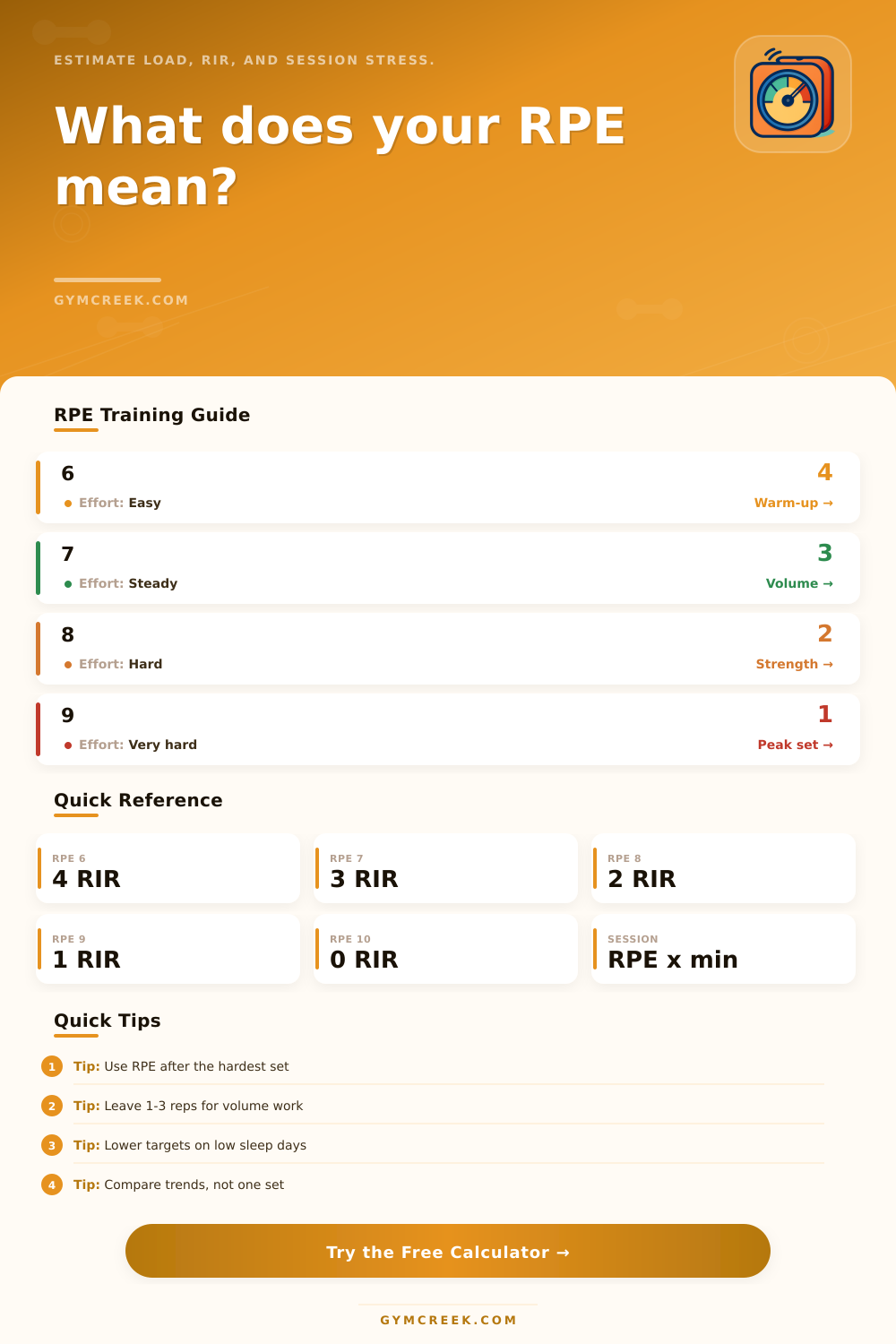
| 6 | 4 reps | Easy speed | Warm-ups, deload |
| 7 | 3 reps | Moderate | Technique volume |
| 8 | 2 reps | Hard but clean | Productive work |
| 9 | 1 rep | Near limit | Heavy top set |
| 10 | 0 reps | Maximal | Testing only |
| Goal | Main range | RIR | Notes |
|---|---|---|---|
| Power | RPE 6-7 | 3-4 | Keep bar speed high |
| Hypertrophy | RPE 7-9 | 1-3 | Use repeatable effort |
| Strength | RPE 7.5-9 | 1-3 | Heavy without grind |
| Conditioning | RPE 6-8 | Varies | Match session purpose |
| Deload | RPE 5-6.5 | 3+ | Reduce stress |
| Session load | Stress | Example | Response |
|---|---|---|---|
| Under 300 | Low | Easy lift | Normal recovery |
| 300-500 | Moderate | Volume day | Monitor fatigue |
| 500-750 | High | Hard session | Plan recovery |
| Over 750 | Very high | Long hard day | Avoid stacking |
| Formula | Variables | Output | Use |
|---|---|---|---|
| RIR mapping | 10 - RPE | Reserve reps | Effort estimate |
| Epley adjusted | Load, reps, RIR | Estimated 1RM | Strength sets |
| Foster load | RPE x minutes | Session load | Training stress |
| Karvonen | HR, rest HR, age | HR reserve | Cardio context |
💡Tips
Rating of Perceived Exertion (RPE) are used to determine how hard an individual feels that a given exercise routine is. Individuals may feel strong with the same weight every day. However, an individual might feel strong on some days and more weak on other days.
An individual may feel strong because they had a good night sleep. However, they may feel weaker if they did not have sleep the previous night. An individual’s body change every day.
How to Use RPE to Adjust Your Workouts
Therefore, the weight that an individual lift can change from day to day. An individual can use the concept of autoregulation to adjust the weights that are lift based on how they feel on each given day. Autoregulation is the practice of changing a workout routine based on the readiness of an individuals body.
RPE is also related to a concept called Reps in Reserve (RIR). Reps in Reserve is a term used to describe the numbers of repetitions that an individual could have performed within a routine before reaching total muscle failure. Suppose an individual performs a routine of squats.
If an individual could have performed two more set of squats before muscle failure, then there RIR would be two. If an individual performs a routine with an RPE of eight, that would indicate that the individual has two reps in reserve. RPE allow an individual to assign a number to how hard an individual is exerting effort during a specific set of weights.
There are a variety of factors that impact an individuals RPE. The quality of an individuals sleep, the number of reps that an individual feels sore from the previous day, and the level of fatigue that an individual feel will all impact the amount of weight that an individual can lift. An individual that feels tired will be able to lift less weights than an individual that feels strong.
The weights may not have been lift with as much strength, but the change in weights is a reflection of an individuals readiness to perform those exercise. By using the concept of RPE, an individual will naturaly avoid lifting too much weight when they are tired from exercise the previous day. An individuals training goal will also impact their use of the RPE concept.
An individual that trains to gain strength will perform exercises that use high intensity yet fewer repetitions. An individual that aims to gain strength through hypertrophy will perform exercises with higher repetition. Hypertrophy occurs when an individual performs many repetition with weights that are challenging to lift but not to the point of total muscle failure.
An individual must select an apropriate RPE value based on their goal for training. Another metric that an individual can use to understand the impact of their training routine is session load. Session load is the product of the effort that an individual put in their training routine multiplied by the length of time that they train.
An individual that has high session load for a long period of time may be overtraining their body. An individual can use a reference table to calculate session load to determine whether their session load is low, moderate, or high. Using session load to track an individuals training will allow that individual to plan their training and recovery from exercise.
The amount of rest that an individual take between sets will impact the RPE of that next set. An individual that takes little rest between sets will find that the next set of exercises will have a higher RPE. Conversely, an individual that takes a long rest period between sets will find that the RPE of the next set is lower.
An individual must keep track of the amount of rest that they take between sets to ensure that any comparison of RPE are based on individual sets with similar levels of readiness. Using RPE requires some practice as it is an estimate of an individuals exertion in their workouts. An individual may incorrectly estimate their RPE at the beginning of a training routine.
An individual may feel that a set was an RPE 7, yet with time and memory, find that they actualy exerted themselves to an RPE 9. However, as they continue to train with the same routine, their ability to recognize their RPE will improve. An individual can use RPE in conjunction with other training metric to track their trends in strength and ensure that the weights that they lift from the gym are within the strength of there body.