10 Rep Max Calculator
Estimate your 10 rep max from a recent set, compare 1RM formulas, adjust for reps in reserve, and build practical training loads for hypertrophy or strength blocks.
📌Presets
Each preset loads a realistic lift, bodyweight, set performance, RIR, goal, and rounding style so the 10RM estimate changes like it would in a training log.
⚙Calculator
10RM strength snapshot
Enter a recent hard set to estimate your 10 rep max and related training loads.
📊Strength Metrics
📑Reference Tables
| Reps | Typical percent | Training use | Notes |
|---|---|---|---|
| 1 rep | 100% | Test strength | Highest fatigue |
| 3 reps | 90 to 93% | Heavy strength | Needs skill |
| 5 reps | 85 to 87% | Strength volume | Common benchmark |
| 8 reps | 78 to 81% | Heavy hypertrophy | Useful bridge |
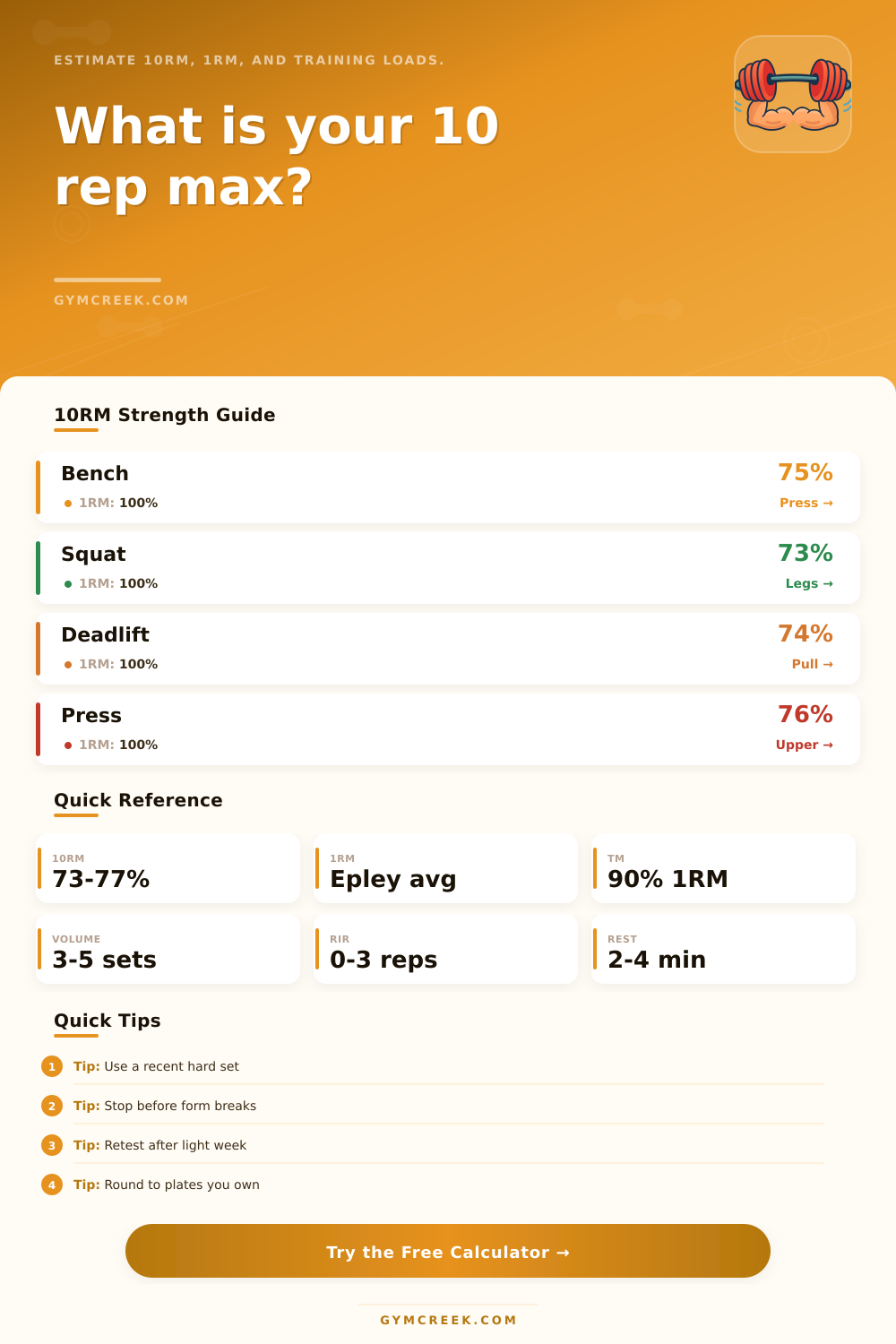
| 10 reps | 73 to 77% | Hypertrophy max | Main estimate |
| 12 reps | 67 to 70% | Volume work | More endurance bias |
| Formula | Equation | Best range | Why included |
|---|---|---|---|
| Epley | Weight x (1 + reps / 30) | 1 to 10 reps | Simple average anchor |
| Brzycki | Weight x 36 / (37 - reps) | 1 to 10 reps | Often conservative |
| Lander | 100 x weight / (101.3 - 2.67123 x reps) | 1 to 12 reps | Formula cross-check |
| Adjusted average | Average with RIR added | Hard sets | Used for final result |
| RIR | Meaning | Adjustment | Use case |
|---|---|---|---|
| 0 | True max effort | No extra reps | Testing day |
| 1 | One clean rep left | Add 1 rep | Best training input |
| 2 | Hard set | Add 2 reps | Safer estimate |
| 3+ | Submaximal work | Add 3 to 4 reps | Less precise |
| Lift | 10RM factor | Technique cue | Estimate caution |
|---|---|---|---|
| Bench press | 75% | Pause or touch standard | Spotter helps |
| Back squat | 73% | Consistent depth | Fatigue can spike |
| Deadlift | 74% | Reset or touch-go noted | Grip may limit |
| Overhead press | 76% | No leg drive | Small jumps matter |
| Pull-up | 75% | Count bodyweight plus load | Use total system |
💡Tips
A 10 rep max calculator allow a lifter to determine the weights they should use for their training based off the weights they have lifted for a certain number of repetitions in the past. Many lifters understands the weights they lift, but they may not understand how to apply that information to form a long term training plan. A 10 rep max calculator allows a lifter to input the weight that they have lifted and the number of repetitions they performed to determine the weights they should lift in the future.
The calculator help a lifter to understand how strong they are, and it provides insight into the weights they should use for both volume and strength training. To operate the 10 rep max calculator, the lifter must input a number of different values. The weight that is placed on the barbell is just one of these values.
How to Use a 10 Rep Max Calculator
The lifter must also input the number of repetitions that were lifted and the number of repetitions left in reserve for that session into the calculator. The number of repetitions left in reserve is the number of repetitions that the lifter could have performed with the same muscles before they began to feel fatigue in those muscles. If a lifter performed eight repetitions with a certain weight but could have performed ten repetitions before feeling fatigued, they have two repetitions left in reserve.
The calculator treats these repetitions as though they were performed, which allows for the calculator to produce an estimation of strength that is as accurate as possible. Another factor that can influence the results of the 10 rep max calculator is the experience level of the lifter. Calculations are more precise for novice lifters.
An experienced lifter will require more precise calculations from the 10 rep max calculator because changes in weight will have a more greater impact on there training. The lifter can select the experience level before the 10 rep max calculator begins to calculate the weights a lifter should use, and the calculator will adjust the suggested weights for precision according to the experience level that is select. Additionally, the type of equipment and the physical readiness of the lifter will also influence the results of the 10 rep max calculator.
Using dumbbells will allow for less weight to be lifted than using barbells. Using exercise machines will allow a lifter to use more weight with dumbbells. A lifters physical readiness will fluctuate from day to day.
If a lifter is feeling tired, they will lift less weight. The 10 rep max calculator will take into account the weight that is lifted during these sessions and calculate the weights that are realistic for the readiness of the lifter during the session in which the calculator was performed. The 10 rep max calculator will provide a set of different weight values for the strength calculations that the calculator performs.
The estimated 10 rep max is the weight that can be used for hypertrophy training. However, the calculator will also calculate the training max, or 90% of the estimated one rep max. This value will limit the weights that are used for the training block that the lifter is currently being perform. Additionally, the calculator will calculate percentages for the back off from the training max that will allow for the creation of the working weights for that lifter.
These weights will be the specific weight that will be used for the sets and repetitions that the lifter performs. The training goal that the lifter desire will influence the use of the weights that are calculated by the 10 rep max calculator. If the goal for the lifter is to gain strength in their muscles, the weights that are lifted will be below the 10 rep max. However, if the lifter wishes to gain strength, the percentages of the weight will be higher, and fewer repetitions will be performed.
These types of workouts will feel heavier than hypertrophy training and require a longer recovery time. The lifter can enter the training goal into the calculator in advance, which will allow the calculator to adjust the percentages for back off from the training max to provide weights that align with the training goal of the lifter. The 10 rep max calculator will also provide a measurement of the relative strength of the lifter.
The calculator calculates the relative strength of a lifter as the ratio of the weight that is lifted to the body weight of the lifter. A lifter who weighs one hundred and eighty-five pounds and lifts a 10 rep max that equals their body weight will perform differently than a lifter who weighs two hundred and twenty pounds and who can also lift a 10 rep max that is equal to their body weight. By tracking the ratio of the weight that they lift to their body weight, a lifter can track their gains in strength.
This statistic will also allow the lifter to track whether they need to increase their strength in their technique or their physical recovery from workouts. It is recommended that an individual not use the 10 rep max calculator as a means of obtaining the most precise measurement of the strength that can be lifted by an individual. Because an individual can feel tired during the session for which they perform the calculation for the 10 rep max calculator, they may not be exhibiting their maximum strength for that session.
In other cases, they may feel exceptionally well-rested, which could allow them to produce an estimation of their strength that is too high. Instead of performing this calculation once, an individual can use the calculator after several different sessions to determine the range of weights that are strongest for that lifter. Finally, the calculator is unable to account for the age of the lifter or the capacity of their body to recover from the workouts that they perform.
Lifter who are of an older age or who have sustained an injury can take more time to warm up before performing any sets. In these cases, the suggested weights provided by the 10 rep max calculator may need to be adjust by the lifter. For example, an individual may choose to use a lighter weight for their first set of repetitions to determine how their body responds to these weights.
While this calculator can provide a map of the weights that an individual should lift, the lifter is in charge of determining how to follow the map that is provided.