9c Strength Test Calculator
Score the classic climbing strength test from bodyweight, 20 mm finger hang, one-rep weighted pull-up, core hold, and bar hang time, then compare the result with sport grade ranges and balance markers.
📌Presets
Presets load realistic climbing profiles. They are useful for checking how finger strength, pulling power, core tension, and grip endurance change the total score.
⚙Calculator
9c strength test snapshot
Enter your test numbers to estimate points, grade range, and the main strength limiter.
📊Strength Metrics
📑Reference Tables
| Points | Total weight | Example at 150 lb | Interpretation |
|---|---|---|---|
| 1 to 3 | 100% to 120% BW | 0 to 30 lb added | Building base strength |
| 4 to 6 | 130% to 150% BW | 45 to 75 lb added | Strong recreational range |
| 7 to 8 | 160% to 180% BW | 90 to 120 lb added | Advanced strength marker |
| 9 to 10 | 200% to 220% BW | 150 to 180 lb added | Elite test territory |
| Score | Movement | Hold time | What it shows |
|---|---|---|---|
| 1 to 3 | Bent-knee L-sit | 10 to 30 sec | Basic compression |
| 4 to 6 | Straight L-sit | 10 to 20 sec | Core tension under load |
| 7 to 8 | Front lever | 5 to 10 sec | Posterior-chain tension |
| 9 to 10 | Front lever | 20 to 30 sec | Elite body control |
| Score | Hang time | Grip demand | Training signal |
|---|---|---|---|
| 1 to 3 | 30 to 90 sec | Base grip | Improve consistency |
| 4 to 5 | 2 to 2:30 min | Solid endurance | Useful route base |
| 6 to 8 | 3 to 4 min | Advanced capacity | High volume tolerance |
| 9 to 10 | 5 to 6 min | Elite grip stamina | Very high endurance |
| Total score | French grade | YDS approx. | How to read it |
|---|---|---|---|
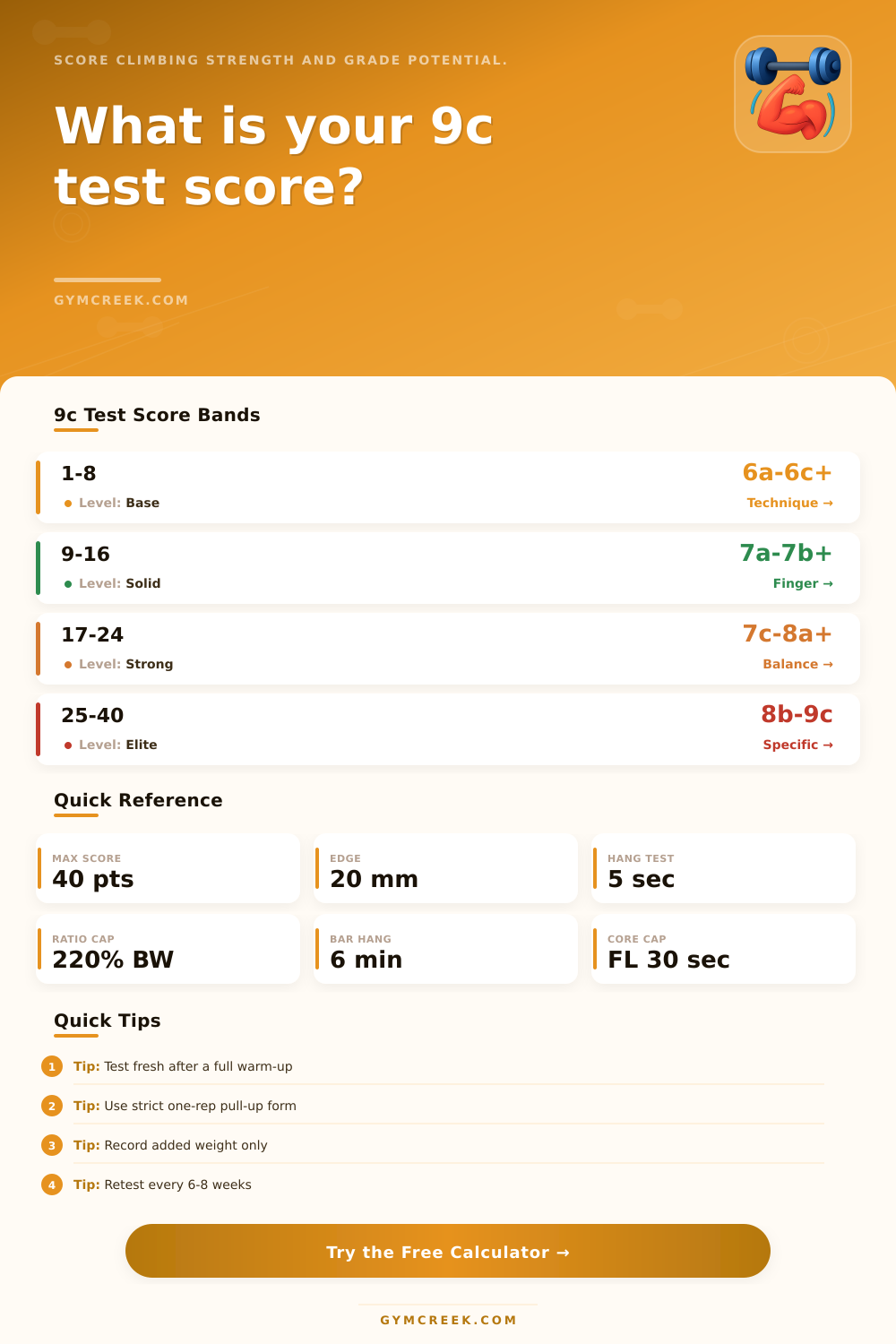
| 1 to 8 | 6a to 6c+ | 5.10b to 5.11c | Strength base is developing |
| 9 to 16 | 7a to 7b+ | 5.11d to 5.12c | Good gym strength |
| 17 to 24 | 7c to 8a+ | 5.12d to 5.13c | Advanced strength profile |
| 25 to 32 | 8b to 8c+ | 5.13d to 5.14c | Elite route potential |
| 33 to 40 | 9a to 9c | 5.14d to 5.15d | World-class test numbers |
💡Tips
The 9c strength test is used to measure four specific physical quality from the climber. The 9c strength test was created due to the fact that many climbers reaches a point with which climbing technique is no longer the limiting factor. Each of the physical qualities that can be measured with the 9c strength test are finger strength, pulling power, core tension, and grip endurance.
Each of these four physical qualities can be measured with the test to determine which physical quality is the limiting factor for that climber. Many climbers tend to compare their physical strength to the climbing routes and problems that they face in there climbing career. The routes and problems that climbers face requires both skill and strength to successfully navigate them, making it difficult for those climbers to separate the two variables.
What the 9c Strength Test Measures
The protocol for the 9c strength test separates skill from strength to provide an accurate measurement of a climber’s physical strength. The protocol involves performing a strict one-rep weighted pull-up, performing a 20 mm edge hang with added weight, performing a core position until fatigue, and a dead hang on a pull-up bar. Each movement scores a value, and the sum of the four score indicates a total score for the climber (out of 40).
That total score can be used to estimate the grade range for that climber’s sport climbing ability. The calculator presented will allow the climber to calculate there total score for the 9c strength test. Each of the inputs for the 9c strength test are important in that they represent the different physical requirements of rock climbing.
For example, the finger score measures the weight a climber can hold on a small edge, the pull score calculates the amount of additional weight a climber can lift in a single repetition, the core score measures the strength of the anterior chain through exercises like L-sits, and the hang score measures the amount of time in which a climber can hold a grip without shaking. While none of the movements for the 9c test are that of rock climbing specifically, they do cover the four main physical qualities needed for rock climbing success. The output of the 9c strength test allows for climbers to determine where they should direct their training efforts.
If a climber scores low on their finger and pull scores in comparison to there core and hang scores, for example, then the body indicates that the climber should increase their strength in these two areas rather than increasing there core strength. The scores for each physical quality also highlight the weakest link in a climber’s physical strength. The ability of the body to recognize that the scores for any of the link variables is lower than the others is another of the benefits of performing this test.
It prevents climbers from wasting their strength and time training physical qualities that they already have high levels of strength for. Many people who perform the 9c strength test make the mistake of performing it only once. If individuals only measure there physical strength once, however, they fail to take advantage of the benefits that the 9c strength test can offer them.
Because strength takes time to change, individuals should perform the test every six to eight weeks if they are climbing three to four days each week. Testing more than every six to eight weeks may lead to inaccurate scores due to the effect of fatigue or skin strength. Testing less than every six to eight weeks, however, allows for issues in physical strength to continue to develop.
The 9c strength test calculator can measure the frequency of the climbers’ climbing, and the suggestion of when to retest the climber with the 9c strength test will ensure that the measurements are consistent with one another. The score from the 9c strength test allows for climbers to compare the physical strength that they can exhibit in the context of the test to the physical strength that they can exhibit while climbing routes. The difference between the score that climbers receive on the 9c strength test and there current climbing grade can help to highlight areas of improvement in climbers.
For instance, if an individual scores high on the 9c strength test but there climbing grade is lower than the grades that can be predicted from there score, the individuals may require additional practice on rock climbing problems. The opposite scenario indicates that the climber has developed techniques that allow them to efficiently climb without relying upon there physical strength. The size of the edges on climbing problems and the grip that climbers use can impact the score that is given to each climber on the 9c strength test.
For example, if the test uses edges of 25 mm instead of the 20 mm edge required for the test, the climbers will score higher on the finger strength scores as a result. The calculator allows climbers to note the size of edges that they use for the test. Additionally, climbers are also asked whether they used an open-hand score or a half-crimp position for the strength test.
Notating these variables will ensure that each score that is measured for a climber is comparable with the scores obtained by that same climber at other times. Bouldering and sport climbing require different physical strengths than one another. The 9c strength test allows for the climber to indicate there main style of climbing and there current grade for each type of climbing.
While these answers will not impact the score that is given to that climber, the answers can help to explain that score to that climber. For instance, a boulder climber that scores high on there finger strength but low scores for there route climbing grade may have issues with transferring that strength to rock climbing problems. A sport climber with higher scores for there hang strength but lower scores for there route climbing may benefit from increasing there endurance on long routes.
The fatigue that a climber feels while performing the 9c strength test can impact there scores. For instance, if a climber performs the test after an intense day of rock climbing, there scores will likely be lower. Testing while the climber is fresh will provide the best measurements of there physical strength.
The 9c strength test calculator also asks climbers if they are feeling fresh, if they performed any light climbing in the past few days, or if they had a particularly hard day the past few weeks. These questions will help to ensure that the climbers themselves interpret the scores correctly. Because the protocol for performing the 9c strength test requires that climbers perform a true one-rep max test for both pull-ups and hang strength, the climbers will likely perform a warm up prior to performing the test.
While they may warm up for rock climbing before, this type of one-repetition maximum requirement will likely require a more thorough warm-up. Performing such a warm up will reveal the physical strength of the climbers that they may not find while rock climbing there routines. Thus, while the score is a benefit of the 9c test, the benefit of performing the warm up prior to the test is likely its primary benefit.
The 9c strength test is not a replacement for rock climbing specific skills. However, by performing the test, climbers can remove the guesswork regarding which physical qualities to emphasize in there training. For instance, if a climber finds that there finger strength to higher than there core strength, they will understand the reason for some boulder problems.
Additionally, if there total score increases from 18 to 24, for instance, they will have a method of knowing that there physical strength has increased. Thus, the value of the 9c strength test can be seen in these examples. Additionally, over time, each climber will have a series of tests that they can compare to one another, and if the variables are held constant, there physical strength will be able to develop according to the predictions of the 9c strength test calculator.