
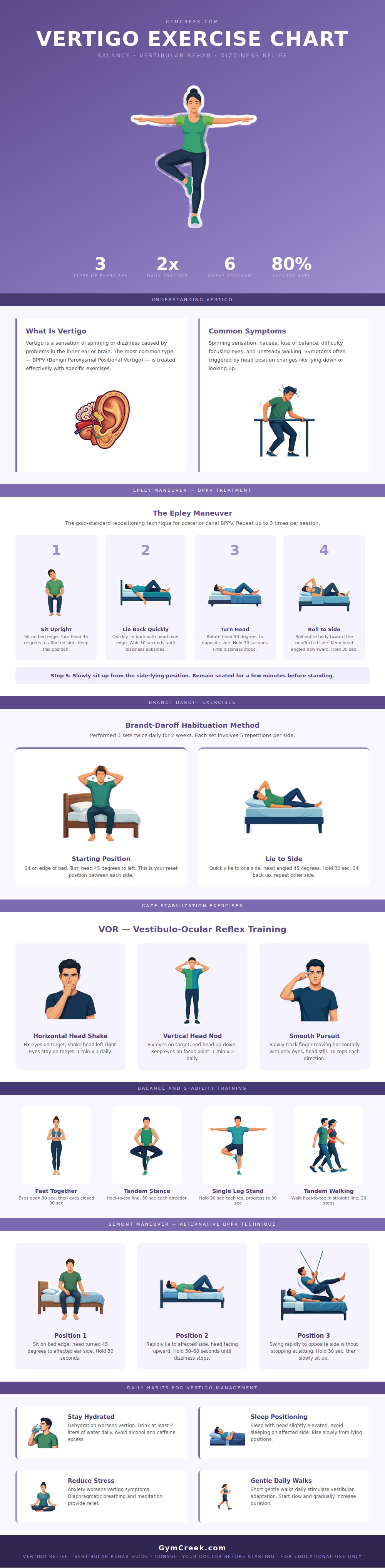
Vertigo is the sensation of spinning or feeling dizzy. Vertigo often occurs as a result of problems that exist in an inner ear of the affected individual. Many individuals who suffer form vertigo experience it when they move their head.
Yet, vertigo is often treatable through the performance of specific exercise that target either the inner ear of those individuals or the brains ability to properly process the information that the inner ear receives. One method of treating vertigo is through the use of exercises that aim to reposition the particle that are in the inner ear of an individual, such as the Epley maneuver. The Epley maneuver is often used to treat individuals who suffer from BPPV (Benign Paroxysmal Positional Vertigo), which occurs when the particles in the inner ear of those individuals move into the semicircular canal of the inner ear.
Simple Exercises for Vertigo
During the Epley maneuver, the individual that is suffering from BPPV lie on their back and turn their head towards the ear that is affected by vertigo. Following the turning of the patient’s head, the patient will lie on their back with their head hanging off the edge of a surface, maintaining this position for thirty seconds. After lying in this position, the patient will rotate their head towards the opposite direction of the ear that was previously turned, and then they will roll onto their side.
Finally, after lying into this last position, the patient will sit up. It is necessary for the patient to allow their vertigo to settle before they perform each of these movement. Often, individuals will experience relief after performing the Epley maneuver one or two times; however, performing the exercises several times during one session can lead to further improvement of the symptoms of BPPV.
Another type of exercise that may help those with vertigo is the Brandt-Daroff exercises. Unlike the Epley maneuver, these exercises dont aim to move the particles in the inner ear of an individual. Instead, the Brandt-Daroff exercises aim to help those with vertigo become accustomed to the movements that can trigger their vertigo episodes.
The Brandt-Daroff exercises involve lying quickly on one side while sitting on the edge of a bed, with the head angled towards the lying side. After lying on the side, the individual should wait until the feeling of spinning stops. After the sensation of vertigo stops, the individual should stand back up, and repeat the process on the opposite side of the body.
These exercises should be performed several times on each side of the body, and each of these exercises should be performed twice a day for several week. The consistency of performing the Brandt-Daroff exercises is important for allowing the nervous system to become accustomed to the feeling of vertigo that those individuals experience. Gaze stabilization exercises target the relationship between the eyes and the inner ear.
Because the inner ear may send information to the brain that indicates that the body is turning while the eyes are not moving, these exercises are used to allow the brain to become accustomed to these instances. Gaze stabilization exercises involve looking at a target while moving the head up, down, side to side, or nodding the head. As the brain learns to become accustomed to the differences between the inner ear and the eyes, individuals will experience less vertigo in everyday life when they are walking or looking at various sign.
Balance exercises are another form of treatment for vertigo. Balance exercises can involve standing with the feet together, standing on one leg, or standing in a tandem stance. Additionally, tandem walking, which is walking while keeping the heels of one’s shoes in contact with the heels of the other shoe, is also balance training.
Tandem walking is beneficial in that it require balance while in movement. Balance exercises can aid the body in achieving ordinary levels of steadiness. In addition to the exercises that are often prescribed for individuals with vertigo, there are also some changes that an individual can make in their everyday life that can aid their recovery from vertigo.
For instance, the individual can increase their hydration levels of their body and keep their fluids in the inner ear stable. Additionally, by rising slow from the bed or the chair, those individuals can avoid any sudden changes in the pressure of the body that may lead to vertigo. Additionally, individuals with vertigo can take walks outside to allow the inner ear to become accustomed to different environments.
Furthermore, by reducing their stress levels, those with vertigo can reduce the intensity of the sensation that they feel. Individuals may make some mistakes while performing these exercises. For instance, some individuals may find relief from the exercises, but then stop performing the exercises because they feel better.
Yet, the body and nervous system require the continuation of these exercises, even if the individual feel better. Another potential mistake with these exercises for individuals with vertigo is in the performance of the exercises with too much force or without allowing the required amount of time between each step of the exercise. Following these time intervals is essential; performing each exercise in this manner will allow for the body to properly move the particles in the bodys inner ear.
The majority of individuals will notice a significant improvement in their symptoms after six weeks of performing these exercises. After six weeks of continuing to perform the exercises, individuals will experience less vertigo, and their symptoms will fade. Through continuing to perform these exercises, individuals will allow their bodies to adjust to their inner ear, and their movements will return to feeling ordinary.
