
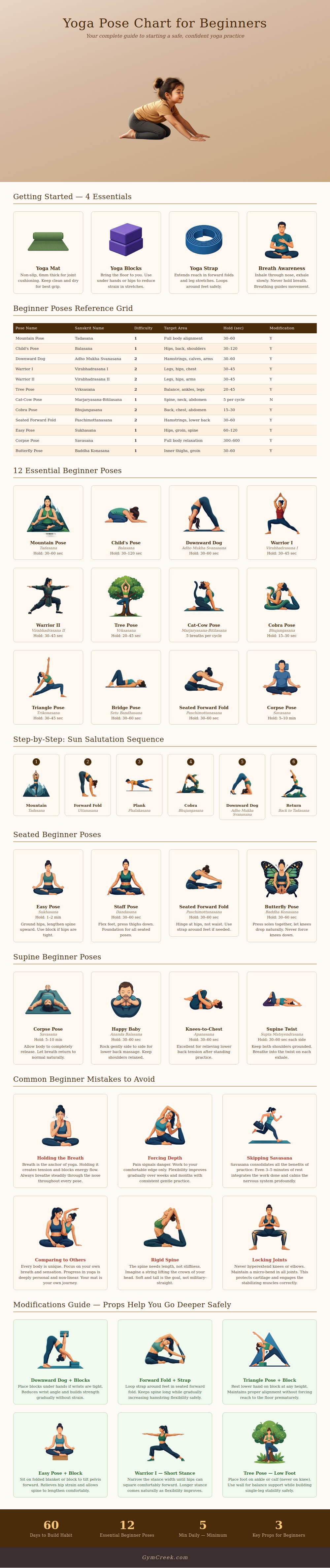
A yoga pose chart is another tool that help a person to begin there yoga practice. A yoga pose chart allows a person to learn the specific pose that they should learn within there yoga practice. For many beginners who begin to explore the world of yoga, they can feel uncertain about where to begin there practice.
Many beginners dont know how to perform the poses correct. A yoga pose chart can alleviate these concern for beginners because a yoga pose chart indicates the poses that are most important for a beginner to learn. A yoga pose chart can also show the poses that build upon one another and how a person can modify a pose to ensure that a person remain safe during there practice.
Yoga Pose Chart for Beginners
While many people often think flexibility is the most difficult element of yoga for beginners to learn, many people struggle with learning to manage there breath. A yoga pose chart can categorize the poses into different category. For example, a pose chart can display poses for individuals to learn how to even out there poses, poses that build the leg, and poses that open the hips.
A balanced yoga practice does not require many poses. However, it does require a few poses that works each of these muscles. Props can be used to even out poses and to assist individuals in performing poses correct.
For instance, an individual can utilize a yoga block to assist individuals with standing pose. A strap can also be used to even out poses when individuals are performing poses like downward dog. Props help protect the joints and they help individuals open there hips and hamstrings.
Props are a necessary component of yoga for the body to feel tight and to remain limber over time. Breath is required for each pose listed on a yoga pose chart. For each pose, individuals must learn to breathe in and out steady.
Holding the breath can lead to tension in the body. Breathing in and out with each pose allow individuals to turn each pose into part of a practice of yoga. As beginners begin to learn yoga poses, there are some mistake that are often made.
Individuals tend to lock there knees in poses like warrior pose. They rush the final resting pose at the end of there practice. Additionally, individuals often compare there body to others in there yoga class.
Using a pose chart to guide individual performance can eliminate these mistakes. For instance, individuals can learn to perform poses like warrior pose with shorter stance so that the hips do not face the ground. Additionally, individuals can perform tree pose by placing the foot on the calf so that the body remains stable.
The goal of yoga is to remain stable in each pose. The goal isnt to attempt to look perfect in each pose. The pose chart includes sun salutations as a series of poses that are to be linked together.
Sun salutations link an individual’s breath with movement like plank pose, cobra pose, and downward dog pose. Additionally, performing the poses can teach individuals how to coordinate there movements. Sun salutations can warm each individual’s spine and shoulders which allows for there remaining poses to be easier to perform.
While performing sun salutations, individuals do not need to include many round into there practice. One mindful round is more valuable then many rushed rounds of sun salutations. Individuals can incorporate sun salutations into there practice because consistency is more important then the intensity of there practice.
Incorporating short round of poses daily is better then longer round of poses. An individual’s nervous system can learn the poses with repetition. An individual’s nervous system can learn the poses with regular incorporation into there daily routine.
With the repetition of poses, each pose will become more familiar with the individual. While many individuals may not wish to include the final resting pose in there practice, it is necessary to include it in a well rounded pose practice. By lying still in the final resting pose, individuals can allow there heart rate to return to normal.
Additionally, lying in this pose allows the muscles that were tight during the pose to release some of the tension. Skipping the final resting pose is an error in an individual’s practice. This pose allows there bodies to experience the benefit of there practice.
Though there may be no visible benefit from the pose, it will allow there muscles, especially those in the shoulders, to remain relaxed for the remainder of the day.
