Sugar Calculator
Estimate daily added sugar from drinks, desserts, packaged foods, and labels, then compare the total with AHA, WHO, and calorie-based fitness targets.
📌Presets
Presets load realistic body data, calorie context, drink patterns, label grams, and training demands so the sugar target changes for each profile.
⚙Calculator
Sugar snapshot
Enter your foods and training context to compare added sugar with daily guidelines.
📊Fitness Sugar Metrics
📑Reference Tables
| Guideline | Daily target | Teaspoons | Best use |
|---|---|---|---|
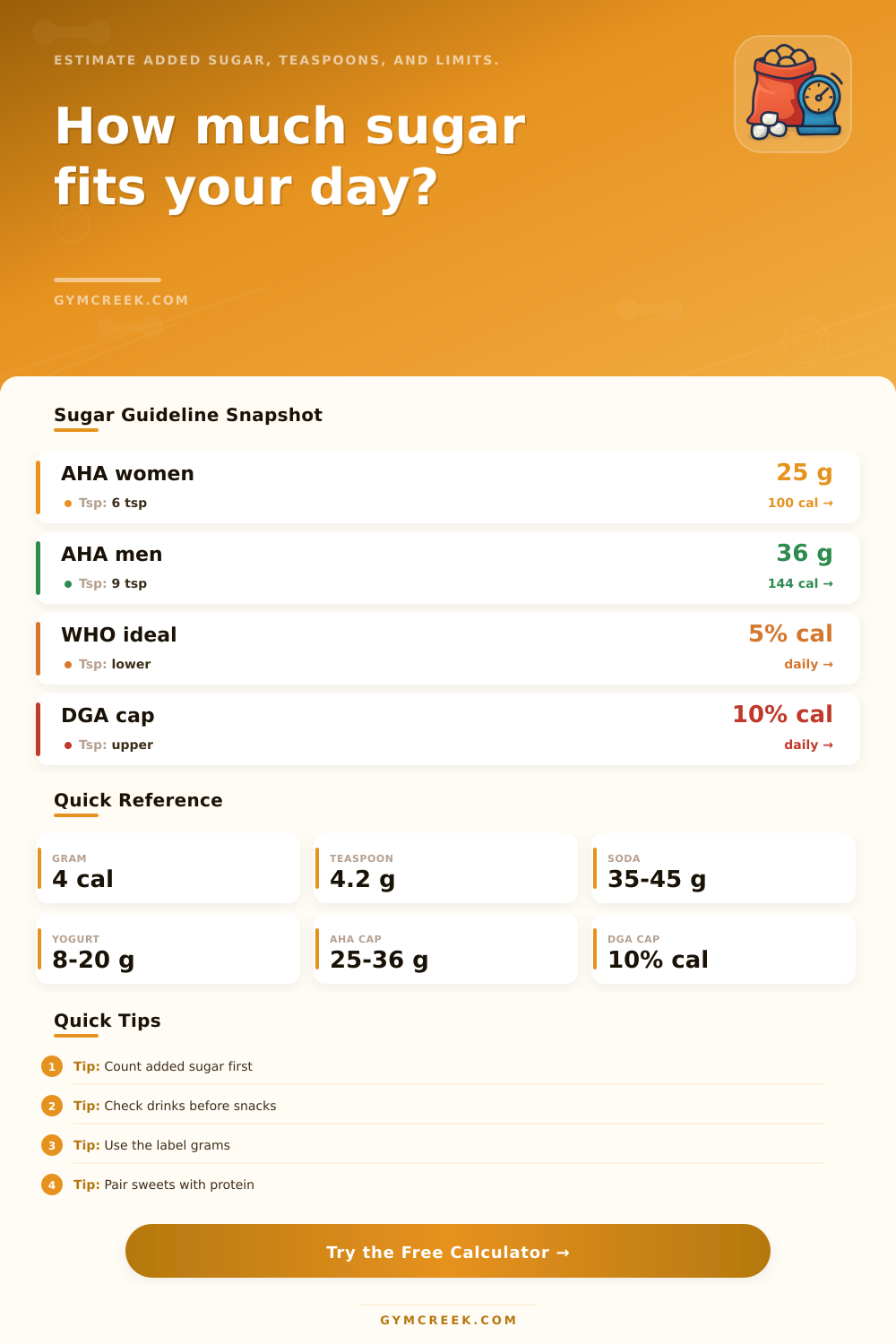
| AHA women | 25 g added sugar | About 6 tsp | Conservative daily cap |
| AHA men | 36 g added sugar | About 9 tsp | Conservative daily cap |
| WHO ideal | 5% of calories | Varies by calories | Lower target |
| DGA upper | 10% of calories | Varies by calories | Upper boundary |
| Source | Typical serving | Added sugar | Calculator field |
|---|---|---|---|
| Regular soda | 12 oz can | 35 to 45 g | Sweet drink |
| Sweet coffee | Medium cup | 20 to 55 g | Sweet drink |
| Flavored yogurt | Single cup | 8 to 20 g | Snack serving |
| Granola bar | One bar | 6 to 15 g | Snack serving |
| Cookies | Two cookies | 12 to 25 g | Dessert serving |
| Scenario | Carb demand | Sugar note | Better signal |
|---|---|---|---|
| Rest day | Lower | Keep added sugar low | Fiber and protein |
| Strength lift | Moderate | Added sugar still counts | Total calories |
| Hard intervals | Higher | Fast carbs may fit near training | Timing and dose |
| Long endurance | Highest | Sports fuel can be purposeful | Session duration |
| Label line | What it means | Count as | Why it matters |
|---|---|---|---|
| Total sugars | All sugar in food | Total sugar | Includes natural sugar |
| Added sugars | Sugar added in processing | Added sugar | Main guideline target |
| Fiber | Non-digestible carbs | Fiber ratio | Improves context |
| Serving size | Label portion | Multiplier | Prevents undercounting |
| Formula | Inputs | Output | Use |
|---|---|---|---|
| Mifflin-St Jeor | Sex, age, height, weight | BMR | Daily energy estimate |
| TDEE | BMR x activity | Calories | Guideline percentage caps |
| Sugar calories | Grams x 4 | Calories | Daily calorie share |
| Teaspoons | Grams / 4.2 | tsp | Practical serving view |
💡Tips
The sugar calculator is an tool that will allow you to calculate the amount of added sugar that you consume each day. Many individual use the sugar calculator to help them keep track of the amount of added sugar that they consume each day. In order for the sugar calculator to determine your daily intake of added sugar, you will need to provide your information to the calculator.
In order to properly use the calculator, it is important for you to understand the information that you will be entering into the calculator, as well as the information that the calculator will provide for you. Added sugar is a form of sugar that is consumed in foods other than those that contain natural sugar, such as fruits or dairy products. The information in the sugar calculator distinguishes between the added sugar that you consume from the natural sugar that you naturaly consume from the foods that you eat.
How to Use the Sugar Calculator
Added sugar is often the focus of health guidelines for individuals, as the body’s recommendations for individuals is generally to limit their intake of added sugars. Thus, by entering the amount of grams of added sugar that you consume into the sugar calculator, you are providing the information that are necessary for the calculator to provide you with measurements of your consumption in relation to the health guidelines. It is also important to track the natural sugar that you consume in meals, though at a level that does not count against your added sugar allowance.
In order to calculate the number of grams of added sugar that you should consume each day, the sugar calculator will ask for information regarding your body makeup (such as your weight, height, age), as well as your level of activity each day. These factor are used to calculate the number of calories that you should consume daily; guidelines for added sugar intake are based off an individual’s calorie needs. If you select certain guidelines for your daily added sugar consumption in the calculator, such as the American Heart Association (AHA), the World Health Organization (WHO), or the Dietary Guidelines for Americans (DGA), the calculation of your calorie needs and that specific guideline will determine your daily allowance of added sugar.
The AHA, for instance, places a cap on the amount of added sugar that individuals should consume each day based upon an individual’s sex, while the WHO and DGA guidelines set a limit for added sugar based upon an individual’s calculated calorie needs. The sugar calculator also asks for information regarding the number of servings of drinks, desserts, and snacks that you consume daily. Added sugars are often contained in these type of products, and the sugar calculator uses these fields to calculate for you the grams of sugar that you consume from these products.
The calculator also asks for the number of training minutes that you perform each day. Though the number of training minutes that you perform each day does not affect the amount of added sugar that you consume, your body may require that you consume carbohydrates, sugars, and energy after those training sessions. The sugar calculator includes fields for the amount of fiber and protein that you consume daily.
Added fiber and protein has an impact upon the way that your body processes the sugars that you consume. For example, if you consume a high amount of fiber, your body will naturally slow the absorption of the added sugars that you consume. In these fields, you will be asked to enter the amount of fiber and protein that you consume daily.
It is also important for you to track these values, as high intakes of protein are generally associated with feelings of fullness. Thus, if the sugar calculator indicates that your protein intake is low for your body, it is possible that your body turns to sugars for feeling of fullness. The results of the sugar calculator will display a variety of different measurements of the added sugars that you consume daily.
For instance, the sugar calculator will calculate the number of grams of added sugar that you consume daily, as well as the number of teaspoons of added sugar that you consume. Other values that will be displayed include the number of grams of added sugar that you still have left to consume that day (or the number of grams of added sugar that you have exceeded your guideline by), as well as the number of calories that added sugars contribute to your diet. While these values cannot replace the advice of a physician, these values can provide you with a more better understanding of how you compare to health guidelines.
One of the mistake that can be made when using the sugar calculator is to use its results to decide what type of added sugar to consume. For instance, if the sugar calculator displays that you still have some grams of added sugar left to consume that day, it does not mean that you should consume that amount of sugar. Similarly, if you have consumed too much added sugar for that day, your day is not “ruined” as a result.
These values are simply a representation of the distance between the information that you entered into the calculator and the guidelines for added sugar intake that you chose. Your reaction to these results is up to you, based upon your general feeling that day and how you trained with your body. Another common mistake with the sugar calculator is entering the total sugars content of a product into the calculator instead of the added sugar content.
For example, soft drinks contain natural sugars and added sugars; the total sugar content is the sum of these two value. The sugar calculator cannot determine this for you, so you must use the added sugars figure for that product to ensure accurate results from the sugar calculator. Additionally, ensure that you enter the correct number of servings of a product into the calculator.
If you consume double the amount of a dessert each day, but do not double the number of grams of sugar that you enter into the calculator, you will understate the amount of sugar that you consume daily. The sugar calculator does not account for all of the variables in your life, such as stress, sleep, or your daily schedule. Therefore, you may use the tool at any given time, but the results may not be directly comparable to another day’s results using the calculator.
For instance, if you use the calculator on a typical weekday, but use it again after a weekend of different activities, your calculations will not be directly comparable. The reference tables that are included with the sugar calculator provide information regarding the specific guidelines for added sugars in various populations, as well as which foods contain the most added sugars. These tables can help you to understand the output of the sugar calculator, as well as to adjust your diet accordingly.
The more that you use the sugar calculator, the easier it will be for you to remember how many servings of added sugars of drinks, snacks, and desserts that you consume daily. The sugar calculator will make it easier for you to calculate the amount of added sugars that you consume daily. Additionally, as you use the calculator more, you will become more aware of the types of added sugars that your body consumes the most, and your ability to calculate how much added sugar you consume will continue to improve.
While the goal for many individuals is to consume as little added sugar as possible from their diets, the sugar calculator can help you to maintain your intake of added sugars within a healthy range. The sugar calculator allows you to monitor your intake of added sugars daily, but you are the individual who must make decisions regarding your diet and added sugar intake.