
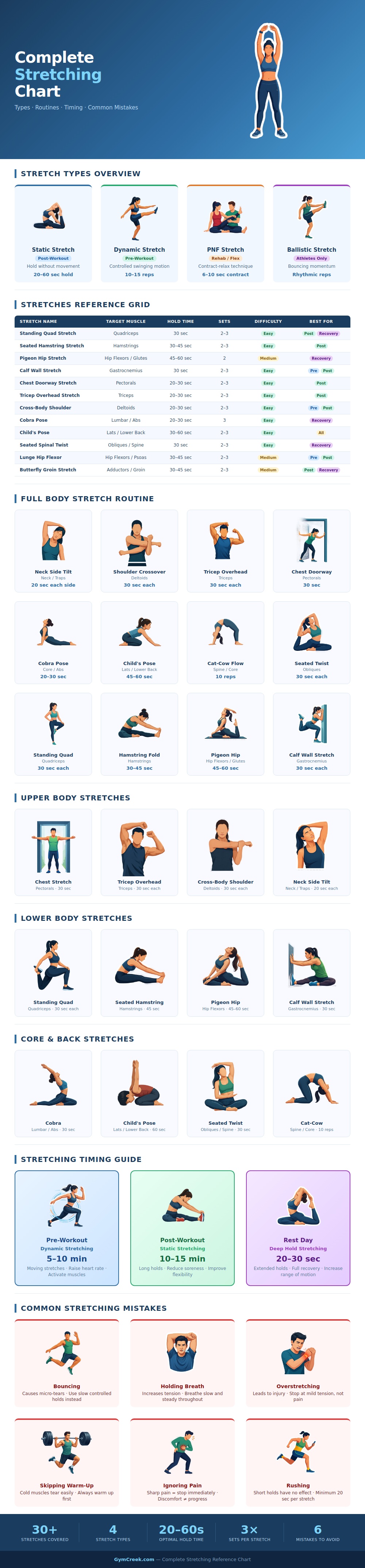
A stretching chart show how to use the various types of stretch for the body. A stretching chart is useful because a stretching chart provide information on which muscles to stretch and for how long. Many peoples feel tightness in there muscles after a workout.
A stretching chart will show individual the movements they need to make to release that tight feeling in their muscle. A stretching chart will categorize four different types of stretch. Static stretch involve holding a position without bouncing.
How to Use a Stretching Chart
These are best performed after an intense workout when the muscle are warm. Dynamic stretches involve movement that prepare the nervous system for physical activity. PNF or Proprioceptive Neuromuscular Training stretch require individuals to contract a muscle before it is stretched.
These are used to increase a person’s range of motion. Ballistic stretches require individuals to bounce during the stretch. This is only for athlete with a high amount of mobility in there joints.
Knowing these different category will allow individuals to identify the type of stretch they will perform to suit their goal. A stretching chart will contain a grid that demonstrate which stretch targets which muscle group. The grid also will show individuals how long to hold each stretch and when to perform the stretch.
For example, the stretching chart will allow individuals to determine whether a chest stretch should be performed before workouts or whether poses like pigeon pose should be performed on rest day. It will also demonstrate which poses require long hold and which require short holds. Using the information from a stretching chart, individuals can prepare a routine that will help them to stretch each part of their body.
Each routine should begin at the neck and continue to the calves. The order in which the muscles are stretched is important because one muscle group can impact another. For instance, if an individual has tight muscle in their hips, they may not feel the stretch that targets their hamstrings.
By releasing the muscles in the hips first, the hamstrings can be effectively stretch. A routine that targets the upper body is important because many individuals sit in front of their computer for long periods of time. Lower body stretches are also important for individuals who sit for long periods with there legs flexed at the hips.
Stretches that target the core and back are also important for increasing flexibility. For example, the cobra pose will stretch and extend the spine, while the child’s pose will flex the spine. Other pose like the cat-cow pose will help prevent the muscles in the vertebrae from becoming locked in one position.
Individuals can use a stretching chart to determine the best time to stretch there muscles. Dynamic movements should be performed for five to ten minutes before training to warm the body and its joints. Static stretching should be performed for ten to fifteen minutes after training to inform the nervous system that the body is resting.
On rest days, individuals can perform static stretching poses for longer periods. The body will adapt to the demands that the body places upon it if individuals continue to hold each pose for long periods during there rest days. Individuals can make mistake when performing the various types of body stretches.
Bouncing at the end of a stretch can cause tear in the bodys tissues. Individuals should always breathe steady during there routine to avoid creating tension in there bodies. The point of pain in a stretch should not be pushed past because it can cause damage to the muscles.
A stretch should not be rushed because it is essential to hold each pose for at least twenty second. Such error can be avoided by using a stretching chart to determine the correct way to perform each stretch. Using a stretching chart allows individuals to increase there mobility.
Better mobility in the body will allow individuals to stand, sit, and lift heavy object in better manner. Overall, a stretching chart is a tool that makes it easy for individuals to see and choose the type of daily stretching pose that work best for there bodies.
