Water Intake Calculator
Estimate daily water intake from body size, activity, climate, sweat rate, caffeine or alcohol load, training time, and preferred bottle size, then turn it into a practical sipping plan.
📌Presets
Each preset loads a realistic body size, climate, training length, sweat pattern, and bottle preference so the hydration output changes meaningfully.
⚙Calculator
Hydration snapshot
Enter your body size and training context to estimate daily water intake.
📊Hydration Metrics
📑Reference Tables
| Component | Formula | Typical range | Use |
|---|---|---|---|
| Base fluid | Body weight x ml/kg | 30 to 45 ml/kg | Daily starting point |
| Training fluid | Sweat rate x minutes | 0.4 to 1.2 L/hr | Workout replacement |
| Climate buffer | Base x environment factor | 0 to 15% | Heat, humidity, dry air |
| Food water credit | Total x diet factor | 5 to 18% | Produce, soup, smoothies |
| Window | Amount | Metric | Purpose |
|---|---|---|---|
| 2 to 4 hours before | 5 to 7 ml/kg | 300 to 600 ml | Start hydrated |
| During easy work | 0.4 to 0.6 L/hr | 14 to 20 oz/hr | Replace sweat |
| During hard heat | 0.7 to 1.2 L/hr | 24 to 41 oz/hr | Limit deficit |
| After training | 1.25 x loss | 125% of loss | Rehydrate steadily |
| Sweater type | Sodium cue | Range | Calculator use |
|---|---|---|---|
| Low | Few salt marks | 200-400 mg/L | Lower range |
| Average | Normal sweat | 400-700 mg/L | Default range |
| Salty | White marks | 700-1000 mg/L | Higher range |
| Heavy salty | Crusty clothes | 900-1300 mg/L | High estimate |
| Profile | Body size | Training | Likely focus |
|---|---|---|---|
| Desk lifter | 75 to 90 kg | 45 min lift | Even spread |
| Runner | 55 to 80 kg | 60 min run | Sweat loss |
| Hot class | 50 to 85 kg | 60 to 90 min | Sodium timing |
| Hike day | 60 to 100 kg | 3 plus hours | Carry capacity |
💡Tips
Hydration require providing enough fluids to your body to perform its functions. The hydration levels that your body experiences depends on many different factors. For example, a person may lose fluid during a meeting while in an air-conditioned office.
Alternatively, the same person may lose fluid during a training session while outside in the environment. Each of these different scenarios requires a different amount of fluid to be lost by the body. If a person dont take the time to ensure that they consume enough fluid for their bodys need, a person may experience a lack of energy or stability in there body.
How to Find Your Daily Water Goal
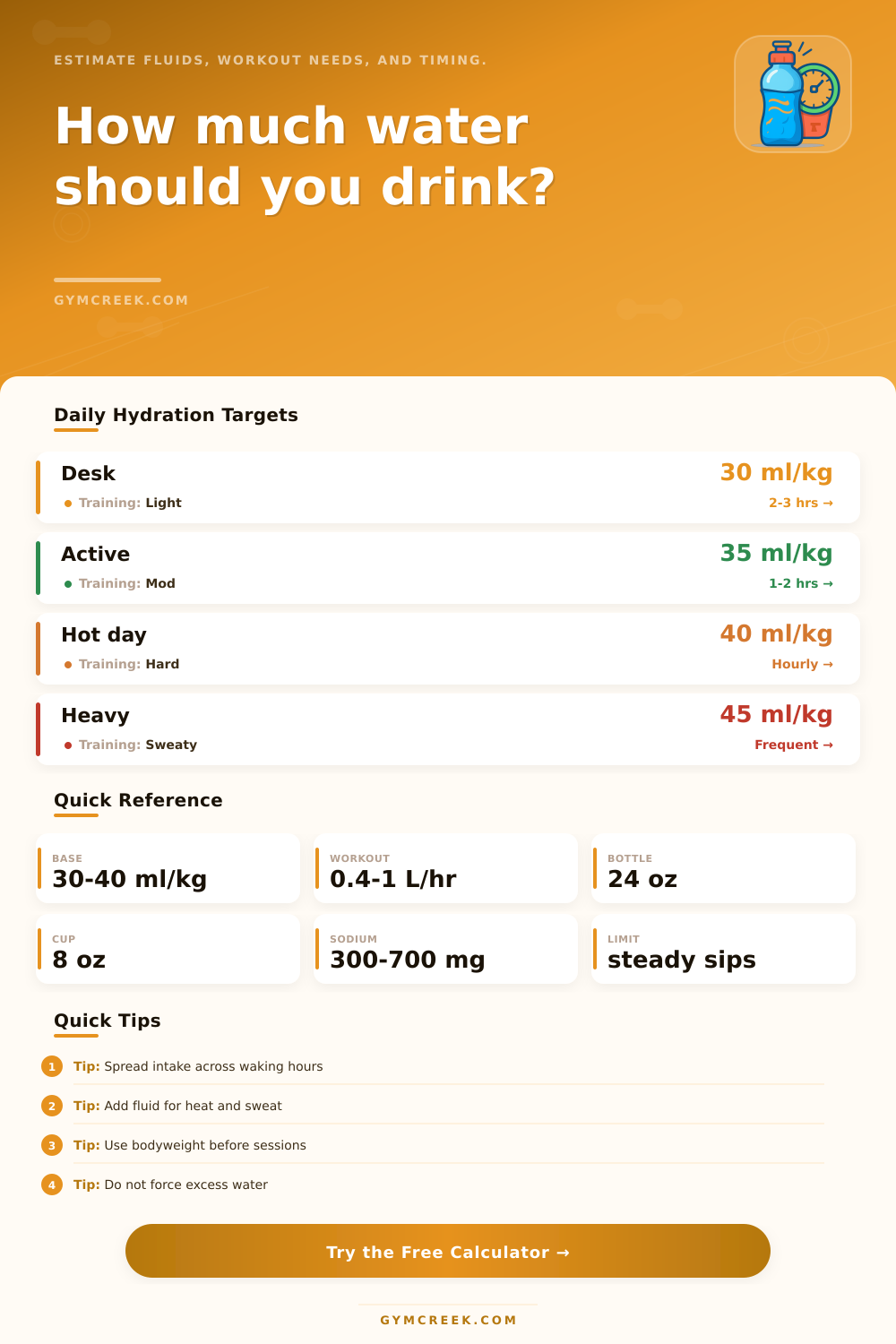
The calculator provides a means of mathematically calculating the amount of fluid that a person should consume each day. The formula use several specific inputs from the person using the calculator to arrive at a fluid target for that individual. These specific inputs include a person’s body size, the length of their training session, and the climate in which they live.
Based off these factors, the calculator also provide a target amount of fluid to consume during each workout session, the amount of fluid to consume hourly throughout the day, and the total number of bottles of fluid that a person should consume that day. Using such a calculator will save a person from having to guess as to how much fluid they should consume each day. Additionally, using the calculator will ensure that the individual does not have to memorize the various rules regarding fluid consumption.
Many individuals may attempt to use a single fluid amount as the goal for hydration, such as the common suggestion that an individual should drink eight glass of water per day. Using this rule, however, is likely to be inaccurate for most individuals due to the fact that this rule does not account for an individual’s body weight, the rate at which they may sweat during the day, and the climate in which they live. If an individual uses only a single number to account for fluid intake without accounting for these factors, they may feel thirsty throughout the day or may drink excessively at the wrong times.
Thus, fluid consumption must be treated as a target that change in accordance with an individual’s activity, environment, and food intake. Body weight is one of the primary factor that must be considered in the calculation of the fluid that an individual should consume each day. The body weight of an individual has both a relationship to the amount of water that is contained in their body, as well as the rate at which they may lose that fluid through activity.
Additionally, age is another factor that may impact the hydration levels of an individual. For instance, an individual that reaches the age of fifty-five years of age has an understanding that their kidneys may be less efficient at the proper functioning of those organs responsible for fluid concentration in the body. Because these kidneys play a major role in fluid balance in the body, an individual’s need for fluid may change with their age.
However, the calculator for determining fluid needs will account for these changes automatically, so that the individual isnt required to make such adjustments to the hydration target that is provided to them. The activity that an individual perform each day will impact the amount of fluid that they should consume. For instance, a person performing a lifting session of moderate intensity may lose approximately half a liter of fluid per hour while performing those exercises.
However, performing the same types of lifting activities at high intensity may cause that individual to lose one liter of fluid per hour. These rates may be entered into the calculator so that the fluid target that is provided to an individual includes adjustments for these different rate of fluid loss. Additionally, the individual may make adjustments for these rates by weighing themselves before and after their workouts to determine their fluid loss for the body.
Thus, this adjustment accounts for the bodys actual fluid loss due to exercise. The climate in which an individual lives can also have an impact upon the amount of fluid that they should consume each day. Exposure to climates that are hot, humid, or dry to the touch will lead to the loss of fluid from the body through the skin and through respiration.
Additionally, an individual that lives at high altitudes may find that their body loses more moisture from the body due to the breathing rates required to ingest the amount of oxygen that is required at these altitudes. Thus, each of these factors will lead to an adjustment in the amount of fluid that an individual should consume to balance these losses. Additionally, the calculator also includes entries for the amount of fluids that contain caffeine or alcohol.
Fluids that contain caffeine or alcohol have a diuretic effect upon the body, meaning that they cause the body to lose fluid. However, the body compensates for these fluid losses over time. By including entries for fluids that contain caffeine, the calculator credits those fluids toward the total fluid goal that is set for an individual.
However, a different adjustment is made for the amount of alcohol that is consumed. These entries are included for the individual to understand that fluid that contains caffeine and alcohol will require adjustments to the plain water goals for the body. An additional factor in the calculation of fluid needs is the amount of water that is provided to the body through the food that is consumed.
Food is one of the source of the water that the body requires each day. Foods like fruits, vegetables, soups, and smoothies all contain water. When fluid is included as one of the goals for each day, an individual may select a high-produce day.
On this type of day, the amount of fluid that is provided to the body through food will be subtracted from the total goal for fluid consumption. Thus, the individual will not consume too much fluid with water. Many individuals may not account for the fluid consumption provided by food.
Thus, by ignoring this factor, individuals may consume too much fluid from water bottles alone. The total amount of fluid that the calculator calculates can be broken into the amount of fluid that should be consumed during each hour of the day. Fluid should be consumed throughout the day; consuming all of the fluid at the beginning of the day or at the end of the day may disrupt the body’s normal sleep and waking cycle.
Additionally, another entry on the calculator is the total number of bottles of fluid that an individual should consume during that day. Breaking the fluid goal into bottles of fluid makes it easier for an individual to understand how much fluid they should consume daily. An additional factor in the calculation of fluid consumption is the fluid content of sodium chloride, or salt.
When an individual performs physical activity, their body can release large amount of salt through their sweat. An individual that is a “heavy sweater” may notice salt deposits on their clothing or salt buildup on the skin. The amount of sodium that the body needs is provided in the form of a range rather than a single number, as each individual’s needs differ from each other.
This sodium input allow an individual to understand if they should consume an electrolyte drink in place of water, or if their body can be supplied with plain water alone. The training that an individual performs can be divided into three different segment that can have their fluid goals individually adjusted. The pre-workout goal suggests that an individual consumes some fluid prior to their workouts to ensure that their body is properly hydrated prior to their exercise.
The fluid goal during the workout is adjusted to ensure that an individual does not consume too much fluid while exercising, as this can lead to discomfort. After their workouts, however, the body continues to lose fluid, so the amount of fluid that is consumed after exercise is greater than that which is consumed during the workout. There are several mistakes that an individual should avoid when managing their hydration goals.
First, they should not treat the calculations from the calculator as a quota that they should strive to achieve as much as possible. Second, they should not ignore the importance of sodium content in their body, especially during long and hot exercise effort. Third, they should not solely rely on the feeling of thirst as a means of knowing when to consume fluid.
Instead, they should use the fluid plan provided by the calculator to determine the amount of fluid that they should consume. The reference tables that are included in the body of the calculator provide more information regarding the mathematics that is used to calculate the fluid that the body should consume each day. These tables may indicate the fluid goals for different amount of sweat loss, and the time periods during which those fluids should be consumed.
These tables dont need to be memorized by the individual, but can be referred to when making adjustments to the calculator to understand how the two may impact each other. Overall, the goal of this calculator is to prevent major change in an individual’s energy and their mood. An individual should aim to use the calculator to finish each day with the same amount of energy and with the same mood as they began their day.
By using the calculator, an individual can not only ensure that their body is properly hydrated, but they can also ensure that their energy, mood, and productivity is maximized.