
Many people who begin to take charge of there weight loss plan select the most difficult form of exercise for their workouts. However, the difficulty of the workouts cause many people to quit the exercise plans that they have created for themselves. Losing fat in the gym focuses less on suffering and more on ensuring that the efforts that you put into your workouts correlate to the amount of recovery that you can allow your body to experience.
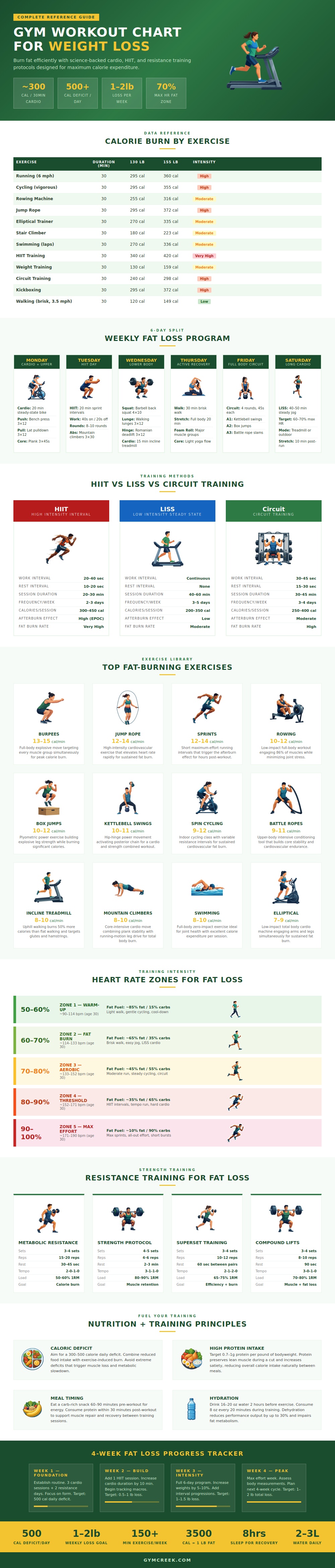
One of the most useful tools in creating a program for losing fat is the use of workout chart that indicates the calories that various workouts burn and allows you to stop guessing whether the workouts that you are performing are effective. The workout chart compares various exercises within a thirty-minute window. Workouts can include efforts that are moderate and very hard but differ in how great of a difference exists between those two levels of effort.
Simple Weekly Workout Plan to Lose Fat
The difference between moderate efforts and very hard efforts is less than people may believe when considering the length of time that an individual can sustain a particular form of exercise. High-Intensity Interval Training is known for burning a significant numbers of calories in a short period of time. However, performing HIIT every day will result in burnout of the bodys system.
Steady forms of cardio burn fewer calories than HIIT but are more consistent throughout the week. The workout chart allows for individuals to see these options without having to experiment with various workouts themselves. A weekly structure is more important than the individual workouts that are performed.
One sample of a weekly structure for exercising includes performing cardio, performing intervals, and performing resistance training for six days a week and taking a recovery day for the body. This particular structure for the week works because it allows time for the body to adapt to the workouts while avoiding allowing fatigue to build up within the body. For example, an individual can perform steady forms of cardio and strength training for their upper bodies for one day, perform intervals for another day, perform strength training for legs for a third day, perform other forms of exercise for Thursday but at a lower intensity, perform other types of exercise for Friday, and perform optional recovery for Saturday.
This type of schedule isnt magical but useful in that it allows an individual to avoid having to make the decision of which type of exercise to perform each day. There are three different types of exercise that can be incorporated into a program for losing fat: HIIT, steady cardio, and circuit training. Incorporating these different forms of exercise will ensure that the individual performs each type of workout at least once each week.
HIIT will burn the most calories during the workout as compared to other forms of exercise. However, because the intensity of the exercise is so high, performing these types of workouts will result in an afterburn effect that continues to burn calories after the session. Steady forms of cardio will not create the same afterburn effect.
However, they will be easier for the body to recover from. Circuit training is an exercise that falls somewhere in the middle of each extreme. It includes both the use of resistance training and short periods of rest.
During circuit training, the individual will elevate their heart rate while simultaneously building their strength. No single form of exercise is the best for everyone. Therefore, the individual must decide which form of exercise will be used three or four times per week.
Various heart rate zones can be used once an individual has passed the beginner stage for their workouts. Performing workouts that are too easy wastes the individuals time. Similarly, performing workouts that are too intense every session will lead to exhaustion of the body.
The heart rate zones can be used within the workout chart to categorize different workouts. Steady forms of cardio can be performed at lower heart rate zones to maximize the fat burning that occurs with those workouts. Higher heart rate zones can be reserved for sessions that last less time.
Knowing the difference between heart rate zones allows for an individual to avoid viewing each workout as a test of willpower. Resistance training can be included in the workout chart because it is another component of body composition. While resistance training will burn fewer calories during the exercise as compared to other forms of workouts, it will eventually alter the body composition of the individual.
If an individual incorporates strength training into their routine, they will eventually gain more muscle and increase their resting metabolism. Muscle also counteracts the loss of muscle that may occur due to the low number of calories that the body consumes each day. The resistance training protocols allow for an individual to include both strength training and metabolic workouts into their routine.
Nutrition and exercise are not two separate projects that an individual must complete. Therefore, the individual must consider the nutrition component of the plan with the exercise component. If an individual creates a calorie deficit, it should be a moderate one.
This deficit will be created in part by the exercises that the individual performs. An adequate amount of protein should be consumed by the body during a calorie deficit to protect the muscle that the body is trying to keep. The individual should time their meals around their workouts to provide energy for them to exercise.
Additionally, the individual should consume protein after their workouts to allow for proper recovery from the exercise. An individual’s progress in the program can be tracked over a four-week period. During the first week, the individual will focus on learning how to perform the exercises.
During the second week, they can increase the volume or the intensity of the exercises. By the third week, the schedule of the individual will feel normal to them. By the fourth week, they will be able to perform the exercises at a higher level before they reassess their progress.
This four-week programing schedule works for the individual because it allows their body time to adapt to the workouts and to allow it to handle more exercise after some time has passed. The true test of a weight loss plan will be seen after the second month. If the individual sees the plan that they follow as doable during the second month, they have found the perfect plan to follow over time.
However, if it is not deemed doable, the workout chart will provide the information necessary to adjust the individuals plan to find a better balance between performing challenging workouts and allowing time for their body to recover.
