
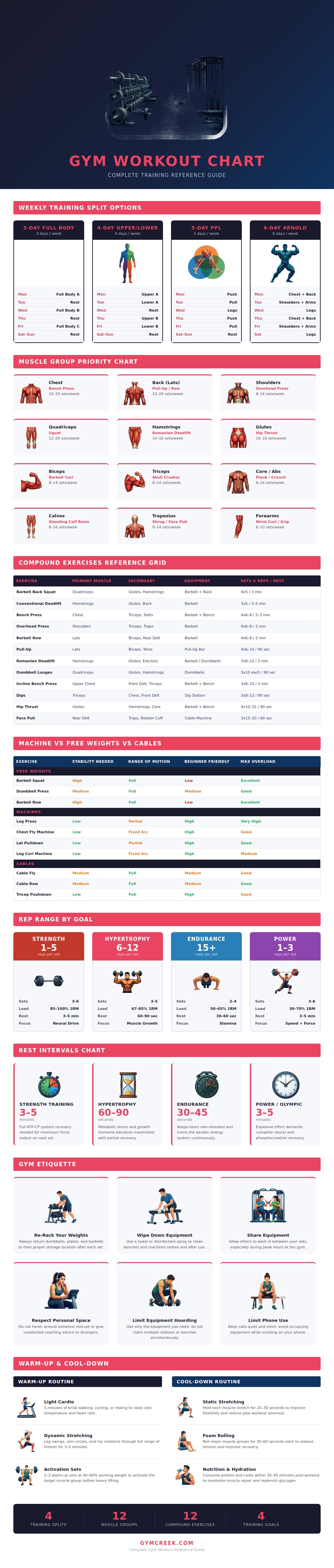
A structured workout chart allow a person to use teh gym equipment in a structured way. Furthermore, a structured workout chart prevents a person from guessing what exercises to perform in the gym. A structured workout chart turns a gym filled with exercise equipment into a system that allows a person to work toward a desired outcome from working out at the gym.
There are many ways to structure a workout plan. However, a structured workout chart display four of the most common ways to divide the week’s training sessions. A three-day full-body workout plan is ideal for individuals with limited time to work out.
How to Use a Workout Chart
A three-day full-body workout plan allows a person to work major muscle groups and provide time for recovery. A four-day upper-lower split workout plan provide more time to train and add more volume to a training routine. However, a four-day split allows a person to train different muscle groups each day.
A five-day push-pull-legs split workout plan allows a person to focus on different training sessions each day. Additionally, a six-day split workout plan allows for a person to train opposing muscle groups and to stay in the gym every weekday. There is no best split routine for a workout plan; the best routine for an individual depends on the number of days per week that an individual can train and the individuals recovery from training.
A structured workout chart also include recommendations for the number of sets for twelve different muscle groups in the body. The chest, back, and other large muscle groups can take more sets than smaller muscle groups like the biceps or forearms. These recommendations are not hard and强制 rules that a person should follow; however, they provide guardrails for a person to not train those large muscle groups with too little volume or train small muscles with too much volume.
For individuals who find that there chest muscles are lacking in strength and size, a person should train the chest muscles with sets toward the top of the recommended set range. However, for individuals whose shoulder muscles feel tired after training, a person can train those muscles with fewer sets toward the lower end of the set range. Compound lifts is crucial to many workout plans.
A structured workout chart displays compound lifts with the primary muscles, secondary muscles, and the loads for those exercises. Exercises like the back squat with a barbell, conventional deadlift, and the bench press are ideal for working the largest muscle groups and moving the most weight. Exercises like the row and overhead press are important exercises; however, they are second in importance to the primary exercises.
Exercises on machines provide the advantage of stability and ease of movement; however, there is less return on the time that a person spends training on these exercises. For instance, a leg press allows a person to push heavy loads with less skill. A cable fly provides more range of motion for the chest muscles.
Many new beginners to the gym will start with more work on the exercise machines and will gradually increase the inclusion of compound lifts as they gain more coordination in performing these exercises. The workout chart includes a section devoted to the number of repetitions to perform for each exercise. The number of repetitions for strength exercises range from one to five sets and require longer rest times between each set of exercises.
Hypertrophy exercises that increase the size of muscle groups use a rep range of six to twelve sets and require more rest in between sets. For endurance exercises, there are more than fifteen repetitions with minimal rest between sets. For exercises that develop the power to perform an exercise, there are fewer sets with full recovery between each set.
The majority of individuals who train for general fitness will train within the hypertrophy rep range. Sets that focus on strength and endurance can be added to a training routine; however, hypertrophy exercises should perform the majority of training sessions for each workout. Rest periods between exercises are important for training sessions.
For strength training, sessions recommend rest periods of three to five minutes. However, for hypertrophy exercises, sixty to ninety seconds are recommended to allow for recovery yet still keep the muscles under stress. For endurance exercises, rest periods are even shorter.
If an individual uses the wrong rest times between sets, the training may turn into an endurance exercise without the individual knowing. In order to maintain a good gym environment, there are tasks a person should perform after training to maintain social goodwill in the gym. A person should not start their training session cold; five minutes of warm up is recommended.
A person should perform dynamic warm up exercises and use light weights to prepare the muscles for the training session. After training, a person can perform static stretches and foam rolling to restore the range of motion in their movements. Additionally, a person should eat protein and carbohydrates after training to aid in the muscle repair process that will allow new muscle to be built.
A structured workout chart allows a person to have a system for training without having to devise another routine each week. As a person becomes more familiar with the workout routine suggested on a workout chart, a person can make adjustments based on the bodys response to the workouts. However, the goal is not to use a structured workout chart for a workout plan; instead, it should be used as a map to learn what kind of training a person needs.
