Chest Measurement Calculator
Convert relaxed and expanded chest measurements into average chest size, breathing expansion, chest-to-waist ratio, shoulder balance, height proportion, and tracking notes for fitness progress.
📌Measurement Presets
Presets load real tracking scenarios, from a first tape baseline to a hypertrophy block, then recalculate the ratios automatically.
⚙Calculator
Chest measurement snapshot
Enter relaxed and expanded tape readings to calculate chest ratios.
📊Chest Metrics
📑Reference Tables
| Reading | Tape position | Breath cue | Best use |
|---|---|---|---|
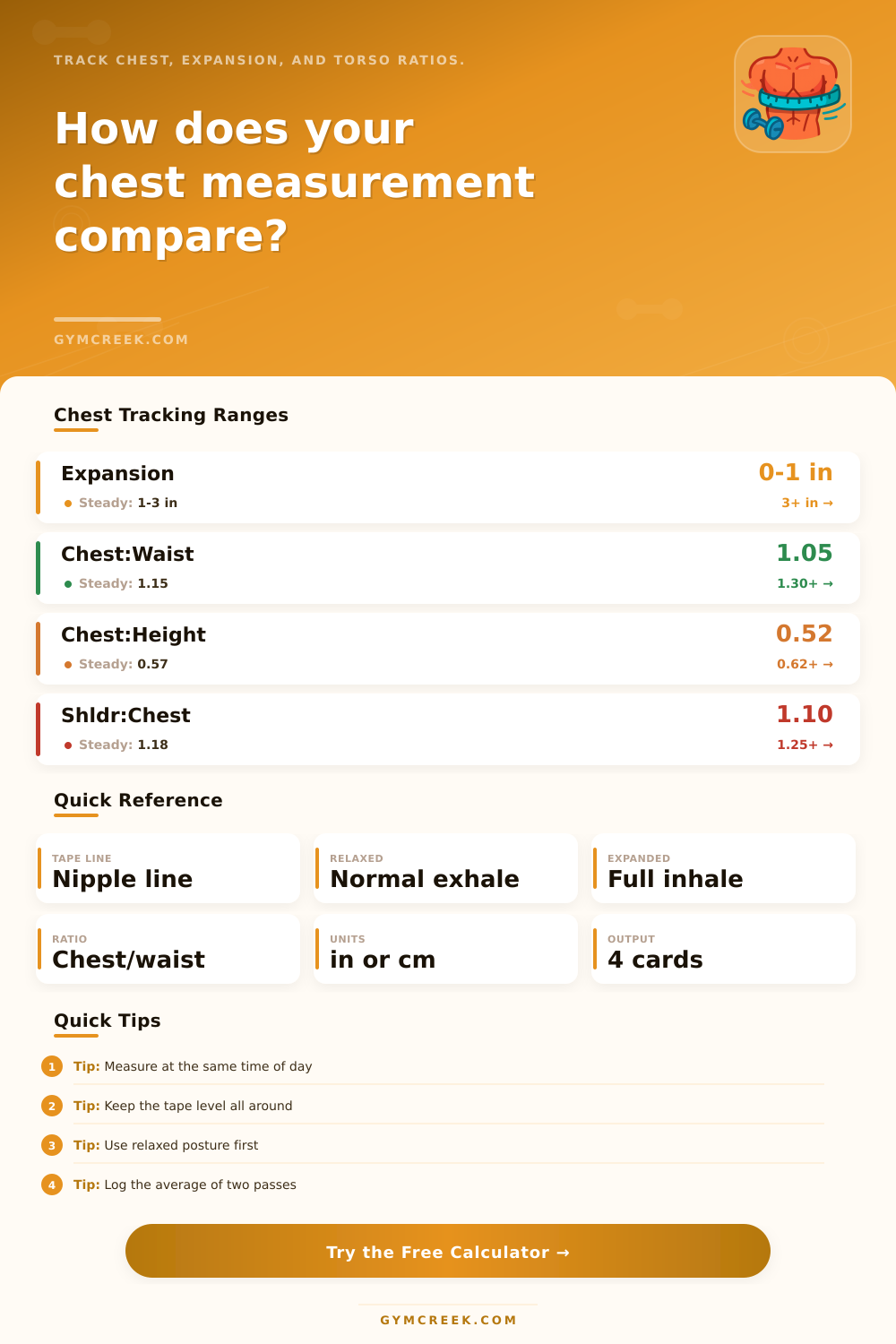
| Relaxed chest | Nipple line, level tape | Normal exhale | Progress baseline |
| Expanded chest | Same line as relaxed | Full controlled inhale | Rib expansion check |
| Waist | Navel or narrowest point | Relaxed abdomen | Chest-to-waist ratio |
| Shoulder | Widest shoulder loop | Neutral arms | Frame balance |
| Ratio | General read | Tracking note | Best comparison |
|---|---|---|---|
| Under 1.05 | Waist near chest | Watch waist and posture | Same waist site |
| 1.05 to 1.15 | Balanced baseline | Common fitness range | Relaxed chest only |
| 1.15 to 1.30 | Strong V-taper | Often athletic look | Same breath cue |
| 1.30 plus | Very pronounced | Check tape tension | Repeat twice |
| Expansion | Metric | What it suggests | Measurement caution |
|---|---|---|---|
| 0 to 1 in | 0 to 2.5 cm | Small breath spread | Check full inhale |
| 1 to 2 in | 2.5 to 5 cm | Typical tracking band | Keep tape level |
| 2 to 3 in | 5 to 7.6 cm | Good expansion | Repeat with same posture |
| 3 in plus | 7.6 cm plus | Large expansion | Avoid flared pose |
| Formula | Variables | Output | Why it helps |
|---|---|---|---|
| Average chest | Relaxed and expanded | Midpoint | Smooths breath swing |
| Expansion | Expanded - relaxed | Tape delta | Breathing range |
| Ratio | Chest / waist | Torso shape | Recomp tracking |
| Mifflin | Height, weight, age | BMR | Energy context |
| Proportion score | 4 tape ratios | 0 to 100 | Trend summary |
💡Tips
Chest measurement are one of the methods for tracking the change that occur in the body. Chest measurement provide the data necessary to track changes over time. While it is true that a number on a measuring tape will provide one measurement of the chest circumference, that single measurement are not the only one that is important.
Instead, the importance of that measurement is based upon how that number compare to previous measurements of the chest circumference over a period of several week. In order to obtain a reliable measurement of the chest measurements for any given individual, specific method must be employed when measuring the chest circumference. For instance, one method of measuring the chest measurements is to measure the chest circumference during a normal exhale of the breath.
How to Measure Your Chest and Track Changes
An alternate method of measuring the chest circumference is to take the measurement of the chest circumference after performing a full inhale of the breath. Method of measuring these different body components can be important to provide an accurate measurement of the changes that occur over time. For instance, measuring the waist at the navel and measuring the circumference of each shoulder are additional measurement that can be taken to provide an understanding of how the chest measurements relate to the remainder of the body frame.
Additionally, height and weight can be used to calculate the ratios of the body measurements that are obtained from the chest circumference measurements. While it may be the assumption of many individual that a large difference between the chest circumference readings taken during the relaxed and expanded breath is a positive measurement of that individuals body, such assumptions may not always be true. In each instance, it is possible for the difference between those two measurement to be large due to factors like the posture in which the individual’s shoulder are when the person takes the chest circumference with a measuring tape.
Factors like posture can be accounted for in the calculation of the chest measurements to provide a more accurate determination of any changes to that feature of the bodys frame. For instance, taking the chest circumference measurements in a solo pose may provide a different reading than if another individual take that same measurement of the chest measurements. Poses like a lat-flare pose will result in a higher chest circumference measurement than when the body is in a more normal pose.
These adjustment to the chest circumference measurements are important in that it ensure that the trend line of the measurements is honest and does not exhibit false changes in relation to the bodys true changes over time. The ratios of the body measurements calculated from the chest measurements can provide information regarding the bodys shape. For instance, the ratio of the chest measurements to the waist measurements can provide information regarding the V-taper of an individual, while the ratio of the chest measurements to the height of the individual can reveal information regarding whether the size of that torso is increasing at the same rate as the increase in the height of that individual.
Additionally, the ratio of the shoulder circumference measurements to the chest circumference can help provide information regarding whether an individual is developing their upper back in a same rate as that of their chest measurements. Each of these ratios can be helpful in that they help to provide an external check of the body measurements without the influence of factors like lighting, mood, or the muscle pump that individuals may exhibit when exercising. In addition to each of these calculations of the body measurements, reference table exist to provide further information regarding the results of those measurements.
For instance, if an individuals chest-to-waist ratio is low, that could be the result of the waist measurement being taken after an individual consume a large meal, or after taking the waist measurement in a different location on the body than previous measurements of that circumference. Additionally, if the expansion number for that individual is low, it is possible that that individual did not perform a full inhale of the breath prior to taking that measurement. These reference tables allow each individual to understand their body measurements in relation to others with similar body frame measurements, and to provide information as to whether they need to take the chest measurements again.
In order to obtain accurate measurements of each individuals chest measurements over time, those individuals should standardize the way that they take those measurement. Each individuals chest measurements may be determined at a different time of day, for instance, as an individuals body measurements can change due to the consumption of food, water, or exercise. By creating a standard method of measuring the chest circumference for each individual, those individuals can ensure that their data is reliable and useful in tracking their changes over time.
Body recomposition will impact the changes to each of the ratios of the body measurements calculated by the body composition calculator. For instance, if an individual is decreasing their weight but the chest measurement remain the same or increases, the ratios will shift. Additionally, if an individual is in a hypertrophy block for their body frame measurements (when both weight and body frame measurements is increasing), the ratios will shift as well.
The body composition calculator can account for each of these changes to determine whether they are the result of changes in the bodys tissue, or whether they are the result of temporary changes in the bodys water or glycogen level. In addition to the factors related to each individuals body, factors like the age of that individual or their level of physical activity can impact their bodys response to the body composition training methods that are employed. For instance, an individual who is 27 years of age and performs physical activity five day each week may experience changes in their body frame measurements at a different rate than an individual who is 52 years of age and who is not physically active each week.
The body composition calculator can account for each of these variables to ensure that each individuals measurement are viewed in the context of their realistic abilities and changes. Thus, each individual should treat such measurement as a skill that must be maintained, and the calculator will act as a means of determining whether each individual is achieving there goal.