Ideal Waist Size Calculator
Estimate a practical waist target from height, current waist, hip measurement, body context, and the waist-to-height ratio used in central adiposity screening.
📌Waist Goal Presets
Presets load realistic heights, waist values, hip measurements, activity levels, body frames, and target styles so you can compare health, balanced, and athletic waist targets.
⚙Calculator
Waist target snapshot
Enter height, waist, hip, and body context to estimate your target waist range.
📊Waist Metrics
📑Reference Tables
| WHtR | Category | Waist cue | Calculator action |
|---|---|---|---|
| Under 0.40 | Low range | Very small waist for height | Review context |
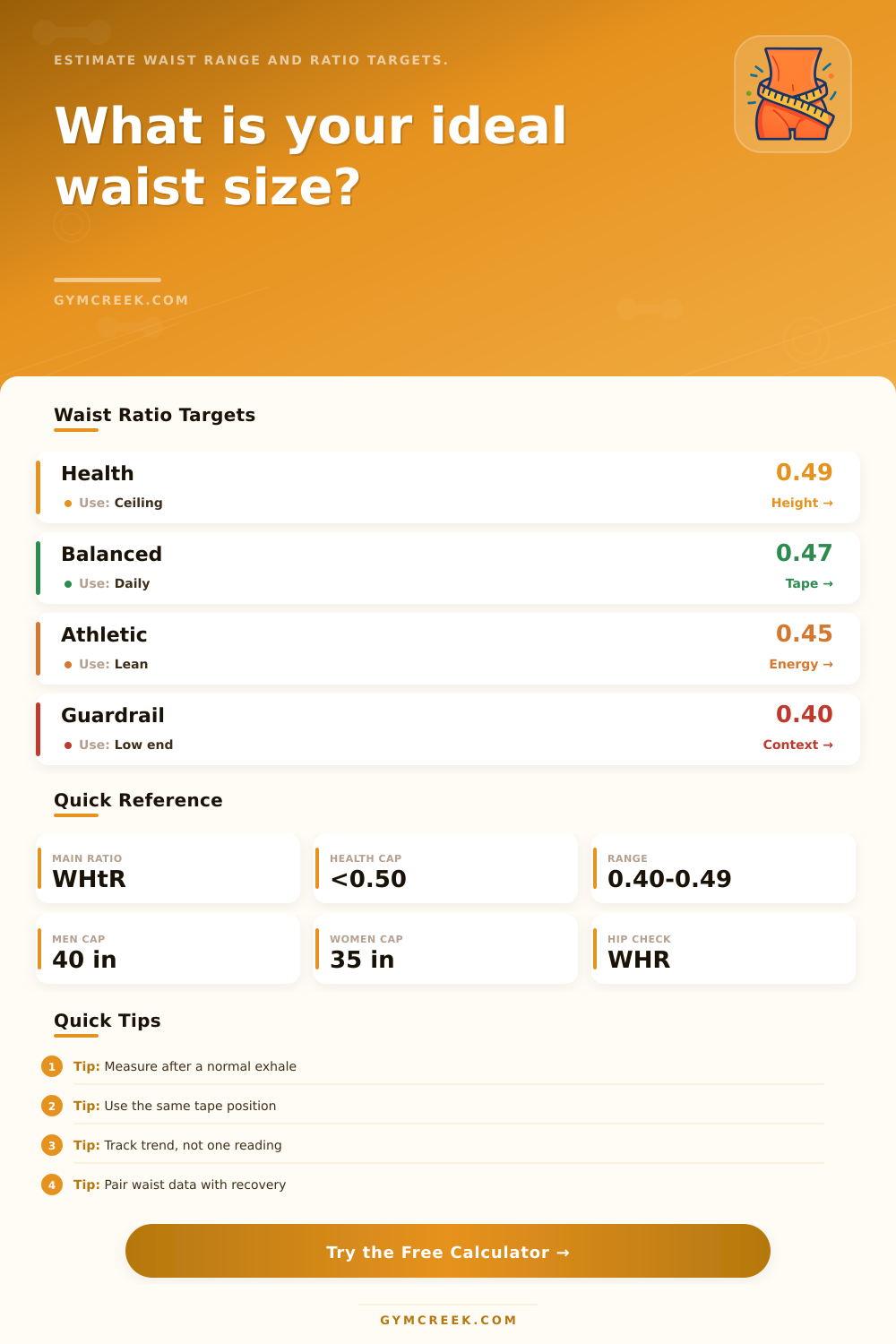
| 0.40 to 0.49 | Healthy central adiposity range | Below half height | Main target zone |
| 0.50 to 0.59 | Increased central adiposity | At or above half height | Uses health ceiling |
| 0.60 or more | High central adiposity | Well above half height | Flags care note |
| Reference set | Men | Women | How it is used |
|---|---|---|---|
| General adult | 40 in / 102 cm | 35 in / 88 cm | Risk reference cap |
| Asian-risk | 35.4 in / 90 cm | 31.5 in / 80 cm | Lower screening cap |
| Waist-to-height | Under 0.50 | Under 0.50 | Applies across sex |
| Waist-to-hip | Under 0.90 | Under 0.85 | Uses hip input |
| Style | Base ratio | Best fit | Notes |
|---|---|---|---|
| Health ceiling | 0.49 | Risk screening | Just below half height |
| Balanced fitness | 0.47 | General training | Middle of healthy zone |
| Athletic lean | 0.45 | Lean athletes | Needs recovery context |
| Body recomposition | 0.46 | Slow body change | Moderate target |
| Maintenance check | 0.48 | Stable weight | Conservative target |
| Formula | What it uses | Output | Limit |
|---|---|---|---|
| WHtR | Waist / height | Central adiposity ratio | Screening estimate |
| WHR | Waist / hips | Shape context | Needs hip measure |
| BMI | Weight / height | Body-size context | Misses distribution |
| Mifflin-St Jeor | Weight, height, age | BMR estimate | Not a waist formula |
💡Tips
Waist size indicate how clothing may fit, how one feel during movement, and how much fat is stored around an organs. While many people strive to find a single number that indicates there weight, the ratio of an individual’s waist to there height may be a more helpful number than weight alone. A waist-to-height ratio is an even more helpful number than a simple inch count of an individuals waist.
A waist to height ratio compares an individuals waist size to their height. The calculator can perform a variety of mathematical function once you enter your height, your current waist size, your current hip circumference, your activity level, and a target style. Based off the information you provide, the calculator will tell you your target waist size and a healthy range for your waist size.
Find Your Target Waist Size
With this information, you can determine if your current waist size is already within your target range or how far off you are from your target waist. Additionally, the calculator will estimate the timeline necessary to reach your target waist based on the rate of change in waist size that you select. This timeline will help you to determine if your target waist is realistic based on much of the time that you have.
One of the reason that the waist-to-height ratio is so effective is because an individual’s height cannot change, but their waist size can change with the addition or subtraction of body fat. An individual that is five feet ten inches in height may have a larger waist size than an individual that is five feet four inches in height, but the two individuals may have the same waist-to-height ratio. The ratio effectively allow for the comparison of two different individuals bodies and fat distribution.
The reference tables that are listed on the calculators’ webpage indicate the cutoffs for healthy waist size for different populations. One set of tables use sex-specific caps for healthy waist sizes. For men, any waist measurement above forty inches indicate a higher risk for health problems.
For women, any waist measurement above thirty-five inches indicate higher risks for health problems. The other set of reference tables include lower lines for waist measurements. These lines are used as a screening tool for Asian populations that are at risk for health problems due to there genetics.
You can switch these reference tables between each other so that the waist size recommendation match the data about the populations with which you are most similar. An individual’s frame size and amount of muscle can play a role in their waist size. An individual with a large frame or alot of muscle may have a larger waist size than an individual with a smaller frame and less muscle.
However, that large frame or amount of muscle does not necessarily indicate health risk to the individual in the same way that a larger waist size do. The calculator allows for an adjustment for frame size so that muscular individuals has a target waist size that is slightly higher than that of individuals with smaller frames, and an individual with a smaller frame may have a target waist size that is slightly lower than an individual with a larger frame. This adjustment for frame size prevents the calculators target waist size from being too difficult for an individual with a specific frame or muscular body type.
Accuracy in the calculation of waist size is vital for the calculator to provide an accurate estimate of the time necessary to reach an individuals target waist size. To calculate waist size accurately, place the tape measure at the midpoint between an individuals lowest rib and the top of their hip crest. This point should be measured after an individual performs a normal exhale to obtain the most accurate measurement of their waist size.
The calculator does not have the ability to place the tape measure, so the accuracy of an individuals waist size will impact the accuracy of the calculator. For many individuals, the current waist size that is input into the calculator will be close to the target waist size. Additional individuals may notice a gap between their current waist and their target waist size; in this case, they can decide on a change in the rate at which they adjust their waist size.
Entering their hip size can provide additional information to individuals. The waist-to-hip ratio can show an individual if they have more fat around their waist than around the hips. This ratio will be compared with the reference lines for healthy waist-to-hip ratios.
The waist-to-height ratio and waist-to-hip ratio can provide individuals with a more complete picture of their body composition than using only one of these ratio. An individuals age and activity level can play a role in determining their healthy waist size. Many individuals gain fat around the waist with the increase of their age, and individuals that are very active may have different goals in relation to fat loss than individuals that are not as active.
Both of these factor are included in the suggestion of the target waist size for an individual. Additionally, these factors are included in the estimation of an individuals TDEE. These factors are included in the suggestion of an individuals target waist size because the target waist size should reflect an individuals lifestyle.
A common mistake in using this calculator is ignoring the fact that an individuals waist size can change by half an inch or more within a day due to various reason. The calculator does not account for these changes, so it is important for individuals to track their waist size over a period of several weeks to determine their trend in relation to their target waist size. Lowering the weekly change rate to which the individual commit to changing their waist size can make the suggestion of an individuals target waist size more attainable.
A longer timeline for reaching the target waist size is more likely to be successful and to prevent the individual from achieving their target waist size only to gain that same waist size after working very hard to reach it. An individual that is already near their target waist size can switch their goal to maintenance to ensure that their waist size does not begin to decline. One of the main purpose of using this calculator is to give an individual a starting line and a destination for their waist size.
Once they have a starting line and a destination, it is easier for them to determine how many mile they must run each day to reach their target. While the waist size measurement is only a snapshot of an individuals body, there is value in monitoring an individuals waist size over a period of many months.