Muscle Building Genetics Calculator
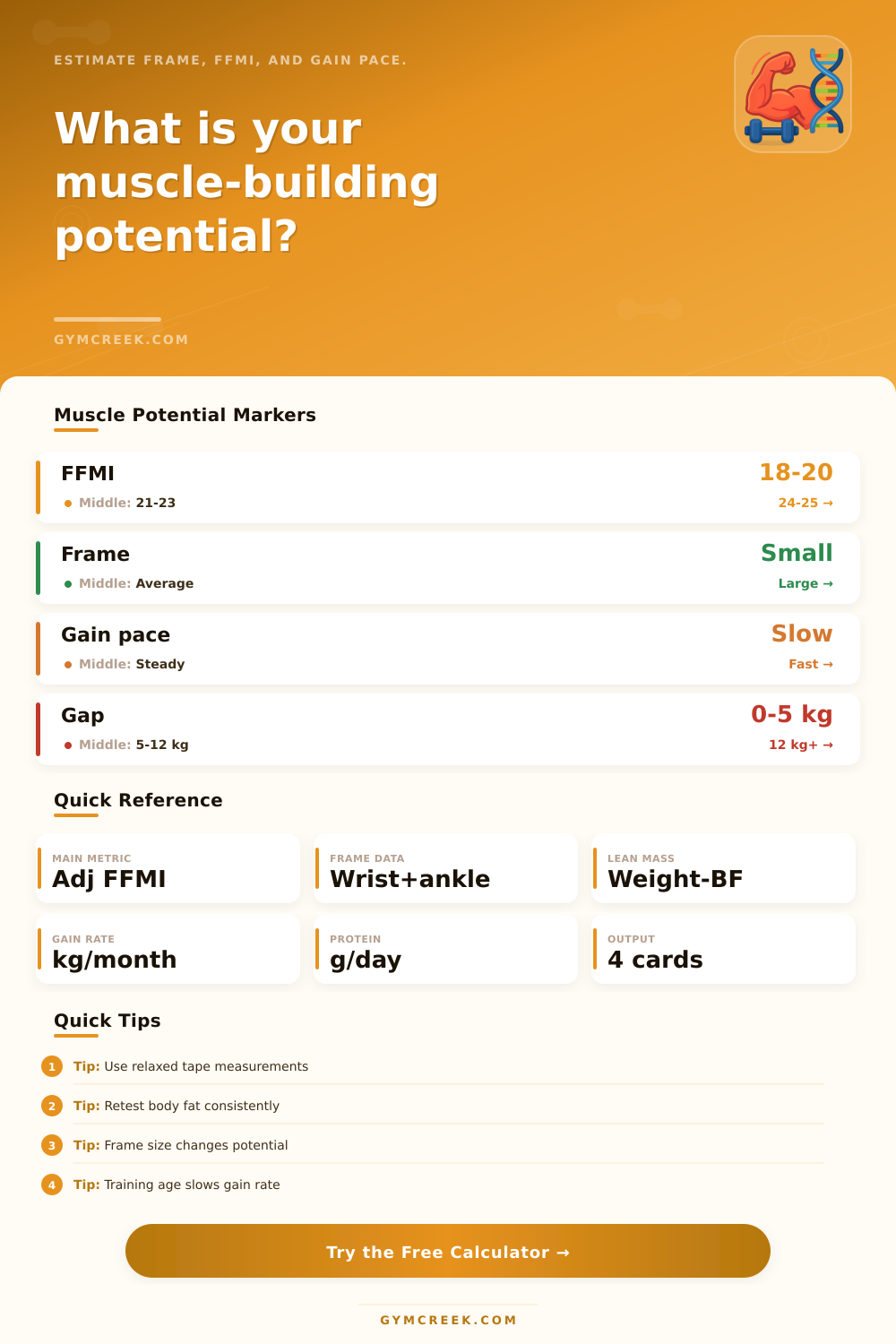
Estimate your natural muscle-building lane using frame measurements, current lean mass, adjusted FFMI, training age, recovery quality, and a realistic gain-rate model.
📌Physique Presets
These presets are realistic profiles, not rankings. They show how height, joint size, body fat, training age, and recovery change the estimate.
⚙Calculator
Muscle genetics snapshot
Enter your profile to estimate frame-adjusted natural muscle potential.
📊Genetic Potential Metrics
📑Reference Tables
| Adjusted FFMI | Male read | Female read | Training context |
|---|---|---|---|
| Under 18 | Lower muscle | Developing base | Often early or detrained |
| 18 to 20.9 | Average to fit | Trained | Good room to build |
| 21 to 23.4 | Trained natural | Highly trained | Progress slows |
| 23.5 to 25 | High natural range | Elite natural range | Needs years of consistency |
| 25 plus | Uncommon naturally | Very uncommon | Check measurements carefully |
| Frame score | Wrist and ankle read | Potential effect | Planning note |
|---|---|---|---|
| Under -0.8 | Smaller joints for height | Lower scale potential | Leanness can look dramatic |
| -0.8 to 0.8 | Average frame | Middle potential range | Use steady progress checks |
| 0.8 to 1.6 | Larger frame | Higher lean mass ceiling | Scale weight can run higher |
| 1.6 plus | Very large frame | Upper potential lane | Verify relaxed tape numbers |
| Training age | Typical monthly gain | What changes | Best use |
|---|---|---|---|
| 0 to 1 year | 0.7% to 1.2% weight | Technique and volume adapt fast | Novice mass phase |
| 1 to 3 years | 0.3% to 0.7% weight | Progress is still visible | Lean bulk blocks |
| 3 to 6 years | 0.15% to 0.35% weight | Smaller jumps matter | Longer tracking windows |
| 6 plus years | 0.05% to 0.2% weight | Potential gap is smaller | Slow specialization |
| Formula | Inputs | Output | Why it helps |
|---|---|---|---|
| Lean mass | Weight and body fat | Fat-free mass | Separates muscle from scale weight |
| FFMI | Lean mass and height | Muscularity index | Compares different heights |
| Adjusted FFMI | FFMI and height | Height-adjusted score | Reduces tall or short bias |
| Frame model | Wrist and ankle | Potential lane | Approximates skeletal frame |
| Mifflin-St Jeor | Age, size, sex | BMR and TDEE | Checks energy context |
💡Tips
When you begin to lift weight with the intention of gaining muscle mass, it is natural to think that the longer that you train and the more effort that you put in, the more muscle that you will gain. This is essentially correct for the first one or two years of training. After two years, however, the rate of muscle gain begin to decline as the process becomes more mechanical.
While genetics will not determine whether an individual can grow strong and muscular, genetics will determine an individual’s potential for muscle mass based off their height and the rate at which their weight change after the beginning of there training program. One genetic factor that can influence an individual’s potential for muscle mass is frame size. An individual’s genetic measurement, such as the size of their wrists and ankles, determines frame size.
How Much Muscle You Can Gain
Individuals that has larger wrists and ankles also typically have thicker bones. An individual that has thicker bones has a ceiling for the amount of muscle that they can carry, suggesting that they have a genetic potential for more muscle mass than individuals with smaller joint. Frame size cannot be changed, but it is a factor that individuals should be aware of after several season of training.
An individual’s training age and frame size are factors that interact with one another, but frame size and training age do not occur in isolation of one another. For instance, an individual that possess a large frame may plateau in their ability to gain more muscle if they have a high training age and average recovery. In contrast, an individual that has a smaller frame may be able to gain muscle in their third year of training if they manage their sleep, protein intake, and training volume correct.
To gain an understanding of an individual’s muscle potential, it is possible to use a calculator that requires an individual to enter their various measurement to determine their potential for muscle gain. An individual’s body fat percentage may complicate the estimation of muscle mass. For instance, if an individual makes an error in their estimation of body fat percentage, their lean mass calculation will also be incorrect.
An error in body fat percentage will lead to an overestimation or underestimation of lean mass. In order to accurately estimate lean mass, each individual should select one method for estimating body fat percentage and use that same method throughout their training. Rate of muscle gain is directly related to the recovery factor of an individual.
The younger the age of an individual, the more recovery that they will have compared to an individual of an older age. For instance, if an individual is 48 years of age, sleeps six hour per night, and consumes fewer calories than they burn each day, they are working against three variable that can influence their ability to gain muscle. If, in contrast, that same individual sleeps eight hours per night and consumes more calories than they burn per day, their muscle gain will be faster.
Because these recovery factor cannot be seen in an individual’s photos, two individuals who perform the same split and train with the same intensity may have different rate of lean mass gain due to differences in their recovery factors. The lean mass gap is a measurement that can be calculated once an individual has determined their current lean mass and their potential lean mass. The lean mass gap will show an individual how much lean muscle tissue remains to be gained prior to the rate of lean mass gain slows.
If the lean mass gap is large, this indicates that the individual is within their early and middle years of training. If the lean mass gap is small, this indicates that the individual is in the later year of training or is close to their genetic potential for lean muscle mass. While the lean mass gap is not a reflection of the effort that an individual puts into their training program, it is a measurement of where an individual is relative to the variables that they provided when entering the calculator.
While protein intake and the number of hard training set performed per week can help to determine an individual’s readiness to gain lean muscle mass, those two factor are not the determinants of lean muscle gain. The lean muscle mass gain calculator use protein and hard set measurements to calculate the rate at which lean mass can be gained each month. If an individual has low protein intake and performs few hard set each week, the lean mass gain will be slower.
Conversely, high protein intake and a high number of hard training set will lead to faster gain of lean mass each month. The most common mistake made by individuals with lean mass gain calculation program are treating the output of the calculator as the individual’s hard limit for lean mass gain, or completely dismissing the idea of genetic range for lean mass. If an individual treats the output of the calculator as their limit for lean mass gain, the individual may stop attempting to gain additional muscle strength or muscle mass.
If an individual dismisses the idea of genetic limits to lean mass gain, the individual may continue to attempt to gain additional lean mass beyond what is provided by their genetics. Both of these mistake indicate a waste of time. However, if an individual treats the lean mass gain calculator as a tool that inform the individual of their potential muscle gain, they can be more aggressive in their training program if their lean mass gain gap is large, or shift to specialized training if their lean mass gain gap is small.
Beyond the individual number that are provided to an individual by the lean mass gain calculator, the value of such a calculator is found in the ability of an individual to watch their lean mass gain gap close over time. Such a calculator allow for an individual to recognize if factor like sleep are preventing their muscle gain program to work as intended. While an individual’s frame and training age cannot be changed, the individual can adjust their controllable factor to ensure that they are in alignment with their calculated potential for lean muscle mass gain.