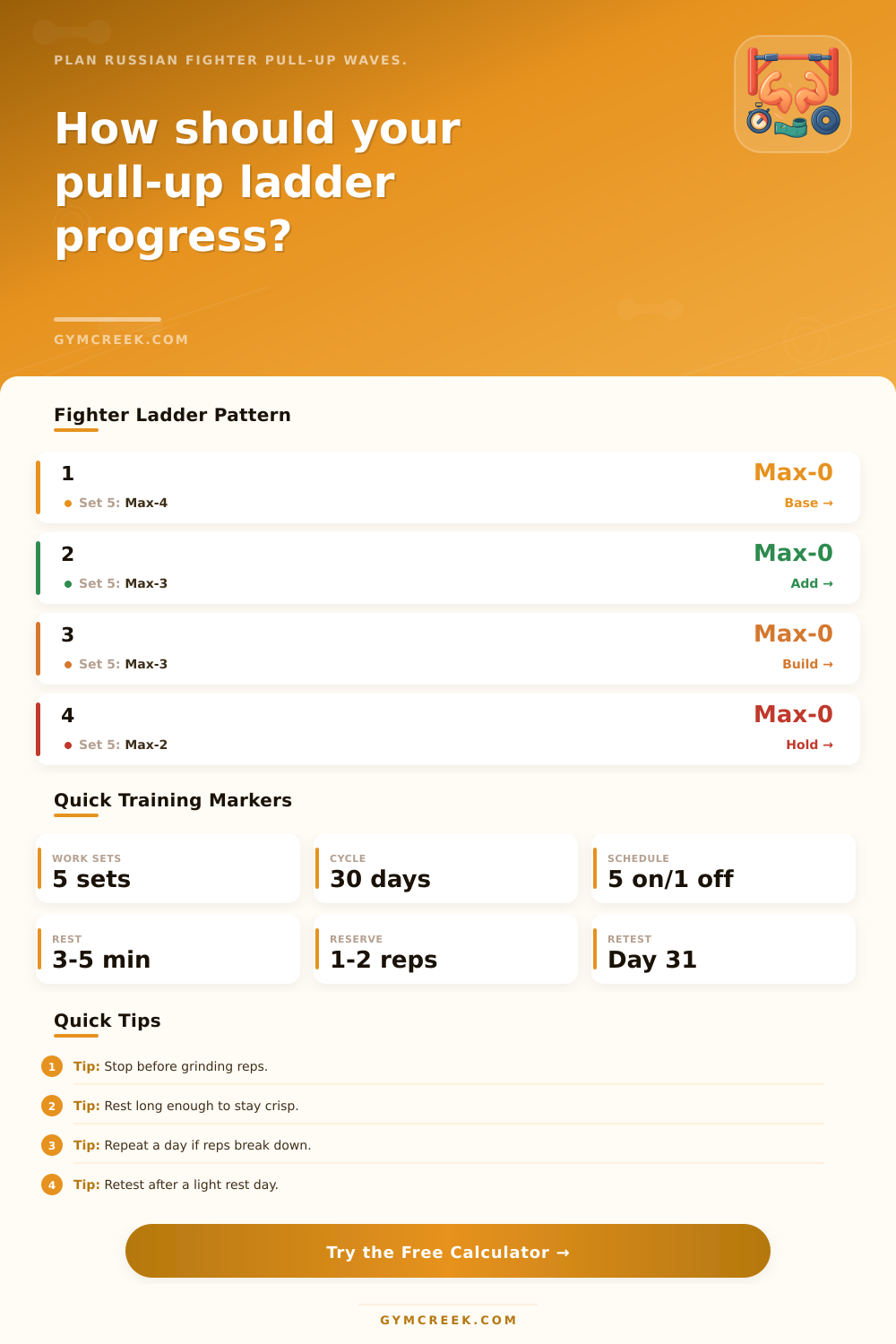
Russian Fighter Pull-Up Program Calculator
Turn a strict pull-up max into a 30-day fighter-style ladder with daily sets, total reps, density, and retest estimates.
📌Pull-Up Presets
Presets load realistic maxes, bodyweights, reserves, schedules, and progression rates, then calculate immediately.
⚙Calculator Inputs
Fighter pull-up snapshot
Enter a strict max to build your ladder.
📊Program Snapshot
📅Generated Training Calendar
| Day | Status | Ladder Sets | Daily Reps | Density | Note |
|---|---|---|---|---|---|
| Calculate to generate the day-by-day ladder. | |||||
📑Reference Tables
| Max Reps | Opening Top Set | Reserve | Cycle Aim |
|---|---|---|---|
| 3-5 | Max - 1 | 1 rep | Build skill |
| 6-10 | Max - 1 | 1-2 reps | Add volume |
| 11-15 | Max - 2 | 2 reps | Manage fatigue |
| 16+ | Max - 3 | 2-3 reps | Density focus |
| Style | Best For | Progression | Recovery Note |
|---|---|---|---|
| Standard | Most lifters | Steady slot raises | Repeat rough days |
| Conservative | Return phase | Slower raises | Best with soreness |
| Aggressive | Low max reps | Faster raises | Stop if grinding |
| Weighted | Strength block | Small rep raises | Longer rests |
| Standard | Men | Women | Meaning |
|---|---|---|---|
| Novice | 3-6 | 1-3 | Base strength |
| Intermediate | 7-12 | 4-7 | Regular practice |
| Advanced | 13-20 | 8-12 | Strong relative pull |
| Elite | 21+ | 13+ | High rep capacity |
| Formula | Variables | Use | Output |
|---|---|---|---|
| Ladder base | Max - reserve | Opening set | Set 1 |
| Backoff | Top - slot | Five sets | Daily reps |
| Density | Reps / rest | Pacing | Reps/min |
| Retest | Max + gain | Projection | New max |
💡Practical Notes
The Russian fighter pull-up program is an program that will help to increase the number of pull-ups that you can complete. Furthermore, the program is designed to build gains in your strength and endurance without causing excessive fatigue. The program will work for you because it will ensure that you never train to the point of muscular failure with the majority of your sets, and because the program will gradually increase the number of sets of pull-ups that you complete over the several week of training.
To gain the most benefits from the calculator, you must understand how your current maximum number of pull-ups will impact your first day of training within the program. For example, if you dont have a clear training program in your mind prior to using this tool, you could potentially find that you both add too many repetitions of pull-ups too quick, or that you perform the same number of repetitions for several weeks without gaining any strength. The calculator will ask for your maximum number of pull-ups as well as your body weight, your rest times between sets, and the training schedule that you would like to use.
How the Pull-Up Program and Calculator Work
Your maximum number of pull-ups will allow the program to determine your ceiling for your training, and the setting for the number of repetitions that you would like to leave in your tank for the first set will determine the number of repetitions of pull-ups that you will perform each session. If you use a reserve of one or two repetitions, your later sets will not become too difficult for your muscle to perform. Additionally, if you start too close to your actual maximum number of pull-ups, your later sets will begin to become forced, as will your recovery from the intense set of pull-ups.
The different progression styles for the program will allow you to control the rate at which your number of repetitions increases throughout your training. For example, if you use a conservative progression style, your body will have time to adjust to the new number of repetitions that you are performing, which is ideal for individuals that may have taken a break from performing pull-ups, or for individuals that may have issues with their shoulders. Alternatively, if you use an aggressive progression style, your top set of repetitions and your back-off sets will increase at a faster rate, which is appropriate for individuals whose maximum number of pull-ups is relatively low.
Additionally, by choosing the weighted option, you will be adding some extra weight to your sets of pull-ups, which will slow the increase in your repetitions. Each of the different progression styles will impact the fatigue score that this calculator represents, which will help to provide an estimate of whether you will feel fresh on the twenty-eighth day of training. The weekly schedule within the calculator will impact the number of days that you train each week.
For instance, if you choose the five-on, one-off schedule, you will train for several days in a row. This schedule is appropriate for individuals whose bodies can recover quickly from training. Conversely, if you choose the three-on, one-off schedule, you will allow for more time to rest in between training sessions, which may help your sleep and joint health.
Furthermore, the calculator will automatically calculate and display the number of training days that you will perform each week. The density within the program allows for you to choose the number of repetitions that you would like to perform within the amount of rest that you will take between sets. For example, if you allow for longer periods of rest, you will be able to take longer breaks between sets to allow your muscles to recover.
However, if you choose a shorter period of rest between sets, your pull-ups will be of a lower quality, and you may find that you are performing half-repetitions for your sets by the fourth or fifth set of pull-ups. Thus, the calculator will allow you to view this trade-off to determine whether you want to rest for four or five minutes between sets of pull-ups. The age within the calculator will ask for your age, as well as the type of grip that you will use during your sets of pull-ups.
For example, if you are an older athlete, you may experience more soreness after performing pull-ups than younger athletes; thus, the program will reduce the projected gains in your strength from the program if you are of an older age. Additionally, if you opt for a rotational grip, you will allow for more even distribution of the grip on each of the muscle groups involved in performing pull-ups, which may allow for increased recovery of those muscles. The reference tables will provide information regarding the maximum number of pull-ups for individuals of all ages, both men and women, as well as information about the different progression styles that may be best for those of various strengths.
Furthermore, the tables will provide examples of what is considered to be a novice, intermediate, or advanced level of strength for both men and women. Most individuals make the mistake of treating each training session as if it is a test to see how strong they are. For instance, if any of your repetitions begin to slow, or if your range of motion for performing pull-ups decreases, you should not increase the number of repetitions that you perform.
Instead, you should perform the same number of sets each session, as the program rewards those who are able to maintain crisp sets, and who take regular rests from training. Recovery from training is more important than the total number of sets of pull-ups that you perform. For instance, if you experience any soreness in your elbows or shoulders, and the soreness lasts longer than your rest days, this means that your starting reserve for your sets was too low, that you rested too often between sets, or that your training schedule was too intense.
Thus, the calculator does not have any way of measuring your joint pain, so you must listen to your body to ensure that your body is correctly setting up each of its calculations for the program. The projection of the number of pull-ups that you will be able to perform after completing the program is an estimate of your capability. Furthermore, this projection assumes that you will take at least one rest day prior to retesting your strength.
Some individuals will gain more strength than projected by the calculator, others will gain less, but the majority will experience an increase in there strength after following the suggestions of the calculator. Thus, the value of the tool is that it forces you to think about your reserve, your density, and your training schedule prior to beginning the program. Additionally, the method will likely succeed in increasing your number of pull-ups because it contains enough challenge to your muscles to provide gains, but not enough challenge that your form will collapse.