
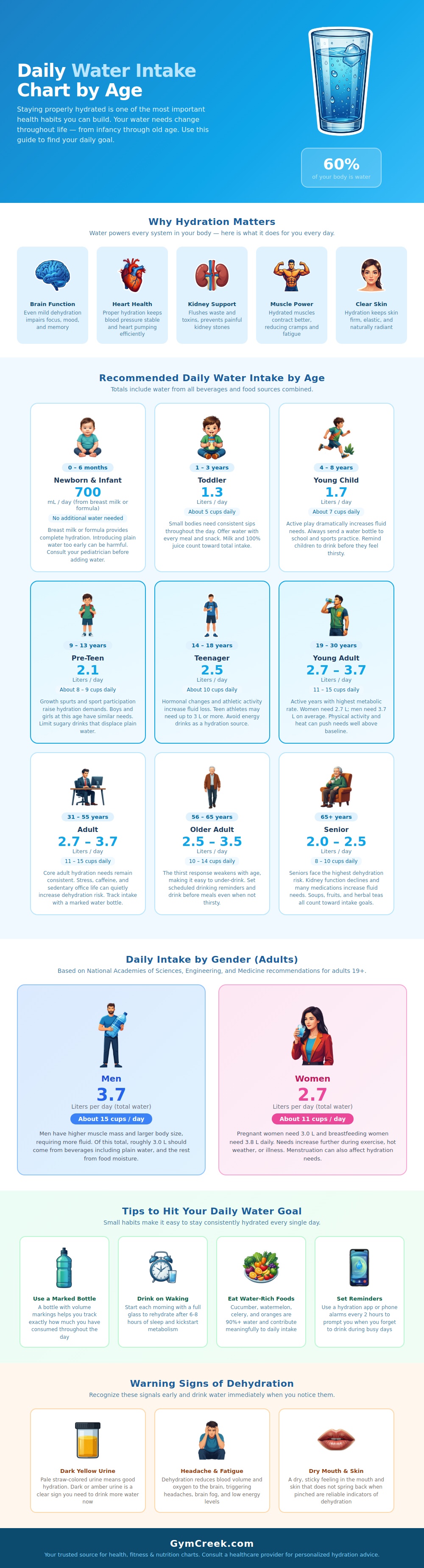
Water is necessary for a human body, but the amount of water that an individual need changes with age. Newborn babies requires a significant amount of water from breast milk or formula. However, teenagers may require more water than young children due to the fact that teenagers may be performing physical activity that cause them to sweat.
These types of changes is due to the change in the size of the body, the level of activity of those individuals, and the change in the efficiency of the kidney of those individuals with age. It is important for individuals to understanding these changes to allow them to understand the needs of the body for water at its current stage of life. Individuals require more water during their childhood years than adults, and the need for water peak during adulthood.
Water Needs at Different Ages
However, after the age of forty-five, individuals require less water than they did during their thirties. The need for water increases during the years when individuals are growing in size and metabolic rate. However, the bodys ability to sense thirst decrease with age, which means that an older individual may become dehydrated without feeling thirsty.
By reviewing the water requirement chart for humans of different ages, individuals can understand how their body’s water needs change with time. Additionally, by reviewing the water requirement chart for humans of different ages, individuals can make meal plans adjustments to ensure that they are drinking enough water each day. Water is required for a variety of bodily functions.
For instance, water helps to maintain stable blood volumes, which allows the heart to perform normal for the body; water provides cushioning for the bodys joints; and, most importantly, it allows the kidneys to efficient eliminate waste from the body. Not drinking enough water can lead to fatigue and difficulty in focusing on tasks. Water requirement charts separate the bodys basal requirement of water from the additional water that may be lost through the exposure to heat, physical activity, or illness.
Men require more water in the body than women due to the fact that men contains more muscle in there bodies. Muscle contains more water than other body parts, therefore women have less water in their bodies than men. However, women require more water than men if the woman is pregnant or breastfeeding the baby.
Other individual difference exist among the bodys fluids. For instance, an individual that performs heavy physical activity will require more water than an individual that performs little physical activity. It is important for the body to establish a habit of drinking water.
Most individuals only drink water when they feel thirsty. However, the body may be dehydrated prior to feeling thirsty. For instance, an individual can drink a glass of water when they wake up in the morning, consume a glass of water with lunch, and consume another glass of water prior to commuting to work in the evening.
Using a reusable water bottle will allow individuals to visually track their water consumption, and being able to visually track the amount of water that an individual has consume will allow them to ensure that they are meeting their water goals. Many of the food that an individual consumes add to the water that their body uses. Foods that are high in water content include fruits and vegetables.
These amounts of water are also accounted for in water requirement charts. Sugary beverage and caffeinated beverages may lead to an individual drinking less water than they should. Therefore, consuming these types of beverages in place of water can lead to a reduction of the water content in the body.
There are a variety of sign that indicate that an individual is dehydrated. Some of these signs include dark urine, headache, and dry skin that does not spring back to normal after being pinched. These signs typically appear before an individual understand that they are dehydrated.
Therefore, recognizing these signs is easier for individuals that understand their bodys water requirements at any given age. The requirements for water in the human body changes with time. For example, the amount of water that an individual of age twenty-five need may be different than the amount of water that an individual of age sixty-five need.
Therefore, it is important for each individual to periodically review the water requirement recommendations to ensure that they are drinking enough water to meet the requirements of their body at their current age.
