Elliptical METs Calculator
Estimate elliptical intensity, calorie burn, MET-minutes, heart-rate context, and weekly aerobic dose from your body size, duration, machine settings, effort, and optional watts.
📌Presets
Presets load realistic elliptical sessions. They are not programs; they simply show how METs change when machine type, cadence, resistance, ramp, heart rate, and optional watts change.
⚙Calculator
Estimated METs
Enter your workout details to estimate session intensity.
📊Workout Metrics
📑Reference Tables
| MET Band | Intensity | Typical Feel | Common Use |
|---|---|---|---|
| Under 3.0 | Light | Very easy, warm-up pace | Mobility, recovery, cool-down |
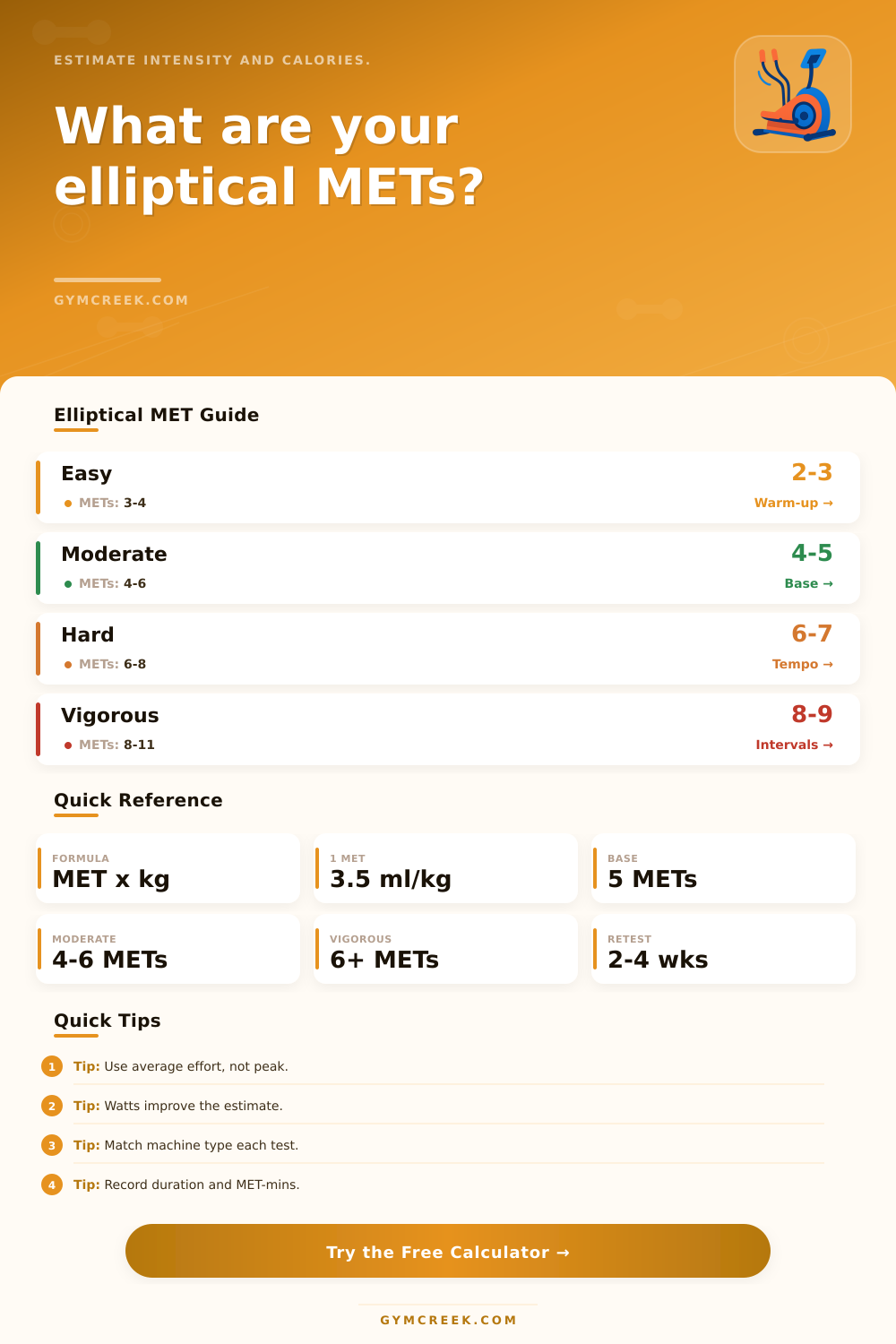
| 3.0 to 5.9 | Moderate | Breathing deeper but controlled | Aerobic base and steady sessions |
| 6.0 to 8.9 | Vigorous | Harder talking, focused effort | Tempo work and fitness blocks |
| 9.0+ | Very vigorous | Short phrases only | Intervals and performance efforts |
| Scenario | Inputs That Matter | Likely METs | Watch |
|---|---|---|---|
| Easy return | Low resistance, low RPE | 3.0 to 4.0 | Keep cadence smooth |
| Steady cardio | Moderate cadence and HR | 4.5 to 6.0 | Use average HR, not peak |
| Tempo climb | Ramp, resistance, RPE 7 | 6.5 to 8.5 | Machine levels vary widely |
| HIIT workout | Hard average, high watts | 8.0 to 11.0 | Include easy intervals in average |
| HR Reserve | Intensity | Typical Session | Calculator Effect |
|---|---|---|---|
| Under 40% | Light | Recovery or easy warm-up | Pulls MET estimate lower |
| 40% to 59% | Moderate | Comfortable steady cardio | Supports moderate MET range |
| 60% to 84% | Vigorous | Tempo or hard steady work | Supports higher MET range |
| 85%+ | Very hard | Intervals or race-like effort | Raises warning for fatigue |
| Formula | Variables | Output | Purpose |
|---|---|---|---|
| MET calorie equation | MET, kg, minutes | Gross kcal | Main calorie estimate |
| Net calorie equation | MET minus 1 | Active kcal | Above-resting energy |
| Watts VO2 estimate | Watts and body mass | VO2 and METs | Anchors measured sessions |
| Tanaka max HR | Age | Estimated max HR | Fallback heart-rate context |
| Mifflin-St Jeor | Age, sex, kg, cm | BMR | Daily energy context |
💡Tips
Elliptical training occupy a middle ground for many people. Elliptical training is easier on the joints than running, but it is more difficult to judge the effort relative to a treadmill session. The number on the elliptical console may not match the effort of the body.
Using a METs estimate allow a person to calculate the effort of the elliptical training session. The METs value calculates the effort, the body weight, and the length of the training session into one figure. This figure express the difficulty of the elliptical training session and the energy expended during the session.
How to work out METs and calories for elliptical training
To calculate a METs estimate for elliptical training, a person input factors related to the actual movement on the elliptical rather than factors related to the elliptical machine. The cadence at which a person turn the elliptical pedals is one of the input. The resistance and the ramp settings on the elliptical are another input.
The average heart rate while training are another input. The watts produced by an elliptical is another input. A calculator perform the math for the person, but the person must decide which inputs to use.
Body weight is a factor in the calculation because the number of calories burn is proportional to body weight. A person who weighs more than another person will burn more calories when performing the same elliptical training with the same METs. Lean body mass is another factor that influence the calculation.
The percentage of body fat influence the calculation. For the same MET value, a higher percentage of body fat mean a lower load on the body. This is an important factor for someone who tracks body fat percentage over many months of training.
Heart rate indicate the level of effort required by the body. Heart rate can tell a person how close to their maximum heart rate they are training without having to perform a test in a laboratory. Using a percentage of heart-rate reserve can indicate whether the elliptical training session was of moderate or vigorous intensity.
The calculator incorporate heart rate information into the calculation. The values for resting and maximum heart rate has an impact on the calculation. Using a person’s known maximum heart rate rather than an estimated value based on their age will produce a more accurate calculation.
The type of elliptical that a person use may impact the METs calculation. Elliptical machines that require the use of the upper body muscles may produce a higher METs calculation than standard elliptical models. Elliptical machines that are in a recumbent position may allow a person to lower the physical demand of the exercise.
These differences is not reflected on the elliptical machine console. A person has to note the make and model of the elliptical when tracking training sessions. The outputs of a METs calculation can help a person plan their future exercise routine.
The accumulation of MET-minutes throughout the week can indicate the total weekly exercise routine. A person can accumulate 500 to 700 MET-minutes weekly to indicate general fitness. Net calories is another calculation that indicate the number of calories burned during elliptical training that is above the body’s resting calories.
Net calories can help a person to separate the cost of training from the cost of having the body in its existing state. Separating these costs allow for the adjustment of nutritional intake during training blocks. A person might make many mistake with a MET calculation for elliptical training.
One of the most common is treating the elliptical console as the truth. Elliptical machines may vary in their measurements of resistance. The resistance on one brand of elliptical may not be the same as another brand.
A person might also make mistakes with the stride rate. Elliptical machines that use longer strides might require a different stride rate than those that use shorter strides. A person can avoid these mistakes by using the same elliptical machine for all MET calculations or by noting the difference between elliptical models in their training logs.
Another mistake is only averaging the minutes when a person was performing intense elliptical training. The average MET calculation should incorporate all training minutes, not just intense training. By entering the total length of training and the average heart rate into the calculator rather than the intense training numbers, the resulting MET value will be lower than expected, but reflect the METs that the body experience during the entire training session.
There are many factors that may impact the calculation of METs during elliptical training. Factors such as the temperature of the room where the elliptical machine is performing, the level of hydration of the person performing the routine, and the level of fatigue will all affect the calculation. A level of resistance that burns 6 METs during one elliptical training session may require a higher level of resistance to burn 6 METs during another training session due to fatigue.
While the numbers on the console provide a person with a baseline for training, a person should treat these values as only one data point within the context of training. One of the most useful habits is for a person to remain consistent in how they record elliptical training sessions. A person should always use the same elliptical machine, use average rather than peak values for resistance, stride rate, and calories burned, and always note their body weight on the day of the elliptical training session.
Using these habits will ensure that a person gain trends in their training that will allow them to adjust their training routine. The calculator will remove the arithmetic for a person so that these trends can be recognized quick.