Elliptical Distance Calculator
Estimate true elliptical distance from stride length, cadence, time, stride count, and machine-reported distance in miles or kilometers.
Distance Results
Your distance estimate will appear here after calculation.
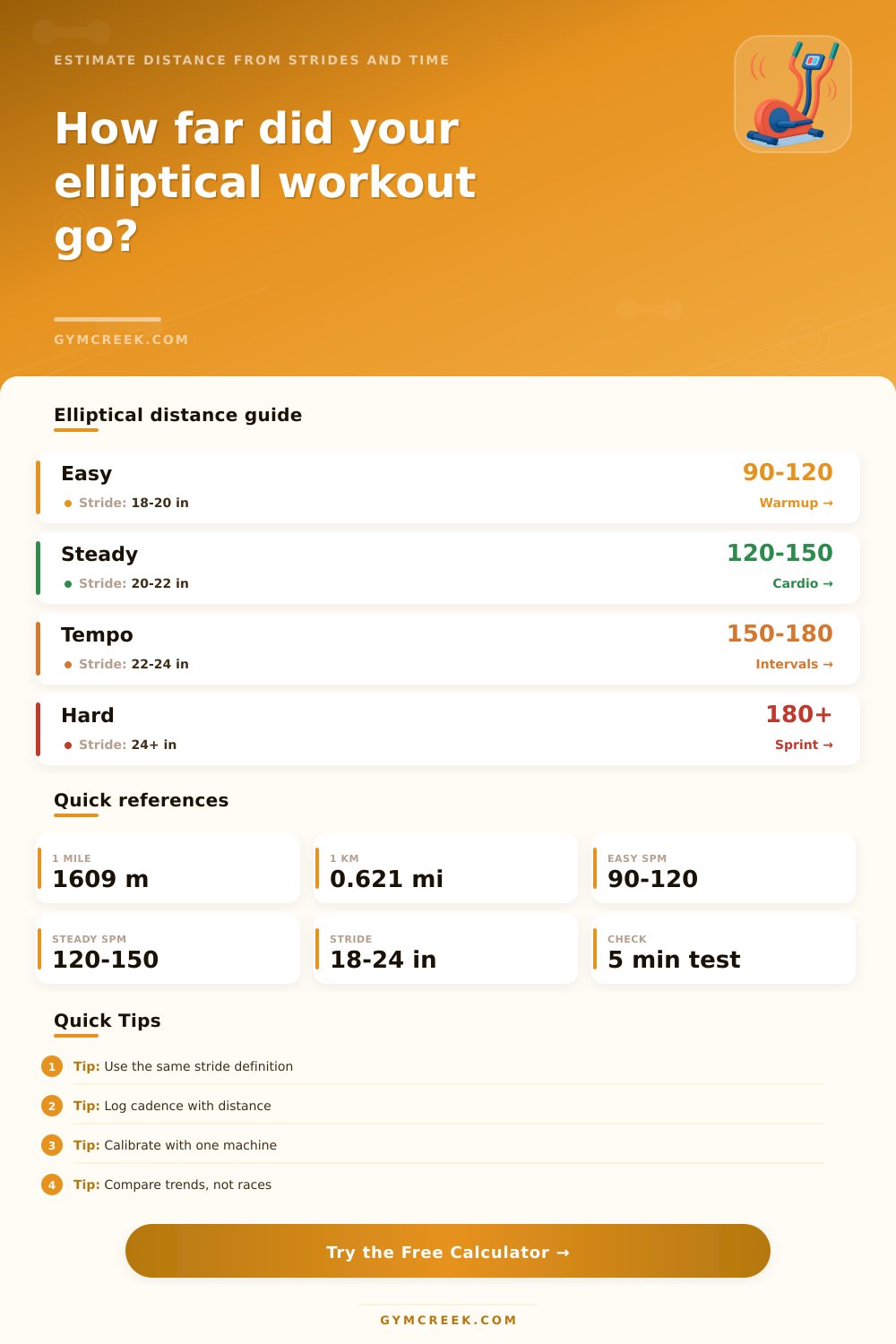
| Cadence band | Strides per minute | Common use | Distance note |
|---|---|---|---|
| Easy | 90–120 spm | Warmups, recovery | Shorter, more relaxed stride |
| Steady | 120–150 spm | Zone 2 and general cardio | Best for repeatable logging |
| Tempo | 150–180 spm | Moderate-hard intervals | Watch stride length drift |
| Sprint | 180+ spm | Short high-output repeats | Machine distance can overstate |
| Formula | Variables | Output | When to use |
|---|---|---|---|
| Distance = strides x stride length | Count, length | True path estimate | When stride count is reliable |
| Strides = cadence x time | SPM, minutes | Total strides | When only cadence is known |
| Machine adjusted = display x factor | Distance, calibration | Machine estimate | When display is consistent |
| Kcal = MET x kg x hours | MET, weight, time | Energy estimate | For workout load context |
| Stride length | Imperial | Metric | Typical fit |
|---|---|---|---|
| Compact | 16–18 in | 41–46 cm | Small frames, light work |
| Standard | 18–20 in | 46–51 cm | Most home ellipticals |
| Long | 20–22 in | 51–56 cm | Taller users, gym units |
| Extended | 22–24+ in | 56–61+ cm | Running-style motion |
| Scenario | Duration | Cadence | Expected distance |
|---|---|---|---|
| Recovery spin | 20 min | 105 spm | About 0.7–0.9 mi |
| Steady cardio | 30 min | 135 spm | About 1.3–1.6 mi |
| Tempo session | 35 min | 160 spm | About 1.8–2.2 mi |
| Long endurance | 60 min | 130 spm | About 2.4–3.0 mi |
An elliptical machine is exercise equipment that provide a low-impact workout for individuals. Additionally, an elliptical machine can help to increase an individual’s heart rate. Most elliptical machines has a distance number on the console of the elliptical machine.
However, the distance reflected on that console does not necessarily match the actual distance that the individual traveled on the elliptical machine. Elliptical distance calculators help to provide a better idea of the actual distance that an individual traveled on the elliptical machine. Elliptical distance calculators accomplish this feat by comparing the distance that the elliptical machine measured with the individual’s physical movement.
How to Use an Elliptical Distance Calculator
Elliptical machines calculate the distance that an individual traveled by either calculating the rotation of the elliptical machine’s flywheel or by calculating the length of an individual’s stride based on the movement of there feet on the elliptical machine’s pedals. The different elliptical machine brands and models perform these calculations in slightly different manner. For instance, one brand may calculate the distance traveled by an individual by counting every time that the individual makes a complete left-foot to right-foot movement along the elliptical machine.
Another brand may count every time that an individual places a foot upon the pedals of the elliptical machine. Because of these different counting methods, individuals can travel the same distance on the same elliptical machine yet recieve different distance numbers on their elliptical machine consoles over the span of time. Elliptical distance calculators allow individuals to input information about their stride length, the number of strides that an individual take in a minute (cadence), the length of time that they are using the elliptical machine, and the distance that is represented on the elliptical machine’s console.
The elliptical distance calculator can use this information to calculate the distance that the individual traveled on the elliptical machine by performing the calculations with that machine’s settings. Additionally, the elliptical distance calculator allows an individual to select the reliability settings for the distances that the elliptical distance calculator calculates. For instance, the elliptical distance calculator can calculate the individual’s distance based on the stride length of the individual and the distance calculated by the elliptical machine.
The balanced settings will favor the distance that is calculated based on the individual’s stride length. Additionally, the elliptical distance calculator can calculate the individual’s distance as the conservative calculation of the distance based on the stride length of the individual versus the distance calculated by the elliptical machine console. The conservative settings will calculate the distance as the lower of the two distances.
This setting is useful for individuals that believe that their elliptical machine calculates the distance that they traveled as too high. Elliptical distance calculators can make these mathematical calculations for individuals instead of requiring the individuals to manually calculate their distance. Stride length is the distance that an individual travels on the elliptical machine with each stride.
Although many individuals may believe that the default stride length for their elliptical machine is the length that their body is designed to travel, that may not be true. For instance, an individual that is tall may have a natural stride length of twenty-two inches or twenty-three inches. An individual that is short may have a natural stride length of eighteen inches.
An individual that changes the stride length setting on their elliptical machine will change the distance that is calculated by the elliptical machine. Therefore, by changing the stride length setting, the individual should also note the stride length that the individual is using. Cadence is the number of strides that an individual takes on the elliptical machine in a minute.
The table to the right has reference numbers for the cadence for different age groups. Additionally, an individual may notice that their cadence changes over time. For instance, an individual may find that performances on the elliptical machine with a cadence of one hundred thirty-five strides per minute may feel different than performances at a cadence of one hundred fifty strides per minute.
Additionally, higher cadences may require individuals to travel shorter strides with their feet on the pedals and may result in higher heart rates. An individual can use the elliptical machine distance calculator to determine if the individual’s average cadence is increasing over time. An individual can enter their weight and their height into the elliptical distance calculator.
However, these two measurements will not impact the distance calculation. Instead, their weight will impact the number of calories that the individual burns during their elliptical workouts. An individual that weighs more pounds will burn more calories than an individual that weighs less pounds during the same workouts.
Additionally, the individual’s height can be used to calculate their stride length. Therefore, if the individual feels awkward using the stride length that is recommended based off their height, they can adjust the settings of the elliptical machine to better accommodate their body. The calibration factor allows for adjustments to elliptical machine settings because elliptical machines may drift from their original settings over time.
For instance, the rubber drive belts that connect the elliptical machine’s pedals to the machine’s flywheel may stretch over time. Additionally, the sensors on the elliptical machine that calculate the distance that the individual traveled may accumulate dust over time. When an individual feels that the distance calculated by the elliptical machine does not reflect their actual distance traveled, they can perform a five-minute workout on the elliptical machine.
When the individual performs the five-minute workout, they can write the percentage difference between their distance traveled calculated by the elliptical machine versus calculated by their stride length into the elliptical distance calculator as their calibration factor. Using this calibration factor will allow the elliptical distance calculator to calculate distances for the individual that are more accurate than they may be with their elliptical machine settings. The elliptical distance calculator can provide an individual with an estimation of the number of METs and calories that were burned during their elliptical workouts.
METs and calories are important because distance is not the only measurement of the strength of an individual’s workout. The resistance and incline settings on an elliptical machine impact the tiredness that an individual feels after their elliptical workouts, even if the distance that they traveled is the same. For instance, an individual may perform two elliptical workouts of the same distance and length.
However, one elliptical machine may have higher resistance settings than the other. In this case, the individual may feel more tired after one elliptical workout than they did after the other workout. Therefore, using the MET and calorie calculations will allow an individual to determine if the strength of their workouts were challenging enough to accomplish their goals with their workouts.
Some individuals may make mistakes when they use an elliptical distance calculator. For instance, some individuals may enter the total number of strides that the individual covered in a specific amount of time when the elliptical machine was already calculating those strides. In this case, the individual may find that the distance that they traveled was twice as long as it actualy was.
Additionally, some individuals may switch between imperial measurements and metric measurements without adjusting their numbers. For instance, an individual may use imperial measurements to determine their stride length, but use metric measurements for their distance calculations. Additionally, an individual may enter the stride length in inches yet measure the distance in kilometers.
These types of errors in input will make it difficult to accurately compare the distance calculations of an individual to others or their previous distances traveled on the elliptical machine. Elliptical distance calculators allow individuals to see the difference between the measurements of distance calculated by their elliptical machine versus calculated based upon their stride length. An individual can use this calculation to determine which distance calculation is more reliable.
Even though an elliptical distance calculator will provide an individual with an estimated distance for the distances that they travel on the elliptical machine, the estimate is still useful. Elliptical distance calculations will be even more useful for individuals that use the same elliptical machine, use the same stride length, and have the same logging habits as their distance estimates calculated by the elliptical distance calculator will create a trend line for that individual. Elliptical distance calculators allow for individuals to avoid performing the mathematical calculations themselves.
Additionally, an individual can use the elliptical distance calculator to more closely monitor their performance on the elliptical machine. For instance, by logging their cadence and their stride length in different months, an individual can determine if their performance on the elliptical machine is increasing in strength. Elliptical distance calculators provide an individual with information that can be used to transform that elliptical machine into a useful piece of exercise equipment.