Treadmill METs Calculator
Estimate treadmill METs, VO2, calorie burn, pace, vertical gain, heart-rate context, and training intensity from speed, grade, duration, and body size.
📌Presets
Presets load realistic treadmill sessions and recalculate METs, VO2, calories, pace, and workload immediately.
⚙Calculator
Treadmill METs snapshot
Enter speed, grade, duration, and body size to estimate treadmill workload.
📊Training Metrics
📑Reference Tables
| Mode | Equation | Speed input | Best use |
|---|---|---|---|
| Walking | 0.1S + 1.8SG + 3.5 | m/min | Walking and power hiking |
| Running | 0.2S + 0.9SG + 3.5 | m/min | Jogging and running |
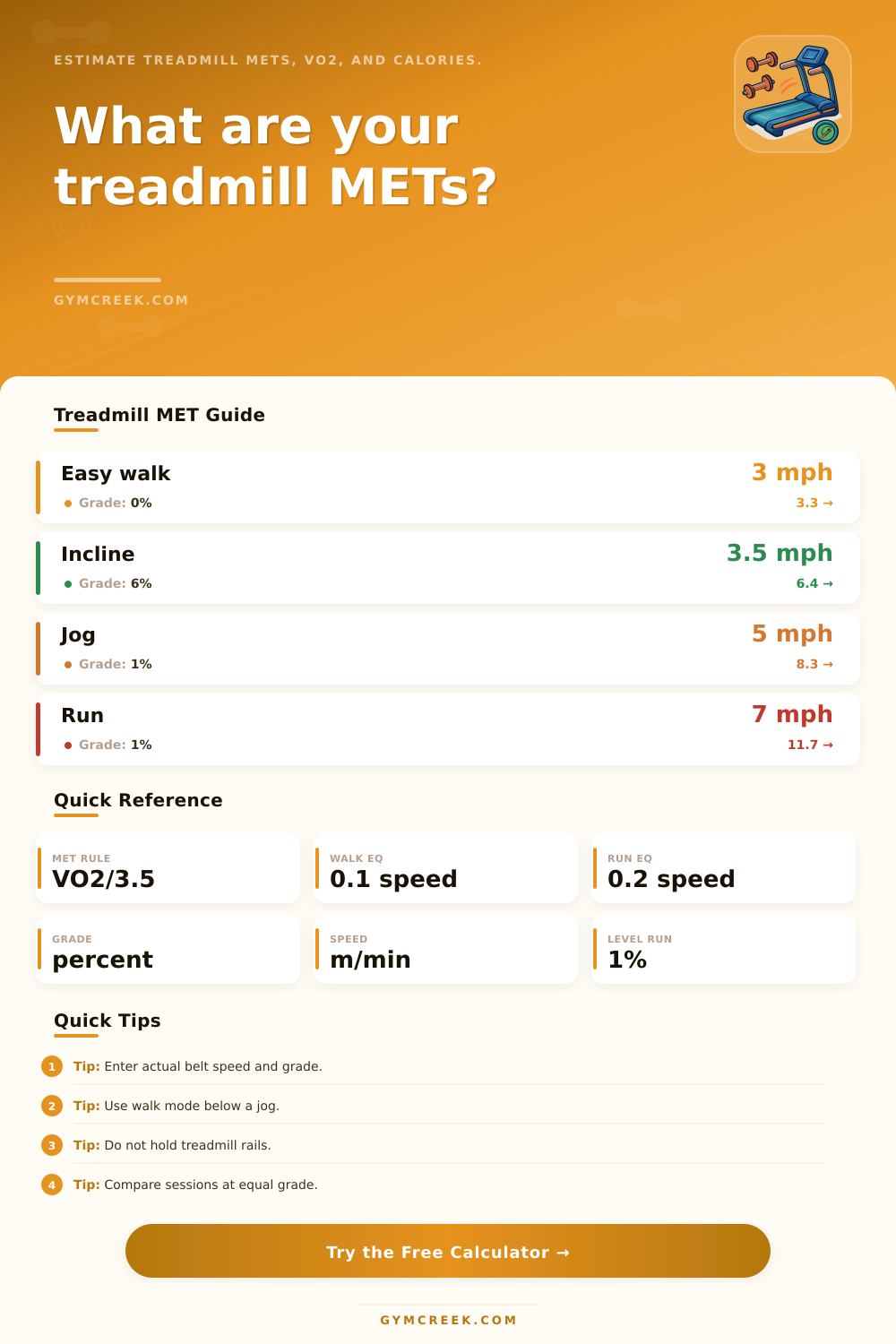
| METs | VO2 / 3.5 | ml/kg/min | Workload comparison |
| Calories | MET x 3.5 x kg / 200 | per minute | Session energy estimate |
| Session | Speed | Grade | Approx METs |
|---|---|---|---|
| Easy walk | 3.0 mph | 0% | 3.3 |
| Brisk walk | 3.8 mph | 1% | 4.4 |
| Incline walk | 3.5 mph | 8% | 7.2 |
| Steady jog | 5.5 mph | 1% | 9.0 |
| Fast run | 7.5 mph | 1% | 12.5 |
| MET range | Category | Typical feel | Training use |
|---|---|---|---|
| Under 3 | Light | Very easy | Warmup or recovery |
| 3-5.9 | Moderate | Breathing rises | Aerobic health work |
| 6-8.9 | Vigorous | Talk in phrases | Conditioning |
| 9+ | High | Hard sustained | Running fitness |
| Check | Good signal | Watch point | Why it matters |
|---|---|---|---|
| Grade | Known setting | Console drift | Grade changes METs fast |
| Rail use | No support | Holding rails | Can lower real effort |
| Speed | Stable belt | Short intervals | Average speed matters |
| HR | Matches RPE | Oddly high | Check fatigue or heat |
| Speed | Min per mile | Min per km | Common mode |
|---|---|---|---|
| 3.0 mph | 20:00 | 12:26 | Easy walk |
| 4.0 mph | 15:00 | 9:19 | Brisk walk |
| 5.0 mph | 12:00 | 7:27 | Jog |
| 6.0 mph | 10:00 | 6:13 | Easy run |
| 8.0 mph | 7:30 | 4:40 | Fast run |
| Variable | Meaning | Unit | Source input |
|---|---|---|---|
| S | Treadmill speed | m/min | mph or kph converted |
| G | Decimal grade | percent / 100 | Incline setting |
| VO2 | Oxygen cost | ml/kg/min | ACSM equation |
| MET | Metabolic equivalent | VO2 / 3.5 | Calculated output |
💡Tips
A treadmill METs calculator are a tool that uses specific formulas to calculate the MET value for your treadmill workout. The MET value is based on the amount of oxygen that your body use during the exercise relative to the amount of oxygen that your body uses while sitting at rest. One MET represent the amount of oxygen that a person uses while sitting quiet.
However, during a treadmill workout, the MET will be higher, as the treadmill requires a greater amount of oxygen from the body than does sitting. Thus, a person who walk at a slow pace on the treadmill will have a MET value of three or four; a person who runs at a fast pace will have a MET value higher than ten. The American College of Sports Medicine create these formulas.
How a Treadmill METs Calculator Works
There are separate formulas for treadmill workouts that involve walking versus those that involve running. The walking equations factor in the amount of time that the person’s foot spend on the treadmill while they are walking, as well as the amount of force that the body muscles use to lift the body while walking. The running equations factor in the amount of time that a runner’s feet are off the ground, or in a “flight phase,” as well as use a different equation that calculates the amount of force that must be use to run compared to walking.
To calculate MET values, the treadmill METs calculator will ask for your body weight, the amount of time that you spend on the treadmill, your walking or running speed, your body weight, and the grade of the treadmill. Each of these variable will allow the calculator to use the formulas related to either walking or running to calculate your MET value. The grade of the treadmill have a significant effect on the MET value calculated.
MET values will be low for individual who walk on a treadmill at three miles per hour on a flat surface. However, increasing the grade of the treadmill to, say, six or eight percent will almost double the MET value. This relationship occurs because as individuals walk on an incline, they must lift their entire body mass upward against the force of gravity.
While the treadmill do not change the force of gravity, it does allow individuals to have a grade that can be used to calculate MET values. Furthermore, because treadmills allow individuals to maintain the same grade during workouts, it is possible to compare two treadmill workouts to each other in a precise way. Body weight is another variable that can influence the MET value calculated on a treadmill METs calculator.
This is because the number of calories that an individual burn while on the treadmill is related to the body weight of that individual. The heavier an individual is, the more mass that they must move with each step that they take on the treadmill. Thus, a heavier runner will burn more calories then a lighter runner while maintaining the same speed and grade on the treadmill.
While the MET value that is calculated does not change with body weight, the number of calories burned will increase with body weight. Therefore, using the calculator allows individuals to separate the strength of each workout from the energy of that individual’s body. The METs calculator can not calculate the heart rate of an individual while on the treadmill directly.
Each individual will have a different resting and exercise heart rate. Two individuals that have the same MET value during treadmill workouts may have vastly different heart rates while performing those workouts. An individual can type in their resting and exercise heart rate into the calculator.
This will allow individuals to compare their heart rates to the METs that the calculator calculate. High heart rates may indicate that the individual is experiencing fatigue, illness, or is too warm on the treadmill. Many individuals do not use the handrails on the treadmill, yet the use of these handrails is a variable that can influence the MET value calculated by the calculator.
If an individual grip the handrails while jogging or walking on the treadmill, the individual will reduce the amount of work that their leg muscle must perform to move the body. Reducing the amount of work that the legs must perform will reduce the MET value by ten to twenty percent. Thus, the MET value displayed on the treadmill will likely be higher than the true MET value that is being calculate.
Using the METs calculator will allow an individual to account for the use of the handrails when determining the true MET value of the individual’s treadmill workouts. In addition to calculating the MET values for treadmill workouts, the calculator will calculate the pace and distance run by the individual during those workouts. These values can be used to compare the treadmill workouts to outdoor workouts at the same pace.
While the pace on the treadmill will be the same as the pace that an individual covers on a road at the same time, the MET value will change depending upon the condition of those outdoor workouts. The MET and the pace can be used to determine whether treadmill workouts are an adequate substitute for jogging on the road. Additionally, the calculator will provide estimates of the amount of distance or volume of exercise an individual should perform each week to meet their fitness goals.
Using these measurements, individuals can ensure that each treadmill session provide enough energy expenditure to meet their physical requirements. To provide accurate calculations of MET values, it is important for each individual to remain consistent in their treadmill workouts. Each individual should use the same methods and habits with each treadmill session.
Using the same warm-up routines, using the same methods for gripping the handrails, and using the same methods of reading the METs displayed on the treadmill will ensure that each individual’s MET value is accurate and can be used to track their improvement over time. Any change in these variables will cause alteration to the individual’s calculated MET value, preventing accurate comparisons between different treadmill sessions. Thus, the goal of each individual is to find a useful session on the treadmill that records the speed at which they ran or walked, the grade of the treadmill, the length of the exercise session, and the contact of the individual’s hand with the handrails on the treadmill.