Treadmill Speed Calculator
Convert treadmill speed to pace, pace to speed, incline to effort, and workout duration to distance, calories, METs, VO2, and heart-rate targets.
📌Treadmill Presets
Each preset fills realistic treadmill settings and recalculates speed, pace, incline effort, calories, and distance immediately.
⚙Calculator Inputs
Treadmill speed estimate
Enter speed, pace, incline, and duration to calculate treadmill effort.
📊Fitness Metrics Grid
📑Reference Tables
| Speed | Pace per mile | Pace per km | Common use |
|---|---|---|---|
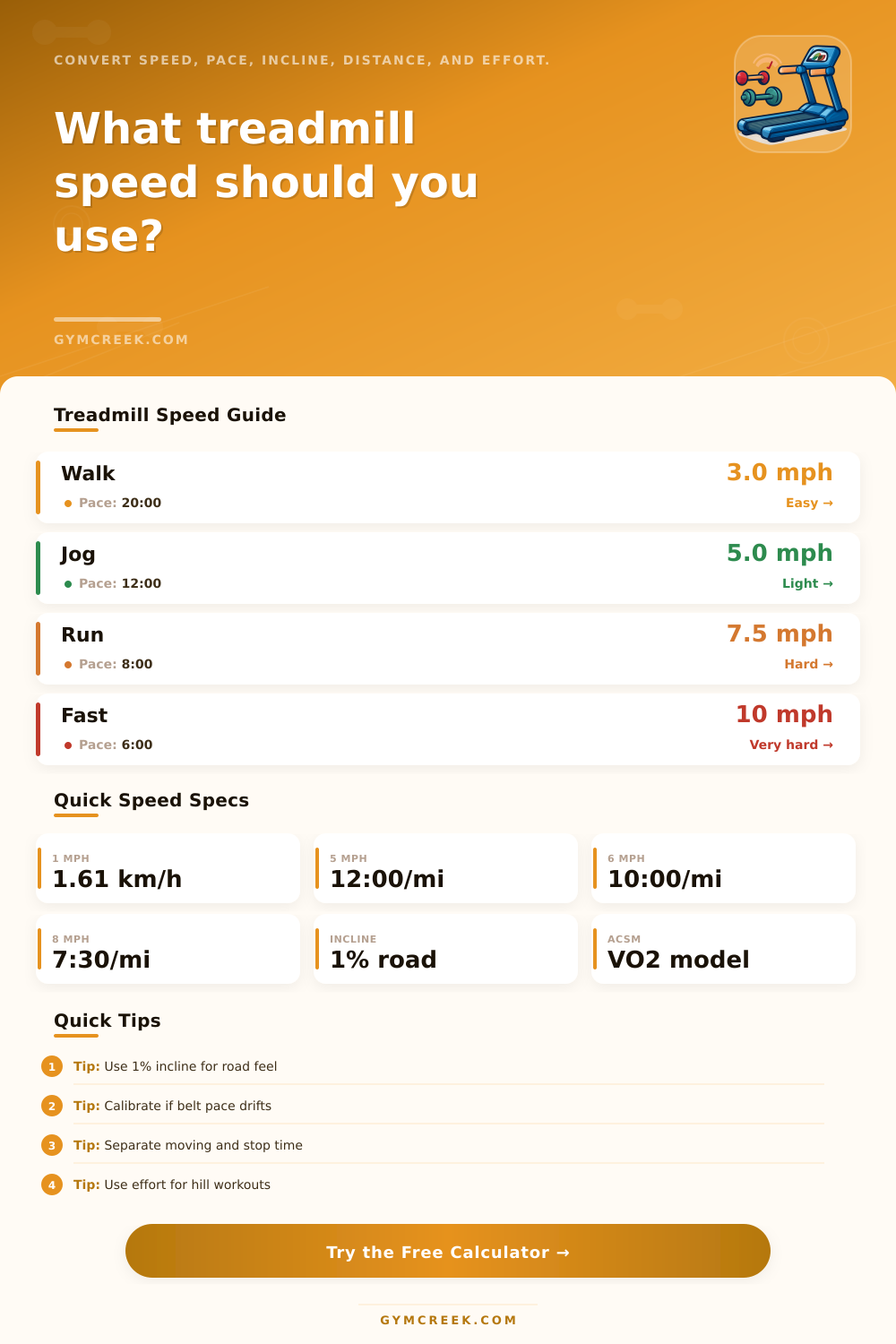
| 3.0 mph / 4.8 km/h | 20:00 | 12:26 | Easy walk or warm-up |
| 4.0 mph / 6.4 km/h | 15:00 | 9:19 | Fast walk or incline base |
| 5.0 mph / 8.0 km/h | 12:00 | 7:27 | Easy jog transition |
| 6.0 mph / 9.7 km/h | 10:00 | 6:13 | Steady recreational run |
| 7.5 mph / 12.1 km/h | 8:00 | 4:58 | Tempo or 5K style pace |
| 10.0 mph / 16.1 km/h | 6:00 | 3:44 | Fast repeat or advanced run |
| Incline | Use case | Effort effect | Notes |
|---|---|---|---|
| 0% | Flat belt speed work | Lowest oxygen cost | Useful for pure pace conversion |
| 1% | Road-feel run | Small effort bump | Often used to mimic outdoor air cost |
| 3-5% | Steady hill aerobic | Moderate effort rise | Reduce speed to hold the same zone |
| 6-10% | Incline walk or hill reps | High oxygen cost | Handrail support changes load heavily |
| 10% plus | Short hill strength | Very high effort | Use shorter bouts and monitor RPE |
| Formula | Inputs | Output | When used |
|---|---|---|---|
| Speed to pace | 60 divided by mph | Minutes per mile | Direct treadmill conversion |
| ACSM walking | Speed, grade | VO2 and METs | Below 5 mph or incline walking |
| ACSM running | Speed, grade | VO2 and METs | Running speeds at 5 mph or faster |
| Mifflin-St Jeor | Sex, age, height, mass | BMR estimate | Daily energy context only |
| Tanaka HRmax | Age | Heart-rate zone | Training intensity estimate |
| Workout type | Speed pattern | Incline pattern | Best metric |
|---|---|---|---|
| Recovery | Stable and comfortable | 0-1% | Talk test and low heart rate |
| Steady endurance | Even speed | 0-2% | Distance and aerobic zone |
| Tempo | Controlled hard speed | 0-1% | Pace and threshold feel |
| Intervals | Fast repeats and recoveries | 0-3% | Work share and repeat pace |
| Hill session | Lower speed | 4-10% | METs and flat-equivalent pace |
💡Treadmill Calculation Notes
Treadmills can be difficult to measure because the treadmill will show numbers for the workout that dont indicate how much the body is working. The treadmill will show how fast the belt is moving, but that does not factor in an incline of the treadmill. The incline of the treadmill can make the workout more difficultly.
The incline of the treadmill can make a difference in the amount of energy the person burns during the workout. In order to understand the workout that was completed on the treadmill, one must consider the speed of the treadmill, the incline of the treadmill, the body weight of the individual on the treadmill, and the length of the workout. Each of these factors can make a difference in how intense the workout was for that individual.
What Makes a Treadmill Workout Harder or Easier
Often, people consider speed and pace to be two different concepts. Speed is the speed of the treadmill belt. Pace is the amount of time it takes for an individual to travel a specific distance on the treadmill.
If an individual changes the incline of the treadmill, their speed may have to change. A small incline may require a greater change in speed then people may think is necessary. A calculator can help an individual determine the proper speed for their incline; the calculator can account for the incline of the treadmill and the individuals target pace.
The incline of the treadmill can change the purpose of the workout. Many individuals will use a one percent incline to simulate the effect of wind resistance when running outdoors. A one percent incline is a small incline.
Four or six percent inclines is consider harder inclines to run on a treadmill. The incline can increase the demand on the cardiovascular system. A higher incline demands more effort from the heart and lung.
If an individual maintains the same speed while increasing the incline, they will be performing more intense training than they originally planned. If they slow their rate, they will not burn as many calorie as they should while on the treadmill. Several factors impact the number of calories that an individual will burn during their treadmill session.
The weight of the individual will impact the number of calories burned. The incline of the treadmill will also impact the number of calories that are burned. Additionally, whether or not the individual utilizes the handrails on the treadmill will impact the number of calories burned.
If an individual grips the handrails, the body will not have to move its weight forward as much; thus, the legs will not burn as many calories. If the handrails support the bodys weight, the legs will not have to move the body forward on the treadmill. Therefore, the use of the handrails will impact the number of calories that are burned during the treadmill session.
The duration of the treadmill session also has an impact upon the total workload of that exercise. For instance, a thirty-minute session that includes a warm-up and recovery jogs will have a different total workload than a session that includes only the steady walking speed of the exerciser. Sessions that include a variety of different intensities will cover less distance and burn fewer calories than sessions that include only those of one intensity.
Furthermore, it is not simply possible to multiply the target pace of an exercise by the number of minutes that the exercise is performed; the inclusion of various intensities will impact the average pace that can be achieved in a session of thirty minutes, for instance. Another of the ways in which one can measure the workload of a treadmill exercise is through the use of heart-rate zones. Many exercisers use calculators to determine their age-predicted maximum heart rates; however, these values are not always accurate of the predicted heart rates of those individuals.
Sessions that require the exerciser to reach higher rates of tempo will include higher heart-rate zones than those that are thought to be “easy” aerobic sessions. Calculators can help to convert the purpose of the exercise to a heart-rate zone, allowing for the exerciser to compare their perceived exertion with that heart-rate zone. If there is a difference between these two rates, it is possible that the treadmill is not calibrate correctly, that the incline is incorrect, or that the exerciser is using the handrails incorrectly.
Environmental factors may also impact the bodys exertion upon the treadmill. For instance, performing an exercise in a warm room with poor airflow may increase the exercisers heart rate. Thus, a treadmill session in such an environment may be felt as more difficult than if performed in a cool room with a fan blowing upon the exerciser.
Though these factors are not displayed on the treadmill console, they can impact the bodys need for recovery following the session upon the treadmill. The calibration of the treadmill may change over time. The rate of the treadmill displayed on the console does not necessarily indicate the actual speed of the running tread of the treadmill.
If the treadmill display is inaccurate, then other measurements of the performance upon the treadmill will also be inaccurate. The accuracy of the treadmill can be measured by performing the same distance on an outdoor course or by using a footpod to measure the distance performed by the exerciser. Though the treadmill display is one of the data values that can be used to monitor performance upon the treadmill, there are others that should also be considered.
The speed, the incline, the MET level, and the heart-rate zone can all help to provide an understanding of the bodys exertion during the exercise. For instance, it is possible for the body to perform a slow walk up an incline that burns the same amount of oxygen as a faster jog on a flat treadmill. The ability to understand these different relationships allow for different treadmill exercises to be substituted for one another, especially in the case of schedule or weather related issues.
Furthermore, the use of calculators can help to understand these relationships. Thus, each of these tools helps to create a controllable environment upon the treadmill for the exerciser.