Kettlebell Swing Calculator
Estimate swing volume, calories, mechanical work, power, cadence, density, and training load from bell weight, reps, sets, duration, and effort.
📌Presets
Presets load full swing-session examples and recalculate workload, energy, power, and density immediately.
⚙Calculator
Kettlebell swing workload
Enter your session to estimate energy, volume, power, and density.
📊Swing Metrics
📑Reference Tables
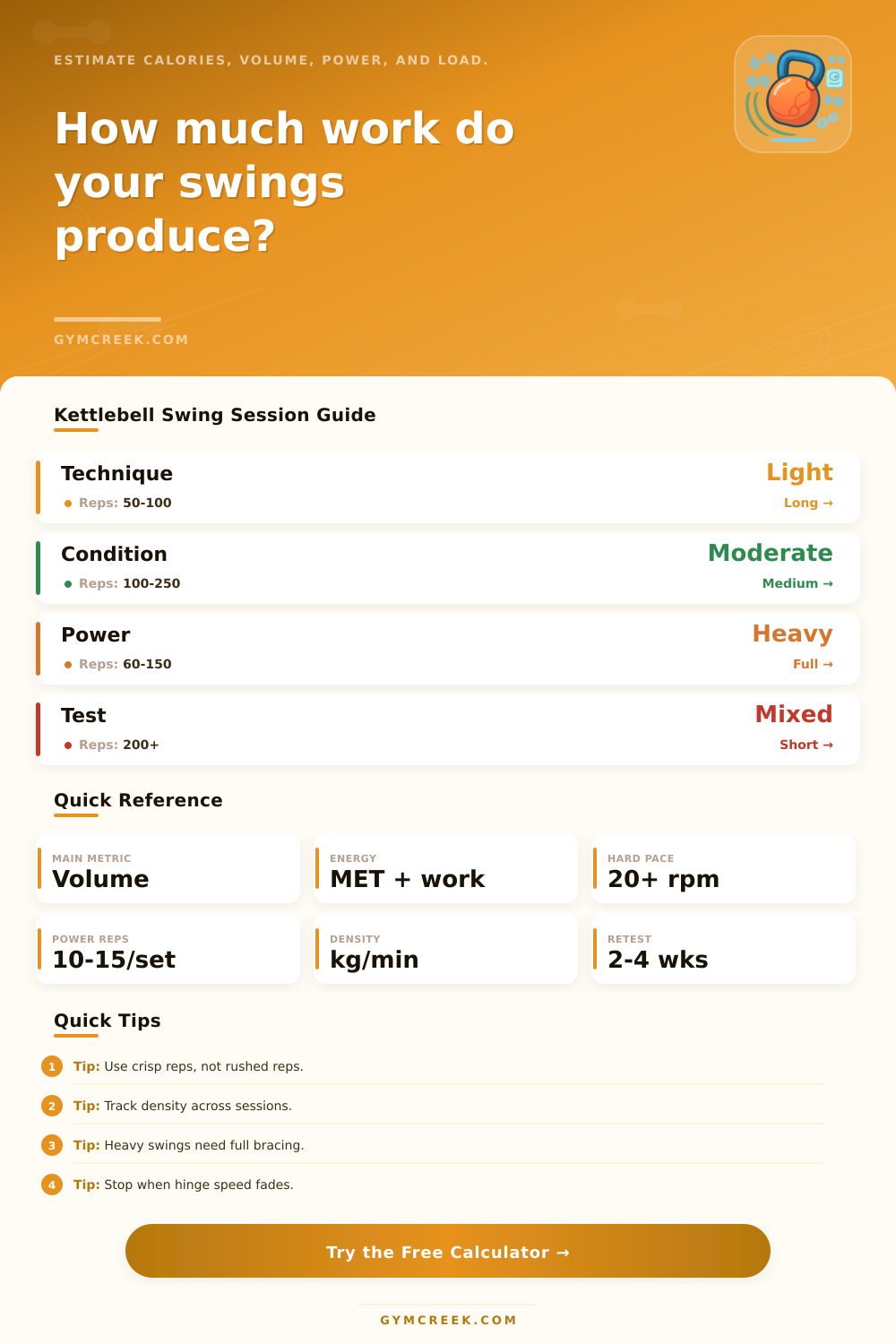
| Session Type | Total Reps | Cadence | Use |
|---|---|---|---|
| Technique practice | 50-100 | 10-15 rpm | Groove the hinge |
| Conditioning block | 100-250 | 16-24 rpm | Work capacity |
| Power session | 60-150 | Explosive sets | High intent reps |
| Density test | 200+ | 20+ rpm | Repeatable benchmark |
| Bell / BW | Typical Feel | Best Use | Watch |
|---|---|---|---|
| Under 15% | Light | Warm-up and skill | Rushing reps |
| 15-25% | Moderate | Conditioning | Breathing |
| 25-35% | Heavy | Power and strength | Bracing |
| 35%+ | Very heavy | Low-rep power | Hinge quality |
| Swing Style | Range | MET Bias | Notes |
|---|---|---|---|
| Hardstyle two-hand | Chest | High | Power hinge |
| One-hand swings | Chest | Higher | Anti-rotation |
| American swing | Overhead | Higher | Longer path |
| Kettlebell sport | Efficient | Moderate | Pacing focus |
| Dead-stop swing | Reset | High | More acceleration |
| Formula | Variables | Output | Purpose |
|---|---|---|---|
| Volume load | Bell x reps | kg or lb | Workload size |
| MET calories | MET x kg x time | kcal | Energy estimate |
| Mechanical work | m x g x height | joules | Power estimate |
| Mifflin-St Jeor | Weight, height, age | BMR | Body context |
💡Tips
Kettlebell swing consist of a hinge and a snap. Depending on the type of training that you perform with the kettlebell swings, kettlebell swings can be used for power or conditioning work. For power work, use heavy kettlebell with long periods of rest between each set of kettlebell swings.
For conditioning work, use lighter kettlebells with short periods of rest between each set of kettlebell swings. Because there are two types of work that you can perform using kettlebell swings, you must use a way of measuring the kettlebell swings that can account for the type of work being perform. One of the factor to consider in measuring the number of kettlebell swings is your body weight.
How to Measure and Track Kettlebell Swings
A 24-kilogram kettlebell will feel very heavy for a person that weigh 65 kilograms but will feel much more lighter for a person that weighs 95 kilograms. Another factor to consider is how ready you are for the workout. A person that feel sharp will be able to produce more power with each set of kettlebell swings than a person who is recovering from an intense period of training.
The style in which you perform the kettlebell swing will change the type of work that you perform with the kettlebell. Performing a hardstyle two-hand kettlebell swing will require the kettlebell to travel a shorter distance than an American style kettlebell swing in which you swing the kettlebell over head. The one-hand kettlebell swing will require the use of the obliques to stabilize the upper body and will also require more grip strength than a two-hand kettlebell swing.
Sport kettlebell swings allow for a higher total number of repetitions to be performed. The cadence at which you perform the kettlebell swings along with the periods of rest between sets will determine if the session is used to perform power work or conditioning work. By performing short periods of rest between sets conditioning work, you will increase the density score for that session.
By performing long periods of rest between sets you will be able to produce higher power with each set of kettlebell swings. The rating of per perceived exertion (RPE) can account for the effort that you put into each session. The higher the RPE, the more effort that you will put into each set of swings.
As such, the intensity of each workout will alter the number of calorie that are burned. The calculator account for the RPE of each training session to determine the calories that will be burned during that session. The reference tables that are provided can provide information on typical range of repetitions for different types of sessions.
For instance, power sessions will typically include fewer than 150 repetitions whereas density tests will include more than 200 repetitions for the same duration of training. However, these reference tables are not a means of replacing your own training judgment. A mistake that individuals often make in performing kettlebell swings is that individuals do not acknowledge the middle ground between strength and cardio training.
Some individuals will use kettlebells that are too heavy and will take long periods of rest between each set. Other individuals may use too light of a kettlebell but will perform the repetitions at a rapid rate. The most effective sessions will use a load that is heavy enough to develop proper technique but light enough to increase the total number of repetitions that may be performed.
By keeping track of the density of the repetitions that you perform with the kettlebell swings you will be able to notice any improvements in your work capacity. If your density score increase over a period of several weeks your work capacity has increased. Another means of measuring your improvement is to measure your score for density over time.
This will provide you with a means of comparing your effort between different sets of training sessions. The calculation of the mechanical work that you perform with the kettlebell swings is a simple process that multiplies the weight of each kettlebell by the distance that it travel and the number of repetitions that are performed. The calculation also includes an efficiency factor for swings that are not performed perfectly with each repetition.
As some energy is lost during each repetition, the efficiency factor will increase the estimated energy that is used during each training session. The training load account for the various factors that determine the intensity of your training session. This training load does not account for how you feel during training but allows you to compare the intensity of two training sessions.
The training load is a single number that accounts for all of the factors mentioned in this discussion. These calculations will allow you to notice any patterns in your training over time. For instance, if your cadence decreases but your density score does not change, you are likely becoming fatigued during your training sessions.
Another example of the usefulness of these calculations will be if you notice that your power score remains the same but you can no longer complete the total number of repetitions that you used to perform. In either case, the calculator will allow you to visually understand your training without having to rely on your memory to explain what occur during your training sessions.