Incline Dumbbell Press Calculator
Estimate incline dumbbell press e1RM, total pressing load, barbell carryover, target dumbbell weight, and body-weight strength ratio from a recent set.
📌Presets
Presets fill realistic incline dumbbell press scenarios and recalculate the estimates immediately.
⚙Calculator
Incline dumbbell press estimate
Enter a recent set to estimate e1RM and target loads.
📊Strength Metrics
📑Reference Tables
| Strength band | Total e1RM ratio | Typical reps | Training cue |
|---|---|---|---|
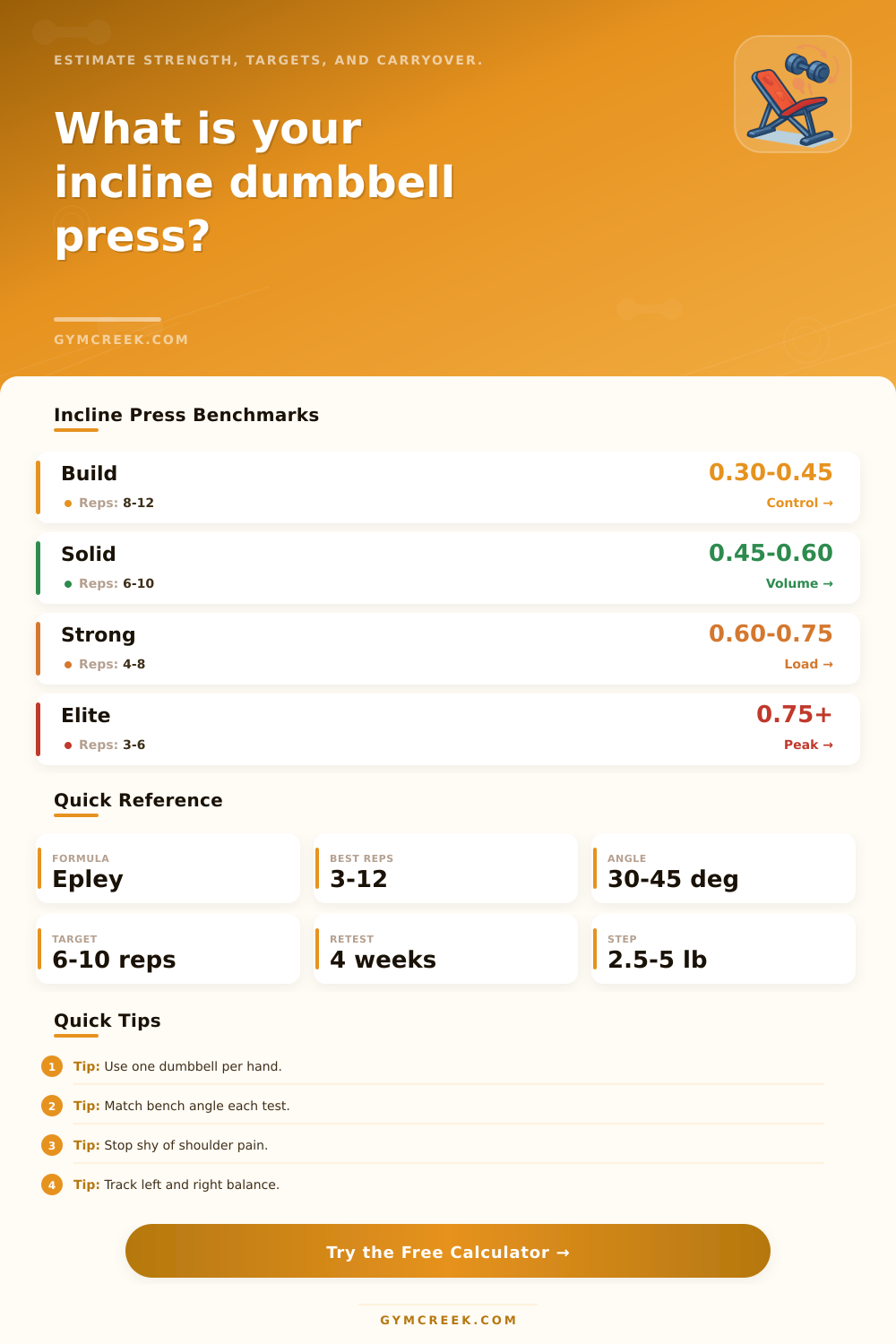
| Build base | 0.30-0.45 x body weight | 8-12 | Own the range |
| Solid | 0.45-0.60 x body weight | 6-10 | Progress volume |
| Strong | 0.60-0.75 x body weight | 4-8 | Add load carefully |
| Very strong | 0.75+ x body weight | 3-6 | Manage fatigue |
| Bench angle | Main bias | Load effect | Use case |
|---|---|---|---|
| 15 degrees | Upper chest plus flat press | Highest load | Heavy progression |
| 30 degrees | Upper chest | Balanced | Default incline |
| 45 degrees | Chest and delts | Moderate drop | Joint-friendly work |
| 60 degrees | Anterior delts | Lowest load | Steep press variation |
| Formula | Use | Equation | Limit |
|---|---|---|---|
| Epley e1RM | Primary estimate | Load x (1 + reps / 30) | Best under 12 reps |
| Brzycki e1RM | Cross-check | Load x 36 / (37 - reps) | Caps near 36 reps |
| Carryover | Barbell estimate | Total DB e1RM / factor | Technique varies |
| Mifflin BMR | Body context | Weight, height, age | Not strength score |
| Scenario | Common input | Expected result | Adjustment |
|---|---|---|---|
| Hypertrophy set | 8-12 reps | Stable target load | Round down |
| Strength test | 3-6 reps | Sharper e1RM | Fresh test |
| Fatigue check | Post-bench set | Lower estimate | Retest fresh |
| Balance audit | Uneven reps | Reduced target | Fix control |
💡Tips
Incline pressing is an type of pressing movement that sits in an unusual position within most training routines. Incline pressing is a variation on the bench press exercise, but the bench is inclined to alter the amount of weights that can be pressed and the muscles that are active during the pressing movement. Though many consider incline pressing to be an accessory movement for the bench press, the shifts in the weights that occur with inclining the bench means that a calculator is dedicated to this task.
Given a single working set, the calculator takes into account the angle of the incline of the bench and the quality of the pressing movements to provide the individual with useful estimate. One of the first concepts that an individual should understand about incline pressing is the way in which the muscles that are activated during the pressing movements shift with the incline of the bench press. At a 15-degree incline, the upper chest and front deltoids is the main muscles that activate during pressing movements, whereas the mid-chest muscles are dominant on the flat bench press exercise.
How to Use the Incline Press Calculator
At a 30-degree incline, the bias of the pressing movement shifts toward the upper chest. At a 45-degree incline, the front deltoids are the main muscle groups activated with the total strength of the individual decreasing at this angle. Finally, at 60-degree angles, the incline pressing movement (with dumbbell equipment) begins to resemble an overhead pressing movement.
The calculator accounts for the mathematical calculations that determine the strength of an individual at these angles, so the individual does not have to make estimations about the effect of incline pressing on his or her bench press strength. Much of the strength of an incline pressing exercise is created from the strength and quality of the individual’s pressing movements for each set. Variables like the rate at which an individual performs the pressing movements, the use of an eccentric movement, or the lockout of the movement will impact the total number of repetition that an individual can complete in a set.
An individual can use the calculator to record the difference between sets of pressing movements. Furthermore, imbalances between the left and right sides of the body with the use of dumbbells is another variable that the calculator accounts for. Whereas imbalances with the use of barbells are noticeable to few individuals, with the use of dumbbells a difference of three or four percent between the left side of the body and the right side of the body is common.
Any difference in strength between each side of the body to larger than four percent may indicate the total load that the individual should attempt to lift during pressing movements. The estimated flat barbell bench pressing strength (as calculated by the incline press movements with dumbbells) will often be surprising to the individual. The reason for this is that incline pressing with dumbbells does not naturaly translate to bench pressing strength with barbells.
The stability required of bench pressing with barbells reduces the need to maintain balance in incline pressing movements with dumbbells. Thus, the calculator yields only a ballpark figure of an individual’s bench pressing strength. It is likely that the incline pressing movement calculations are higher than an individual’s actual flat bench pressing strength if the individual has not performed any flat bench pressing barbell movements in recent days or weeks.
Another measurement of interest to the individual is the body weight ratio. This measurement is vital to understand whether or not the individual’s pressing strength is increasing in relation to his or her body size. A body weight ratio below 0.45 indicates that the individual should focus on the pressing movement and increasing the volume performed.
A ratio between 0.45 and 0.60 indicates that the individual has a solid base for pressing movements and may begin to increase the load or frequency with which the movements are performed. Ratios above 0.75 will reveal smaller gains in strength unless the individual manages his or her recovery from workouts. Thus, fields for entering an individual’s age, level of activity, and daily energy needs is included in the calculator.
A related calculation to the pressing movements is the target load calculation. This measurement allows an individual to input the number of repetitions that he or she would like to perform within the next training routine, and it calculates the weight of the dumbbells that will allow the individual to reach his or her target number of repetitions. Most dumbbell exercises use five-pound increments in dumbbell sizes, so rounding to the closest pair of dumbbells will prevent the individual from attempting to use a weight that does not naturally exist within the gym.
Furthermore, rounding the target load will prevent the individual from selecting a too-heavy load for his or her pressing movements. In order to effectively use this calculator, an individual must ensure that he or she uses the same angles for pressing movements, uses the same range of motion for pressing movements, and has recovered from any workouts prior to testing pressing strength. Otherwise, the estimates that the calculator provides may drift from the actual strength of the individual.
By recording these variables in the calculator, however, the individual ensures that he or she can provide a fair comparison of his or her pressing movements over time. After performing these calculations over several training months, it will become obvious to the individual which angles and number of repetitions provide the best estimates for his or her pressing movements. Common mistakes in the performance of incline pressing movements can be avoided by the use of the calculator.
For instance, if an individual always performs pressing movements with low repetitions and at steep angles, his or her incline pressing measurements may appear impressive, but he or she will have limited carryover of those pressing movements to other pressing exercises. Conversely, if an individual stays within the eight to twelve repetition range at a more moderate incline angle, his or her pressing movements will exhibit a more steady estimate of pressing strength. In this case, though, he or she may have to perform additional exercises to develop the strength to lockout from the pressing position.
The calculator does not provide any recommendations of which method is “correct” for the individual, but it does allow the individual to understand the implications of each method on the target load measurement. Though outside of the mathematical calculations that the calculator performs, considerations of recovery from pressing movements are important. Factors like age, sleep, and the total number of training hours that the individual performs will impact the rate at which an individual can perform pressing movements with the same degree of strength.
Thus, fields for entering the individual’s activity level and energy needs is provided. Though the calculator will not adjust the estimate for the pressing movements according to these variables, they are important to consider in the planning of an effective and safe training regime. The value of the calculator only becomes apparent after retesting the pressing movements every four to six week.
The small gains in the adjusted pressing movements indicate that the training regime is starting to exhibit results. If, however, an individual’s pressing movements plateau or steadily decline in the adjusted measurement of strength, this is an indication that either the individual is becoming fatigued or that his or her pressing movement setup is changing. Without keeping track of these variables, though, the individual may not be aware of such changes.
Thus, the value of the calculator enables the individual to make the next pressing movement decision. This way, the individual maintains control of the weights that are used for pressing movements and can continue to manage his or her recovery from those exercises.