Sprint Wind Calculator
Estimate whether a sprint mark is wind legal, convert a sprint result toward a zero-wind equivalent, and review altitude, reaction, pace, and training context.
📌Race Presets
Presets load complete sprint scenarios and recalculate wind status, equivalent time, speed, and energy context instantly.
⚙Sprinter And Race Inputs
Your sprint wind estimate is ready
Review the wind-adjusted time, legal status, speed, reaction context, and density estimate.
📊Sprint Benchmarks
📘Reference Tables
| Event | Wind rule | Common adjustment | Interpretation note |
|---|---|---|---|
| 60m indoor | No outdoor wind reading | Usually none | Compare by timing method and reaction. |
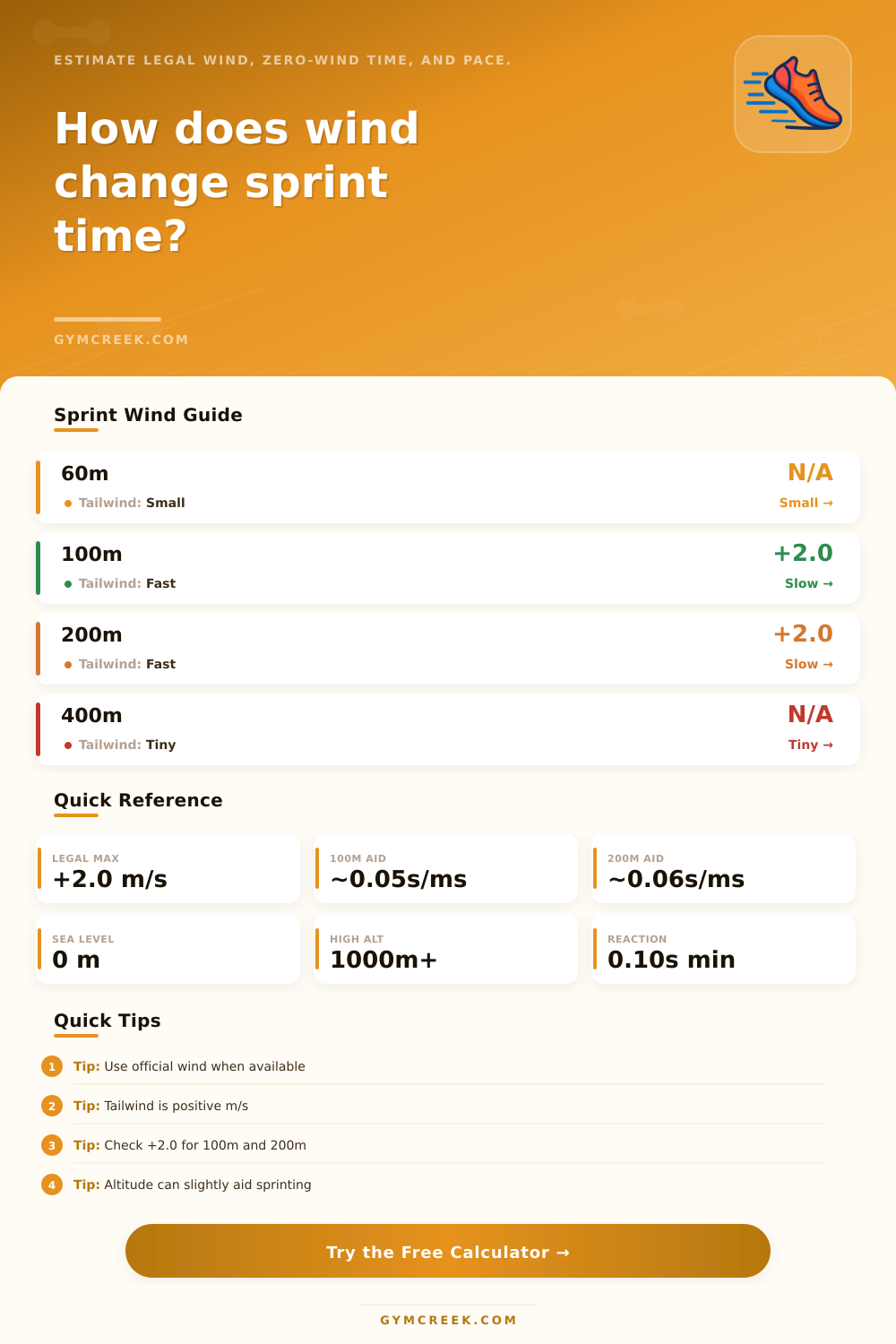
| 100m outdoor | Legal through +2.0 m/s | About 0.04-0.07 s per m/s | Tailwind improves time; headwind slows time. |
| 200m outdoor | Legal through +2.0 m/s | About 0.04-0.08 s per m/s | Bend and exposure make estimates less exact. |
| 400m outdoor | No standard wind legality mark | Small net estimate | Wind direction changes around the lap. |
| Wind reading | Race meaning | Record status | Use in calculator |
|---|---|---|---|
| -2.0 m/s | Strong headwind | Legal | Equivalent time becomes faster than result. |
| 0.0 m/s | Still or neutral | Legal | No direct wind correction. |
| +1.9 m/s | Strong legal tailwind | Legal | Equivalent time becomes slower than result. |
| +2.1 m/s | Wind aided | Not legal for records | Still useful for training comparison. |
| Formula block | Variables | Output | Why it matters |
|---|---|---|---|
| Wind correction | Event, time, wind, exposure | Zero-wind equivalent | Normalizes sprint results across meets. |
| Air density ratio | Altitude and temperature | Density context | Lower density slightly lowers drag. |
| Mifflin-St Jeor | Weight, height, age, gender | BMR and TDEE | Frames training energy context. |
| Tanaka HRmax | Age | Training HR range | Useful for warm-up and recovery work. |
✅Calculation Notes
Wind can change the results of a sprint. More importantly, wind can change the results in ways that is significent to those who monitor the time that is recorded on a stopwatch. Tailwinds will pushes a sprinter forward, but headwinds will fight against the strides of a sprinter.
These effects of the wind are visible during the 100-meter sprint, which lasts for a very short amount of time. The coach and the sprinter must be able to determine whether the recorded time reflect the actual ability of the sprinter to perform at such speeds, or whether the wind has assisted that athlete during that sprint that will not be provide during future sprints. The effect of the wind is not the same for every race.
How Wind Affects Sprint Times
For example, there is no wind reading for a 60-meter sprint. Therefore, the sprinter and the coach treat the 60-meter sprint as a separate race category. The 100- and 200-meter sprints are conducted outdoors, but only has legal wind limits.
Should the wind in either of these sprints fall outside of the legal limits, the status of the sprinters time with the wind is noted for record purpose. For the 400-meter sprint, the effect of the wind is spread throughout the entire lap. Additionally, the start and second curve are the main variables for these sprints.
Understanding these rules will allow coaches and sprinters to better understand a sprinters abilities with honest. Wind is only one of the many variables that may impact a sprinters final time. Other variables include the time it takes to react to the starting gun, the lane in which the sprinter begins, the condition of the track, and the reliability of the wind gauge.
The calculator listed above can account for these variables. Air density, which sprint athletes often ignore, becomes important for those who race at an altitude. At higher altitudes, the air is thinner and produces less drag for the sprinter.
Less drag mean that the sprinter will shave some time off their sprint. For example, if an athlete can sprint 10.8 minutes at sea level, they may be able to sprint quicker at 1500 meters where the air density is low. Additionally, the temperature of the air affects air density.
On hot days the air density decreases, but the body tires more quick. These factors affect sprints without the athlete knowing, but their effects can be explained. A person must make a decision regarding how to use the time that was recorded for a sprint.
If the time was sprint into a tailwind that was above the legal limits, the coach and sprinter will want to have an adjusted sprint time for the sprinters records. This time will help to indicate into what target the sprinter and the coach can train the sprinter. Additionally, if the sprinter raced into a headwind, it is possible for their recorded time to be an understatement of their sprinting abilities.
In this case, an adjusted time will help the athlete and coach to determine into which races the sprinter can enter in the future. The calculator above can make these adjustments. Beyond reaction time and other sprinting variables, an athlete may also consider the energy expenditure of a sprinter.
When sprints at a faster rate, a sprinter will create more energy with each stride. This change in energy affects the way that the wind can impact the sprints results. A sprinters body mass and height are two variables that may impact the energy needed to sustain sprinting efforts over multiple sprints within a season.
These variables are helpful to those who wish to understand the energy needs of a sprinter without spending much time in think about it. While there are many variables that impact the final time of a sprinter, the most common is failing to understand that the effect of the wind is not an on-or-off switch. Instead, a modest tailwind will improve a sprinters time for a race, but will not push that time to the legal limits for sprints.
A light headwind will cost the sprinter time, even if they feel particularly strong during their sprint. The calculator above accounts for the degree of exposure to wind, the sprinters lane, and the reliability of the measurement of wind as a variable. Another potential error in calculating the impact of wind on a sprinters time is to ignore the fact that the wind is only measured at the finish line of a sprint.
For instance, during a 200-meter sprint, half of the sprint is performed on a curve. If the wind is recorded at the finish line, it does not reflect the impact of the wind on the portion of that sprint that was performed on a curve. However, the adjustments to the sprinters time will remain accurate if the sprinters time into the headwind is entered into the calculator.
The value of any time recorded for a sprint is the information that that time provide about the sprinters abilities in future races. A legal sprint mark recorded into a headwind provides a baseline for future races. A time that is aided by the wind indicates the sprinters speed, but only if they understand the conditions of the wind that sprints them to their recorded time.
The adjustment of the recorded time for the impact of wind will help to an athlete’s future performance.