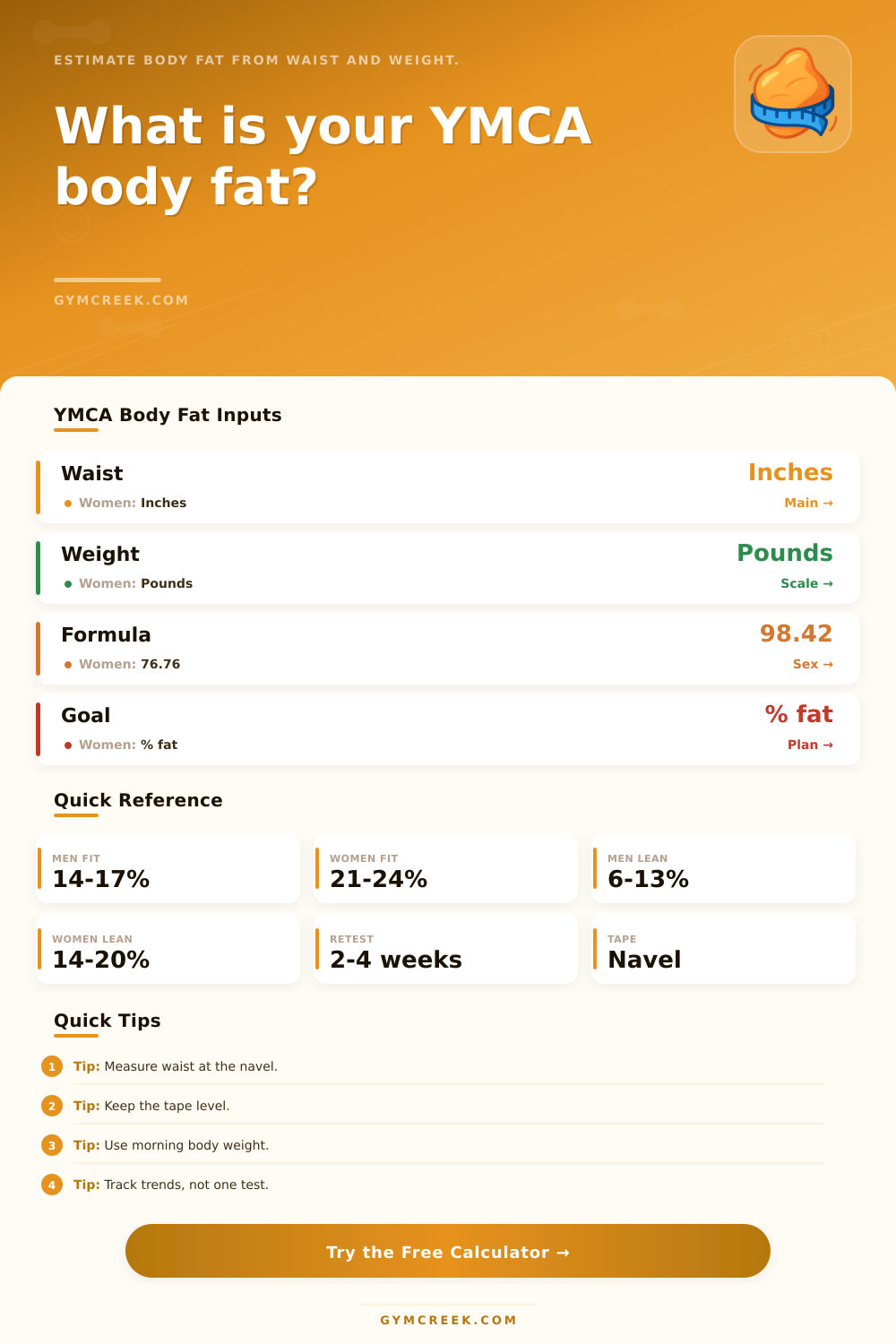
Body Fat Calculator YMCA
Estimate YMCA body fat percentage from waist and body weight, then compare fat mass, lean mass, BMI context, and goal-weight projections.
📌Presets
The YMCA formula uses waist circumference and scale weight. Height, age, activity, and goal fields add BMI, BMR, TDEE, and planning context.
⚙Calculator
YMCA body fat snapshot
Enter waist, weight, and goal details to estimate your result.
📊Fitness Metrics
📑Reference Tables
| Sex | Formula | Required inputs | Best use |
|---|---|---|---|
| Male | ((4.15 x waist) - (0.082 x weight) - 98.42) / weight x 100 | Waist in, weight lb | Quick trend check |
| Female | ((4.15 x waist) - (0.082 x weight) - 76.76) / weight x 100 | Waist in, weight lb | Quick trend check |
| Metric users | cm and kg are converted before the formula | Waist cm, weight kg | Same equation |
| Goal weight | Lean mass / (1 - target body fat) | Lean mass, target % | Planning context |
| Category | Men | Women | Note |
|---|---|---|---|
| Essential | 2-5% | 10-13% | Very low |
| Athletes | 6-13% | 14-20% | Lean sport range |
| Fitness | 14-17% | 21-24% | Fit general range |
| Average | 18-24% | 25-31% | Common adult range |
| Higher | 25%+ | 32%+ | Higher fat range |
| Check | Good practice | Why it matters | Retest cue |
|---|---|---|---|
| Waist site | Navel level | Formula expects abdomen measure | Same site every time |
| Tape tension | Snug, not tight | Small pulls change percent | Repeat twice |
| Body weight | Morning weight | Food and fluid shift scale | Use weekly average |
| Timing | Every 2-4 weeks | Daily changes are noisy | Compare trends |
| Scenario | What to watch | Useful output | Planning note |
|---|---|---|---|
| Fat loss | Waist down, lean mass stable | Fat mass change | Use modest weekly rate |
| Recomp | Waist down, weight stable | Body fat percent | Track strength too |
| Lean gain | Weight up, waist controlled | Waist-to-weight signal | Slow gain works best |
| Maintenance | Stable waist and weight | TDEE context | Retest monthly |
💡Tips
A bathroom scale only provides one measurement of the bodies weight. However, using only that measurement does not indicate the body composition of an individual. Two individuals of the same weight may has varying amounts of muscle or fat.
The composition of the body can affect how clothes fits on an individual, how much energy they experience daily, and the effect their movements has on there joints. The YMCA method use two different measurements to estimate the body fat of an individual. Those two measurements are the individual’s waist circumference and total weight.
How to Use the YMCA Method to Estimate Body Fat
The YMCA method does not require a laboratory or any piece of expensive equipment to calculate body fat percentage. All that is required is a tape measure to measure the individual’s waist circumference and a scale to determine their total weight. The YMCA method uses a specific formula to calculate the body fat percentage of an individual.
The formula use the waist measurement taken at the navel to reflect changes in the abdominal fat of the individual. The total weight of the individual is also used in the equation to calculate body fat percentage. The formula uses two different constants depending on the sex of the individual being measured.
Men and women often has fat stored in different areas of the body. By accounting for the way that each sex tends to store body fat, the formula can more accurately calculate the percentage of body fat of each individual. To calculate body fat percentage using the YMCA method, an individual can use a calculator that will use the information from the individual’s waist measurement and total weight.
The calculator will then provide the individual with an estimate of there body fat percentage. This estimate isnt a medical diagnosis of body fat percentage. However, it can help an individual understand their composition of the body.
This estimate can be of most help to individuals that measure themselves continuous to compare changes. For instance, if an individual has a consistent waist circumference but their weight decrease, their body fat percentage is likely decreasing. If an individual’s waist circumference and weight both decrease, the percentage of body fat may remain the same.
The way that an individual takes there waist measurement can significantly affect the body fat percentage that is calculated. The tape measure should be placed level with the navel. The waist should be measured after an individual exhales normally.
An individual should not suck in their stomach or push it out when taking the measurement. The tape should not be pulled too tight around the waist. The total weight and waist circumference of an individual should be taken at the same time of day.
Morning weight after using the bathroom may provide the most consistant measurements of body fat percentage. A body fat percentage estimate allow individuals to separate the fat in their body from their lean mass. Lean mass is the weight of individuals that does not include body fat.
Knowing the difference between lean and fat mass allows individuals to set goals regarding their body fat percentage. If an individual wants to decrease there body fat percentage, it is beneficial to use the lean mass measurement as an anchor for their goals. An individual can use the lean mass measurement to calculate a goal weight that decreases their fat mass but does not decrease there lean mass.
By using lean mass as an anchor for their weight, an individual can more easily reach their goal without having to lose too much weight, which could lead to losing lean muscle mass. An individual’s activity level can impact their body fat percentage. The calculator use an activity level multiplier to calculate the total daily energy expenditure for that individual.
However, the total daily energy expenditure is only an estimate of the total number of calories that an individual burns each day. An individual that is very active will have a higher activity level than an individual that is very sedentary in their daily life. An individual should adjust their activity level if they change their lifestyle.
Many individuals make mistakes when they begin to calculate their body fat percentage using the YMCA method. An individual may take there waist measurement at different locations on there body each time. An individual may weigh themselves after eating a meal.
An individual may compare one measurement to the reference tables without repeating the measurement. While reference tables provide a good idea of where an individual’s body fat percentage sits compared with others in the population, that percentage should not be directly compared to these charts. The YMCA method of calculating body fat percentage is different than many other methods.
Other methods of calculating body fat percentage use skinfold calipers, bioelectrical impedance, or DEXA scans. These scanning methods use technology to measure the body fat percentage of an individual. The YMCA method is significantly simpler and require no technology.
However, it does not provide the same accuracy in measuring body fat percentage as the other methods. Therefore, the YMCA method should be just one data point that an individual measures for their body fat percentage. Body recomposition is when an individual works to lose fat but gain muscle mass.
During the body recomposition process, an individual may find that there waist measurement decreases slowly with no change in there total weight. An individual’s body fat percentage will increase during this process. An individual can use a calculator to estimate how many weeks it may take to reach there goal body fat percentage.
An individual’s water weight in the body can be affected by many factors. Hormonal shifts, sleep cycles, and stress can cause an individual to retain more water than they would otherwise. This water weight can lead to an increase in body weight and waist circumference measurements.
An individual who weighs themselves after eating a meal high in sodium may have a high body weight reading but not a high body fat percentage. This can be caused by water retention. A more accurate body fat percentage can be determined by taking the body weight and waist measurement several times over a few weeks.
The goal is to determine the direction of an individual’s trend in body fat percentage, not react to each measurement made. The ability to estimate an individual’s body fat percentage is helpful for making decisions about health and body composition. If an individual’s body fat percentage is moving in the desired direction while also maintaining their energy and strength, they are doing something beneficial for their body.
However, if the body fat percentage does not appear to be moving in the right direction, an individual may need to adjust their plan to achieve their goal. The body fat percentage can be calculated with a scale and tape measure. When an individual consistently measures their body fat percentage, it creates a feedback loop where they measure their body composition, calculate their body fat percentage, adjust their body composition, and measure their body composition again.