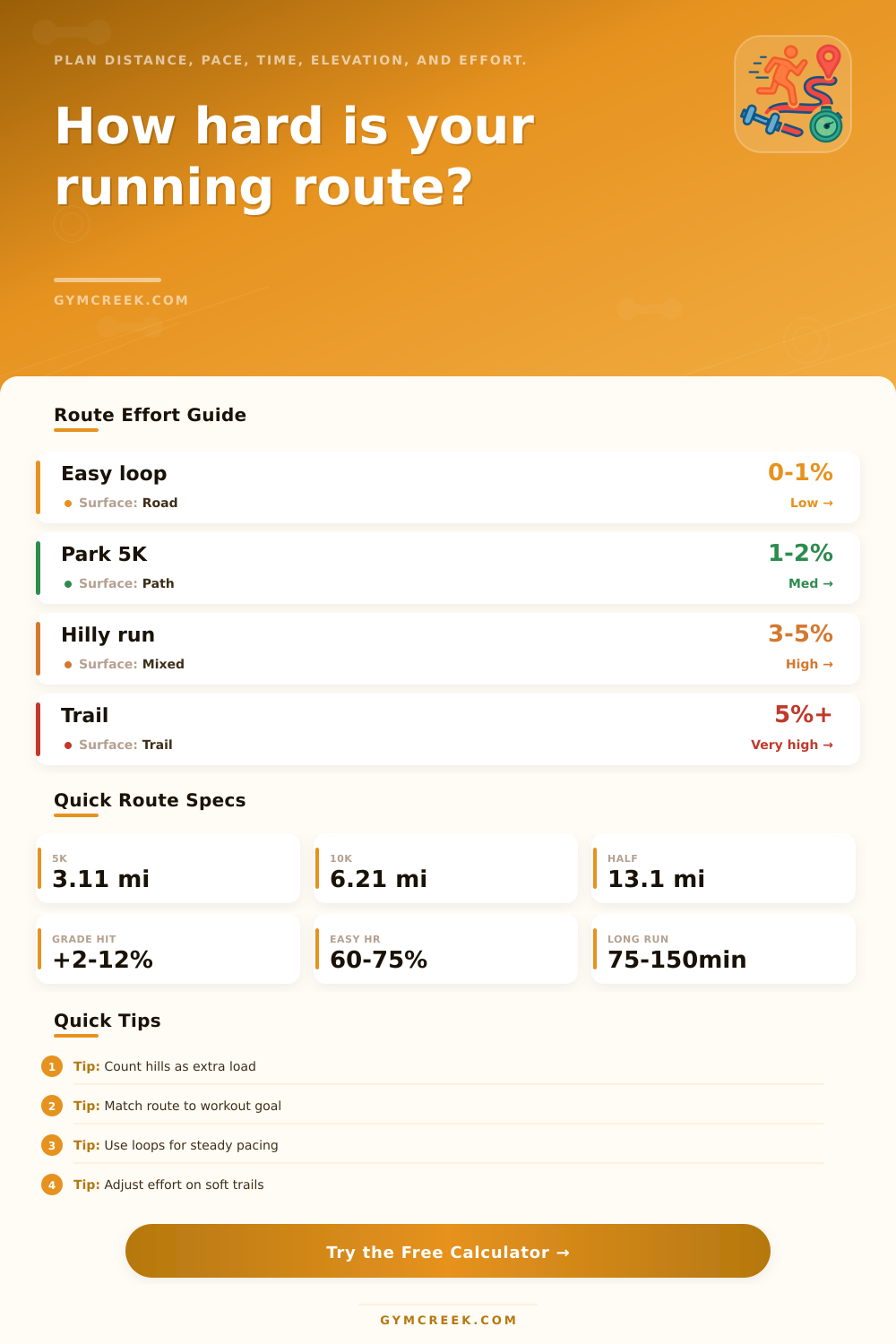
Running Route Calculator
Plan a run route from distance, shape, elevation, surface, weather, pace target, and training goal, then estimate time, adjusted effort, heart-rate zone, and calories.
📌Route Presets
Presets load complete route scenarios and recalculate the route plan immediately.
⚙Runner And Route Inputs
Your route plan is ready
Review the adjusted distance, moving time, route load, and intensity target before you head out.
📊Route Benchmarks
📘Reference Tables
| Route type | Best use | Pacing note | Risk check |
|---|---|---|---|
| Loop | Easy, tempo, long runs | Steady rhythm, familiar finish | Check wind direction on open sections |
| Out and back | Time-based aerobic runs | Turn at halfway by time or distance | Avoid starting too fast with tailwind |
| Point to point | Run commute or supported long run | Plan effort by terrain segments | Confirm fluids, transit, and safety exits |
| Repeated laps | Progression, interval, or controlled runs | Use lap splits to monitor fade | Mental fatigue can distort effort |
| Factor | Low impact | Moderate impact | High impact |
|---|---|---|---|
| Elevation gain | Under 50 ft/mi | 50-120 ft/mi | Over 120 ft/mi |
| Surface | Track, road | Gravel, dirt | Grass, technical trail |
| Temperature | 45-65 F | 66-78 F | Over 78 F |
| Training load | Route under 20% weekly volume | 20-35% weekly volume | Over 35% weekly volume |
| Formula | Variables | Used for | Notes |
|---|---|---|---|
| ACSM running | Speed, grade | VO2 and MET load | VO2 = 0.2 speed + 0.9 speed grade + 3.5 |
| Mifflin-St Jeor | Weight, height, age, gender | BMR and TDEE context | Useful for daily energy estimate |
| Tanaka HRmax | Age | Training zone estimate | HRmax = 208 - 0.7 x age |
| Riegel scaling | Distance, time | Long-route caution | Route fatigue rises nonlinearly |
✅Route Planning Notes
A route calculator is a tool that can help you plan your runs by considering different factor beyond the distance of your run. Many individuals consider the distance of their run when they are planning to run, but distance isnt the only factor to consider when planning a run. Other factors to consider include the terrain of the run, the surface of the run, the weather when you are running, and the shape of the run.
For instance, a route that is flat and features pavement may be the easiest route to run, but a route that features hills and trails will be more difficult due to the extra load that these features can place on the body. A route calculator allow you to enter these different factors to help you determine how each of these factors will impact the effort that you must expend during your run. One factor that you must enter into the route calculator is the distance of your run.
Plan Your Runs with a Route Calculator
In addition to this factor, you should also enter the elevation gain of your run. Each foot of elevation gain require the body to expend additional energy to support the bodys weight during the run. You should also enter the surface that you will be running on into the route calculator; roads are different than gravel or trail surfaces in the amount of energy that runners must expend.
Finally, you can enter the temperature at which you will be running into the route calculator; high temperatures require runners to expend more effort then they would at low temperatures during their run. Another factor to consider when using a route calculator is the shape of the route that you plan to take. For instance, loop routes is different from out-and-back or point-to-point routes in the way that runners may feel during their run.
Additionally, runners may feel differently on a route that they run multiple laps on in comparison to the same distance on a route that they run only once. Although these factors will not change the distance of your run, they will change the training cost of that run. A route calculator can help runners to understand how each of these factors will change the training cost of their run.
The pace of your run can be entered into your route calculator, but the route calculator can also adjust this pace according to the terrain, the surface that you will be running on, and the temperature at which you will be running. Additionally, if you enter the distance of your run and the time at which you plan to complete your run (with stops), the route calculator can provide an estimate of the total elapsed time that you will spend completing your run. The effort that you expend on the ground when you run is affected by both the elevation and the surface of your run.
For instance, a modest grade may require a significant amount of effort if the grade is to be traveled over many mile. The same is true of soft surfaces require the body to expend more energy to push the body forward than hard surfaces. The route calculator takes these factors into consideration so that individuals understands how each of these factors impact their run.
Additionally, the route calculator can compare two different routes for an individual so that they can see which route may require the same effort as the other but over a different distance. Another factor that a route calculator can calculate for you is your heart rate zone and the number of calories that you will burn during your run. Both of these factors require the route calculator to have information about your age and gender in order to calculate the maximum heart rate that you can reach during your run.
Additionally, with your goal for your run (such as recovery or tempo), the route calculator can inform you of the target heart rate zone that you should aim for during your run. The number of calories that you will burn can be calculated based on the effort that your body must expend at the adjusted pace that the route calculator determine for you. These estimates allow you to understand the energy cost of your run.
Another factor to consider when planning your runs is your weekly volume. Your body cannot perform only that one run; instead, you must consider how that one run will impact the other distance that you will run that week. For instance, a single run of fourteen miles may feel different if that single run is half of your weekly mileage as compared to when that single run of fourteen miles is only one small portion of your total mileage for the week.
Route calculators can help you to understand the impact that each run may have on your total weekly mileage. Many runners tend to make mistakes when planning their runs. For instance, runners may plan a route that includes hills but plan to run at the same pace that they use when they are running on flat terrain.
Additionally, many runners may not consider the temperature at which they will be running and may feel the need to recover after their run due to the effort that the heat requires of their body. Finally, runners may not consider the different effort that is required of runners on different surfaces; a track session may not be the same as a trail run of the same distance. The route calculator allows runners to plan their runs.
The output of the route calculator will allow you to determine whether or not the run that you have calculated will be beneficial to your goals. For instance, you may determine from the route calculator that you should shorten the distance of your run or you may determine that you should save your run for a day when you can recover from running. Additionally, using the route calculator will allow you to recognize patterns in your running and use those patterns to make more accurately estimates of your future runs.