Age Graded Calculator Running
Compare a running race time across age, sex, distance, course surface, heat, hills, and pacing context using transparent age standard estimates.
📌Runner Presets
Presets load real runner scenarios and recalculate the age grade, adjusted age grade, age-standard time, equivalent open performance, and benchmark band.
⚙Calculator Inputs
Age graded running score
Enter your race time to compare performance across age, sex, distance, and conditions.
📊Metrics Grid
📑Reference Tables
| Score range | Common label | How to read it | Best use |
|---|---|---|---|
| Below 50% | Recreational | Useful personal baseline | Training progress |
| 50-59% | Fit recreational | Solid race completion | Local comparison |
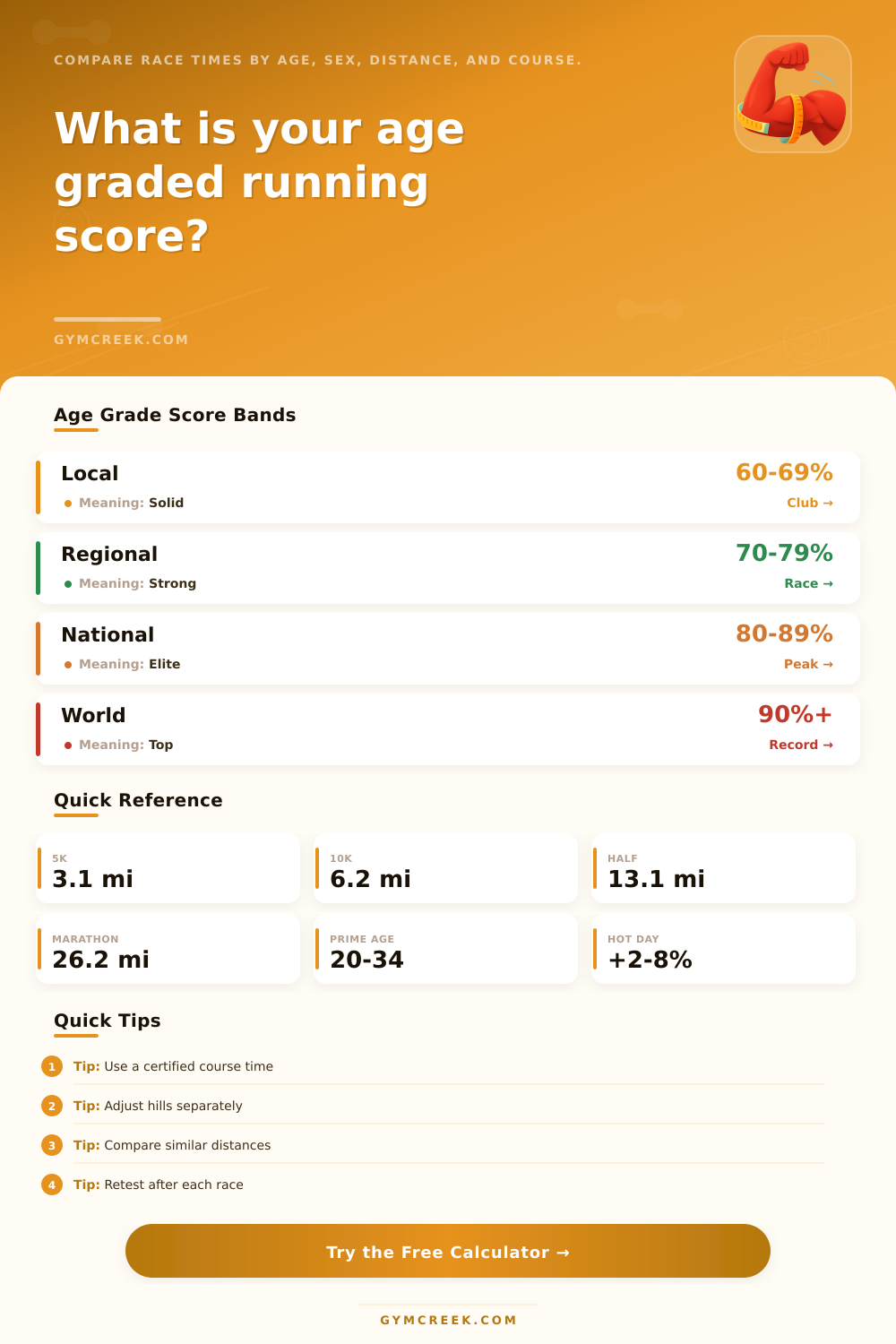
| 60-69% | Local class | Competitive club result | Age group racing |
| 70-79% | Regional class | Strong trained runner | Serious racing |
| 80-89% | National class | High-level performance | Championship goals |
| 90% plus | World class | Near record standard | Elite benchmarking |
| Distance | Male open | Female open | Calculator role |
|---|---|---|---|
| 1 mile | 3:43 | 4:07 | Short distance anchor |
| 5K | 12:35 | 14:15 | Road race anchor |
| 10K | 26:10 | 29:35 | Main road anchor |
| Half marathon | 58:30 | 1:04:10 | Endurance anchor |
| Marathon | 2:00:00 | 2:12:00 | Long distance anchor |
| Age band | Male factor | Female factor | Interpretation |
|---|---|---|---|
| 14-19 | 0.90-0.99 | 0.91-0.99 | Youth curve approaching open standard |
| 20-34 | 1.00 | 1.00 | Open standard years |
| 40-49 | 0.94-0.99 | 0.95-0.99 | Small age adjustment |
| 50-59 | 0.83-0.94 | 0.86-0.95 | Masters curve matters more |
| 60-69 | 0.67-0.83 | 0.72-0.86 | Age grade enables fairer comparison |
| 70 plus | Under 0.67 | Under 0.72 | Standards become progressively slower |
| Factor | Low impact | Moderate impact | High caution |
|---|---|---|---|
| Temperature | 40-60 F | 61-75 F | 76 F plus |
| Elevation gain | 0-50 ft per mile | 50-120 ft per mile | 120 ft plus per mile |
| Surface | Track or road | Gravel or rolling path | Technical trail |
| Time source | Certified race | GPS race effort | Solo time trial |
💡Age Grade Tips
Age grading is used to compare running performances from individuals of various ages because raw times from races doesnt always reveal the true performance of an individual runner. For example, a 45 year old runner may run a 5K race in 22:30, and a 25 year old runner may run a 5K race in 19:40. While the 25-year-old runner seem to have a faster split in relation to there raw time, the performance of the 45-year-old runner may be more impressive given their age.
Age grading help individuals to compare the performances of runners of any age by adjusting for that age, along with other variable. To determine an age grade for a runner, the system begin with a standard time for each distance for running races that is open to all runners and ages; the open standard. The open standard is the time that an elite runner can achieve during there prime years.
What Is Age Grading and How It Helps Runners
The age grading standards curves out from this open standard to include runners of various ages and distances. The age grading curve isnt a straight line, but modeling of human physiology allow for the curve to still be reliable in reporting the age grade of runners. To calculate the age grade of a runner, the age grading calculator require the input of the runner’s age, sex, distance of the race, and their split for the race.
One of the variables for the calculator is the course for the race. Not all courses for races are the same; some are on flat areas, others are on hills, and some are on technical surfaces. These variables will impact the time that the runner log for the course, but will not impact the ability of the runner themselves.
The calculator asks the runner for the course split for the race as one of the variables to determine their adjusted age grade. While the adjusted age grade is not an official time or split for the runner, it does indicate their potential time for a race on a flat, evenly course. Another variable for the calculator is the purpose of the runner.
Some runners wish to compare their age grade to others within their clubs, but others wish to determine if their marathon split will qualify them for a championship race. The purpose of the race is another variable that can be input into the calculator, but the age grade split for the runners will be the same regardless of their purpose for running. The reference tables within the calculator will translate the percentage grade for the runner into meaningful information for the runner.
For instance, a score within the low sixties for an age grade indicate that the runner is competitive within their clubs. A score within the seventies indicate that the runner can compete in regional races. A score within the eighties or higher indicate that the runner may compete within national races.
These score ranges are established to align with the age group races within each of these area. The body weight, height, and activity level for the runner will produce an estimate of the amount of energy the runner use during the race. A runner of a higher weight will use more energy than a runner of a lower weight.
A runner that performs more activities within higher training volumes will use more energy than a runner performing less activities or training volumes. While these numbers are not precise in the estimation of the energy use of the runner for other purposes (such as fueling requirements), these numbers provide context for such energy expenditure. Many runners make mistake with the calculator.
For instance, a runner may have raced on a hot day, thus leading to a lowered adjusted age grade. A runner might have performed a time trial on a course that was unmeasured, leading to an adjustment of the age grade for that split. To avoid these mistakes, ensure that the same variable are used for each race that is entered into the calculator.
Using these variables for multiple races will allow runners to see trends in their splits. Another mistake for many runners is to often treat the age grade as a ranking of their performance versus others of the same age, but instead, that age grade is a split that indicates their performance on a particular day. Raw age grades may be used to compare performances within the same race on the same day, but adjusted age grades may be used to compare performances over time.
Thus, the raw and adjusted age grade are both useful, but with different purposes. The calculator will also produce a time for the runner that may be referred to as the open-equivalent time. This time indicate how fast the runner would of had to run at their prime age to achieve the same age-graded split.
This split is rarely the same as the split that the runner log for the race. However, if the split is very high relative to the open standard for splits, the runner is aware of the potential for improvement. If the split is close to the open standard, the runner may be nearing their limit for their distance and age.
While age grading cannot be used as a replacement for training or racing, it does remove the confusion of various factors that impact a runner’s split. For instance, a 60-year-old runner with an age grade that increases from 68 to 74 has notably improved their performance. Similarly, a 28-year-old runner who races in a challenging course but still produces a high age grade knows that their effort and performance is above what the split may have indicated for their time.
These insight are only useful if the runners continue to race and record their performances. The value of age grading becomes apparent over time for runners rather than after one race alone.