Marathon Run/Walk Calculator
Build a marathon run/walk plan from your interval ratio, run pace, walk pace, current base, longest run, recovery margin, and race-day course details.
📌Runner Presets
Presets load realistic run/walk patterns, paces, training bases, aid-stop delays, and recovery profiles. You can change any field after loading one.
⚙Calculator Inputs
Run/walk marathon plan
Enter your interval, pace, and current training base to calculate the plan.
📊Plan Metrics
📑Reference Tables
| Pattern | Run | Walk | Best fit |
|---|---|---|---|
| Conservative finish | 2 to 3 min | 1 min | First marathon, hot day, or limited base. |
| Classic Galloway | 4 to 5 min | 1 min | Balanced finish goal with frequent resets. |
| Steady cruiser | 8 to 10 min | 1 min | Moderate base and steady pacing. |
| Performance breaks | 12 to 15 min | 30 to 60 sec | Experienced runner protecting late miles. |
| Runner | Weekly base | Long run | Peak range |
|---|---|---|---|
| First timer | 15 to 25 mi | 7 to 11 mi | 28 to 38 mi |
| Steady finisher | 25 to 35 mi | 10 to 14 mi | 36 to 48 mi |
| Time goal | 35 to 45 mi | 13 to 17 mi | 45 to 58 mi |
| Advanced | 45 mi plus | 16 mi plus | 55 to 70 mi |
| Formula | Variables | Used for | Output |
|---|---|---|---|
| Cycle distance | Run pace, walk pace, interval time | Blended pace | Average race pace |
| Mifflin-St Jeor | Sex, age, weight, height | BMR context | Daily kcal estimate |
| Progression cap | Base, weeks, recovery | Peak feasibility | Weekly volume target |
| Long-run ratio | Peak week and experience | Durability target | Longest run/walk cap |
| Check | Green flag | Caution | Adjustment |
|---|---|---|---|
| Run share | 70 to 90% | Over 94% | Add short planned walks sooner. |
| Long-run share | 30 to 35% | Over 38% | Raise weekly support or cap long run. |
| Weekly gain | Under 10% | Over 12% | Use cutback weeks and smaller jumps. |
| Aid rhythm | 2 to 3 mi | Long gaps | Carry fluid or time walks at stations. |
💡Practical Notes
A run/walk strategy refers to a method for running a marathon that includes period of running and walking. A run/walk strategy isnt a method for giving up on being able to run quick, but is a method for maintaining some movement while the legs begins to feel tired. Many runners feel fatigue around mile eighteen of a marathon.
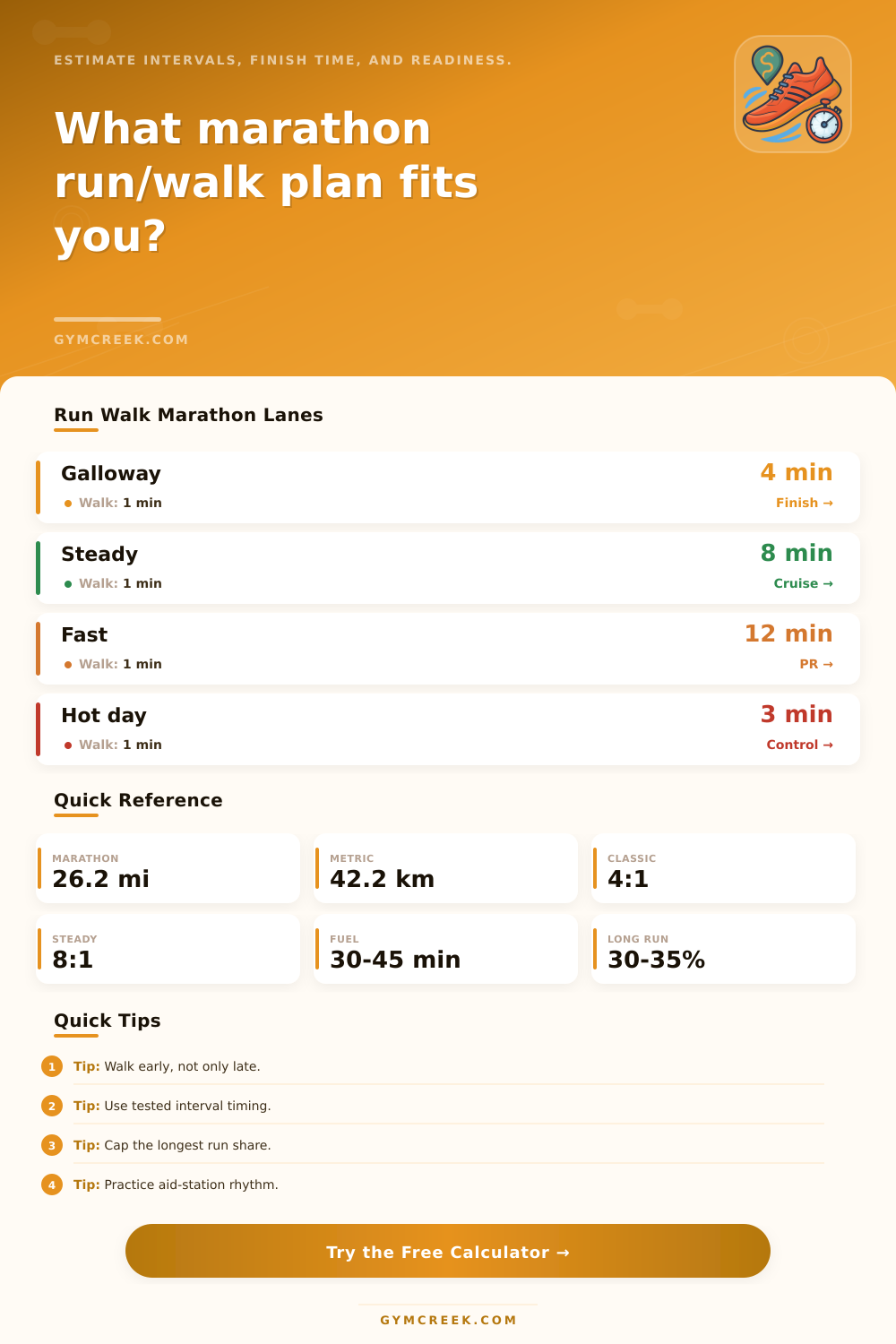
For these tired runners, a run/walk strategy can help to transform that fatigue into a method of movement. To develop a plan for a run/walk strategy for a marathon, the runner must decide what the interval for running and walking will be. For example, many runners use intervals of four minutes of running followed by one minute of walking.
Run and Walk Plan for a Marathon
Four minutes of running followed by one minute of walking allows the legs to recover for the remainder of the marathon to maintain a steady pace. Other runners prefer intervals of eight minutes of running followed by walking. Some runners prefer these eight minutes of running as a way of allowing there legs to feel more natural with their fitness level.
The calculator will provide the runner with an estimate of the runner’s blended pace, the number of cycles of running and walking the runner will complete during the marathon, and the number of miles they should run during each cycle. The runner’s speed when running and walking calculates the blended pace. The blended pace will determine the runner’s time for the marathon.
The number of cycles will help the runner understand the rhythm of the run and walk strategy for the marathon. The training distance the runner will complete before the marathon will impact how manageable the intervals of running and walking will be for the runner’s body. If the runner isnt reaching the distance that are suggested for training for the marathon, they may need more time to develop the endurance for the marathon.
The calculator will look at the number of miles that the runner will run each week and how many weeks remain until the marathon to calculate the peak mileage for the marathon. While the peak mileage is not the goal for the runner to aim for, it will indicate if the body has enough time to train for the marathon. Long runs allow the runner to become accustomed to feeling steady when tired.
The calculator will allow the runner to set a goal for how far the runner will complete during long runs based on their experience and the volume of miles that they can walk each week. Many runners will aim to reach a distance for long runs that allows them to feel prepared for the marathon, but not so long that their other training miles for the week is suffered. Many runners will find themselfs making mistakes such as performing one long run too long and other training miles too lightly for the other portions of their week.
If the runner makes such mistakes, the runner will not be able to develop the strength required for their body during the other portions of their training for the marathon. Several variable will impact the calculator’s results for the runner. These variables will include the spacing of aid stations, the temperature of the weather, and how long the runner plans to take to consume fluid during the marathon.
The calculator will account for the number of stops the runner will make based on the spacing of the aid stations. However, the calculator will not factor in the impact that the sun or the temperature of the weather will have on the performance of the runner. These variables are unable to be accounted for in the calculator, thus encouraging the runner to practice the required intervals during training runs with similar weather condition.
The ratio of the distances of running and walking will impact the energy that the runner need to complete the marathon. Because running burns more calories than walking, runners need to consume more calories when running a larger number of miles. The fueling plan for the runner should account for the actual time that the runner will be on the course for the marathon.
The calculator provides an estimate of the number of calories that will be burned and the distance at which the calculator should provide the first fueling reminder. These estimates will assist the runner in planning the marathon race, but the runner should also pay attention to their bodys hunger and thirst signal. Recovery will determine how quickly the runner can increase the volume of their training for the marathon.
A person who sleeps well will be able to adapt to increased training for the marathon more effectively then a person who sleeps poorly. The same is true for stress level; a person who has high levels of stress will adapt to the marathon training differently than a person who has low levels of stress. The calculator incorporates these difference in adaptation by adjusting the estimate of when the runner will be able to increase their training volume.
The calculator recognizes the differences between the effect that the same training has upon different individuals. The tables listed on the calculator provide information regarding the number of miles that runners will run during each interval and the mileage that runners will log each week with each given plan. These tables are a means of allowing runners to compare their plan to other runners with similar experience.
These tables should not be followed as rule, but as a means of understanding the various plans that is suggested for runners. The calculator provides means of testing the plan that the runner intends to use during the marathon. The runner can adjust each interval and the target distance for the marathon to view how these changes will impact the distance that must be trained and the time that the runner will need to complete the marathon with their given plan.
This allows the runner to find the best plan for their specific marathon race.