Marathon Split Calculator
Plan marathon pacing checkpoints from goal time, split strategy, course profile, weather, recent fitness, and recovery context.
📌Race Presets
Presets load realistic marathon goals, pacing styles, course demands, and runner profiles, then calculate mile, kilometer, 5K, half, and final split checkpoints.
⚙Split Inputs
Marathon split plan
Enter your goal time and race context to calculate checkpoint pacing.
📊Split Metrics
📑Reference Tables
| Checkpoint | Distance | Clock target | Segment pace |
|---|---|---|---|
| 5K | 3.1 mi | --- | --- |
| 10K | 6.2 mi | --- | --- |
| Half | 13.1 mi | --- | --- |
| 20 miles | 20.0 mi | --- | --- |
| Finish | 26.2 mi | --- | --- |
| Goal time | Pace per mile | Pace per km | Half checkpoint |
|---|---|---|---|
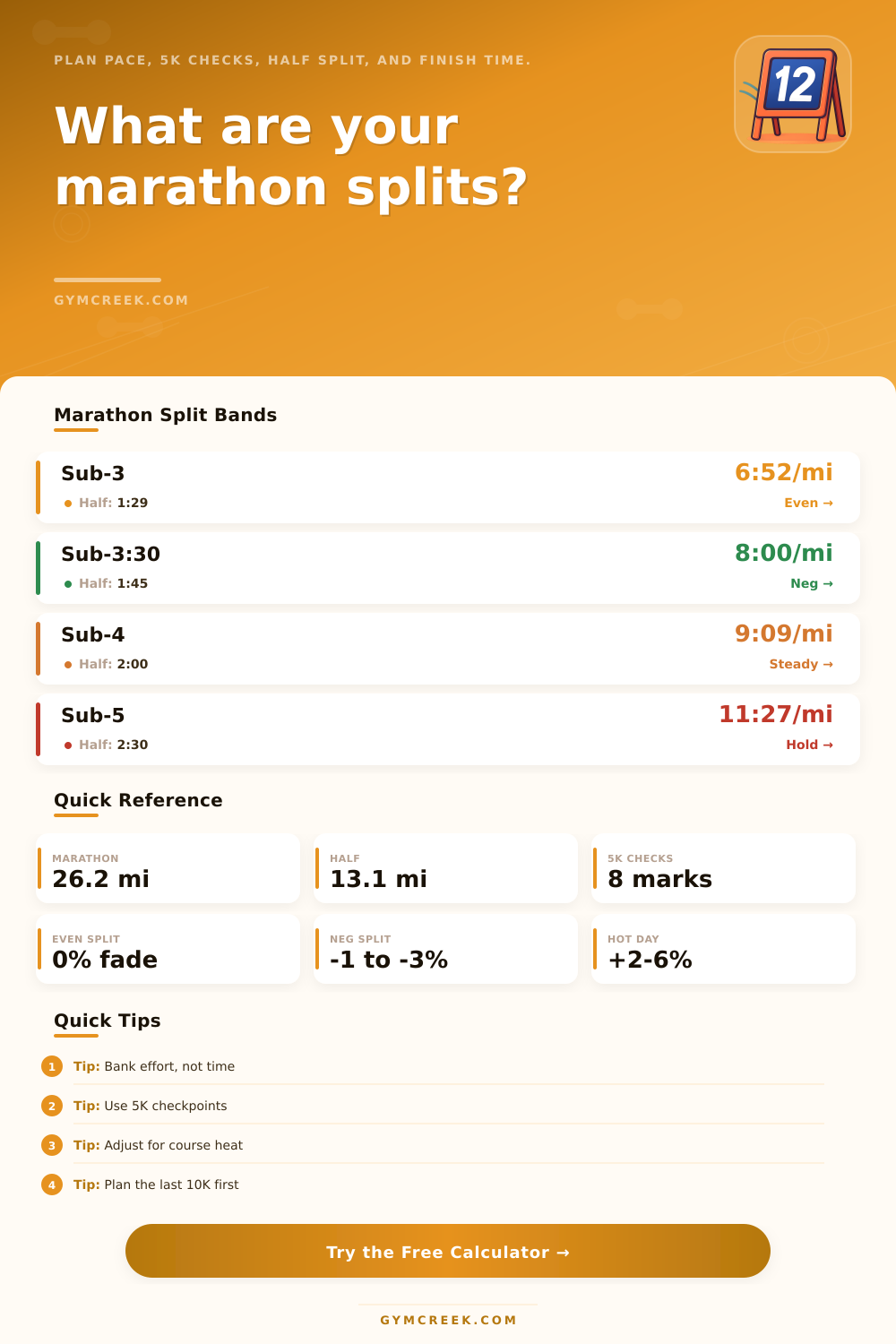
| 3:00:00 | 6:52 | 4:16 | 1:30:00 |
| 3:30:00 | 8:01 | 4:59 | 1:45:00 |
| 4:00:00 | 9:09 | 5:41 | 2:00:00 |
| 4:30:00 | 10:18 | 6:24 | 2:15:00 |
| 5:00:00 | 11:27 | 7:06 | 2:30:00 |
| Strategy | First half | Second half | Best fit |
|---|---|---|---|
| Even split | 50.0% | 50.0% | Experienced steady runners |
| Negative split | 50.3-51% | 49-49.7% | Patient PR attempts |
| Positive split | 49-49.7% | 50.3-51% | Hot or hilly survival plans |
| Time bank | 48.8-49.5% | 50.5-51.2% | Only with strong durability |
| Formula | Inputs | Output | Use |
|---|---|---|---|
| Split distribution | Goal time, bias | First and second half | Checkpoint clock targets |
| Heat index proxy | Temperature, humidity | Pace adjustment | Weather effort warning |
| Tanaka max HR | Age | 208 - 0.7 x age | Marathon HR cap context |
| Mifflin-St Jeor | Weight, height, age | BMR and TDEE | Energy context |
💡Split Planning Tips
Planning a marathon require you to understand the specific effort required for every single mile of the marathon that you are planning to run. Planning a marathon allow you to understand how each mile should feel before you reach that particular mile. A marathon is an event that can be controlled to allow you to reach the final mile or it can unravel to make it difficult for you to reach that finish line.
However, a marathon finish can be controlled if you have decide the parts of the marathon that will be difficult to run before the marathon starts. Planning a marathon split allow you to turn the marathon finish time into a series of decision that will help you to execute the plan when your body and mind begins to disagree with each other. The first half of the marathon will determine the second half of the marathon, and many runners underestimate just how much the first half of the marathon will control the second half.
Plan Your Marathon Mile by Mile
By running the first few miles of the marathon at a faster pace, runners may find themself negotiating the last 10 kilometers of the marathon instead of planning for it. The calculator allow you to set a goal time for the marathon, and it also allow you to select how much effort you will invest in the first half of the marathon or how much effort you would like to save for the last half of the marathon. By adjusting the bias percentage, runners can see the time cost of a negative split of the marathon, as well as what effort a negative split of the marathon would provide to runners during the later stage of the marathon.
Weather conditions and the profile of the race course are two of the most important factor to consider when planning to run a marathon, but many training plans does not account for these factors. Many runners may train in 58-degree weather with low humidity but may find themself racing against conditions of 75-degree weather with high humidity, which require a different amount of effort to complete the marathon. The calculator allows for these condition to be entered into the program, allowing runners to see how their required effort will change due to the weather.
Hill climbs will require more effort for runners to complete the marathon, and the calculator allow runners to see how many extra mile of effort are required for such a marathon course. A runner’s weekly mileage and the length of their longest run determine how much their marathon pace may fade during the race. A runner who consistently runs 38 mile a week with one long run of 18 miles may have different result to a runner who runs 55 miles with a 22-mile long run.
The split calculator will use these variable to produce a confidence score for the runner using the calculator. This score will allow the runner to understand if the plan for the marathon is realistic based on their training. However, it is important to note that this score isnt a guarantee that the plan will succeed.
Discipline in how runners recover and the start of the marathon are two of the most important variable in planning to have a successful marathon, but many runners tend to ignore these variable. A lack of sleep or high level of stress will not alter a runner’s goal for their marathon but will change the amount of buffer that they will need during the early miles of the marathon. If runners take an aggressive start to the marathon, they will also require a buffer for the first part of the race.
The split calculator will allow runners to mark these boxes, ensuring that the plan produced for them will reflect the runner that is starting the marathon rather than the one who perfectly trained for it. The table included on the calculator will provide runners with the context of the plans that the calculator would produce for them. However, the tables should not be used as rule to the marathon.
One table will provide runners with the time needed to produce splits of the first and second halves of the marathon based on the goal that they want to produce for themself. The other table will allow runners to compare the even splits, negative splits, and positive splits that can be executed during a marathon. The splits calculator will provide runners with specific time for certain distance during the marathon, but those time should not be treated as a script to be followed during the race.
The 5K and 10K splits will allow runners to determine if they are beginning the race too fast for the plan that they created. The 20-mile split will allow runners to determine if the first half of the marathon was run honest. Finally, the split calculator will provide the pace that runners should maintain for the last 10 kilometers of the marathon for them.
The split calculator may change once runners begin their marathons, but the change in the plan is not a failure of the split calculator. During a marathon, runners’ condition, legs, and focus will all change. However, the split calculator will allow runners to understand how much deviation from the plan they will experience.
At the start of the race, runners may be able to decide whether they will protect the second half of the marathon or if they will race towards the time that they have trained to finish. Many runners feel that the last 10 kilometers of a marathon are when most race are won or lost, but most training plans do not include preparation for the last 10 kilometers of a marathon. By planning for the last 10 kilometers of a marathon first, runners will have a better understanding of the purpose of the remaining mile.
The first half of the marathon will either set up the runner for a good finish or steal it from them. While the split calculator will not run the marathon for runners, it will allow them to understand the tradeoffs before they must make those tradeoffs during the race.