Half Marathon Time Calculator
Predict your 13.1-mile finish from a recent race or known pace, then adjust for hills, heat, weekly mileage, longest run, taper, and pacing strategy.
📌Runner Presets
Presets load realistic half-marathon contexts and recalculate immediately, including a recent race, body metrics, training base, course, weather, and split plan.
⚙Calculator
Half marathon finish estimate
Enter a recent race or pace to estimate your 13.1-mile finish.
📊Fitness Metrics Grid
📑Reference Tables
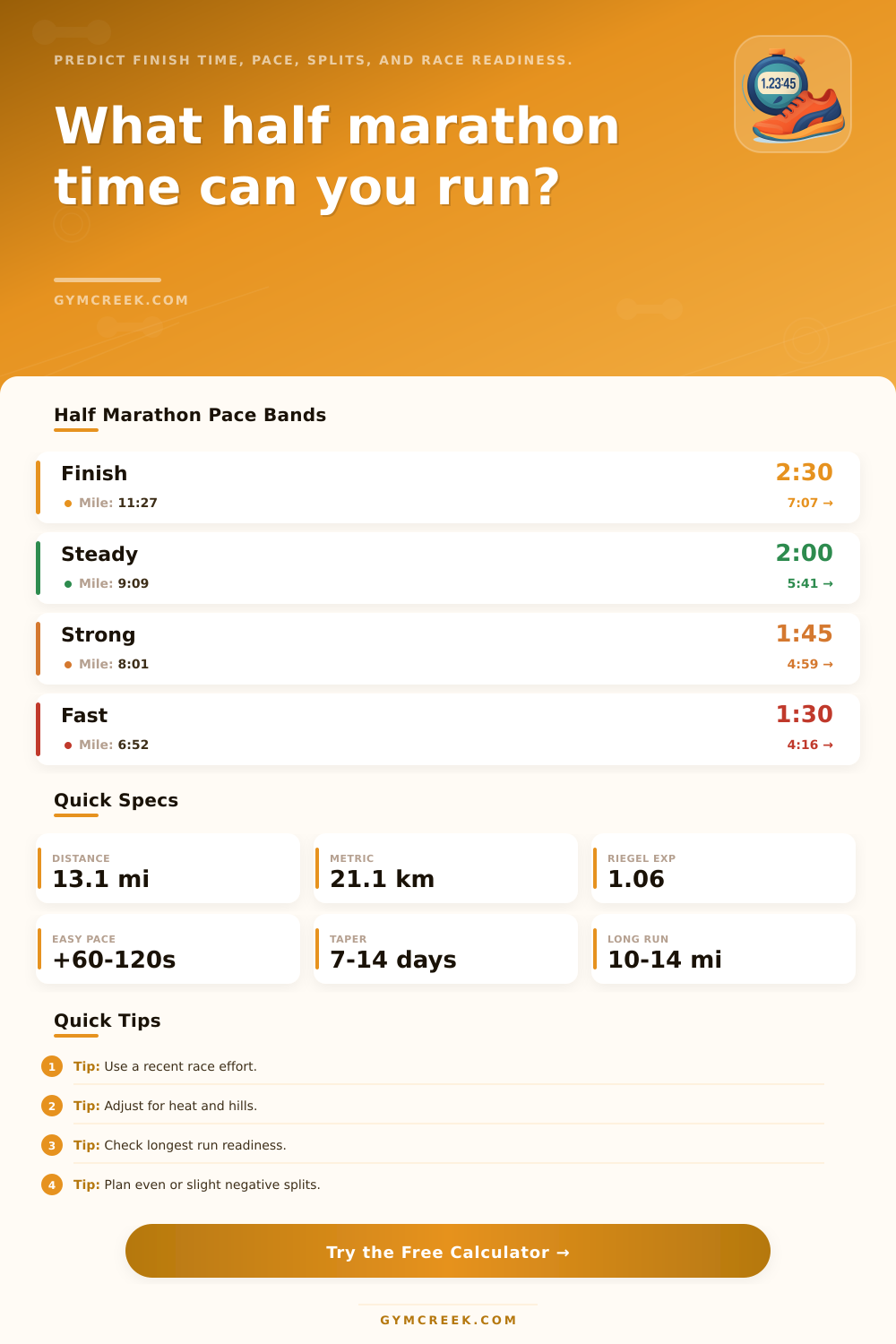
| Finish goal | Mile pace | Kilometer pace | Typical use |
|---|---|---|---|
| 2:30:00 | 11:27 | 7:07 | Finish-focused first half |
| 2:15:00 | 10:18 | 6:24 | Comfortable recreational target |
| 2:00:00 | 9:09 | 5:41 | Common milestone goal |
| 1:45:00 | 8:01 | 4:59 | Strong trained recreational runner |
| 1:30:00 | 6:52 | 4:16 | Competitive age-group target |
| Formula | Inputs | Output | When to use |
|---|---|---|---|
| Riegel | Time and distance | Race prediction | Recent race conversion |
| Pace model | Known pace x 13.109 | Direct time | Goal-pace planning |
| Mifflin-St Jeor | Sex, age, height, mass | BMR estimate | Energy context only |
| Readiness score | Mileage, long run, taper | 0 to 100 score | Training support check |
| Training signal | Developing | Solid | Strong |
|---|---|---|---|
| Weekly volume | Under 18 mi | 18-35 mi | 35+ mi |
| Longest run | Under 8 mi | 8-11 mi | 11-14 mi |
| Taper length | 0-4 days | 5-14 days | 7-12 days |
| Race execution | Positive split | Even split | Slight negative split |
| Adjustment | Low impact | Moderate | High caution |
|---|---|---|---|
| Temperature | 40-60 F | 61-75 F | 76 F plus |
| Elevation gain | 0-300 ft | 300-800 ft | 800 ft plus |
| Surface | Road | Gravel | Technical trail |
| Fatigue exponent | 1.04-1.06 | 1.08 | 1.10 |
💡Race Planning Tips
A half marathon is a distance of thirteen point one miles. For those who is racing in a half marathon, specific preparation are required to prepare the athlete’s body for the fatigue that will occur during the race. Many variable need to be considered in preparation for a half marathon.
A half marathon prediction tool is helpful for runners to understand when they will complete there half marathon. The half marathon prediction tool require specific input to calculate an adjusted finish time for the half marathon. The inputs that is required for the half marathon prediction tool include the runner’s result from a recent race, the training volume of the runner, the length of the longest run completed by the runner, the temperature for the race, and the elevation for the half marathon course.
How a Half Marathon Time Calculator Helps You Plan Your Race
The requirement of these four specific input will inform the calculator of what the adjusted finish time for the half marathon will be. These inputs will allow the calculator to inform the runner of the adjusted finish time so that the runner doesnt experience a surprise at the end of the race. Other components that is included in the calculator are readiness score.
These score do not indicate the runners potential for success in the half marathon. These score calculate the runner’s readiness based on training load, longest run, and taper length. While a low readiness score does not indicate that the runner will fail the half marathon, it does mean that there is a higher chance for the runner to walk or to fatigue during the half marathon.
Therefore, if a runner have a low readiness score, they may want to adjust their goal or their plan for the race. The readiness score informs the runner of the risks involve in the race. Other components of the calculator include pacing strategy.
A pacing strategy can help the runner to avoid losing time during the half marathon. Using an even effort throughout the half marathon is usually the best strategy as opposed to a late start and surge at the beginning of the race. Many runner may feel the need to save time at the beginning of the race as their leg feel fresh, but this can lead to fatigue later in the race.
The split option for the half marathon will show runners the cost of a negative split half marathon plan and the benefit that may result from implementing such a plan for the second half of the race. The course for the half marathon can feature various surface and terrain that will impact the runners different. The half marathon time calculator will adjust for these variable.
For example, if the half marathon incorporates a technical trail, the calculator will apply a multiplier to the total time to account for the effort required of those who race on such terrain. The reference table included on the calculator will translate the finish time into mile pace and kilometer pace. These reference table will allow runners to set specific workout and determine if they’re goal for their half marathon is realistic.
For example, if the goal for the half marathon is a two-hour finish time, the runner will need to incorporate mile that take nine minutes to complete. These reference table will eliminate the mental math for runners to determine if their goal is realistic. Many mistake are made when using a half marathon time calculator.
One mistake is to use the best case training run for the race instead of the time for a recent half marathon race. Training run do not include the same effort as the half marathon race. Another mistake is to ignore the heat or hills for the half marathon.
These variable will impact the race, and these adjustment should be made to the calculated time. The biggest mistake is treating the calculated time as a contract for the runner. This calculated time will not be met for the half marathon, but it is the time that will most likely be experienced during the half marathon if the input are set up as the runners have programmed them.
The half marathon time calculator is most useful during the week leading up to the half marathon. During these week, runners can test the effect of increasing the temperature for the half marathon or the effect of the hills on the half marathon course. By using this calculator, runners will have a specific adjustment for the half marathon so that they will not feel anxious about the race.
All of these benefit of the half marathon time calculator will allow runners to prepare for their half marathon, set a goal that reflect their training, and have a plan for the race. They should of used it more early. It is actualy a great tool for training.