NIOSH Lifting Calculator
Estimate the revised NIOSH recommended weight limit, lifting index, multiplier losses, and practical task limits from the measured geometry of a manual lift.
📌Presets
Presets show how reach, vertical height, travel distance, twist, frequency, duration, and coupling change the recommended weight limit.
⚙Calculator
Recommended weight limit
Enter the measured lift details to estimate RWL and lifting index.
📊Lift Metrics
📑Reference Tables
| Factor | Symbol | Best condition | What lowers the RWL |
|---|---|---|---|
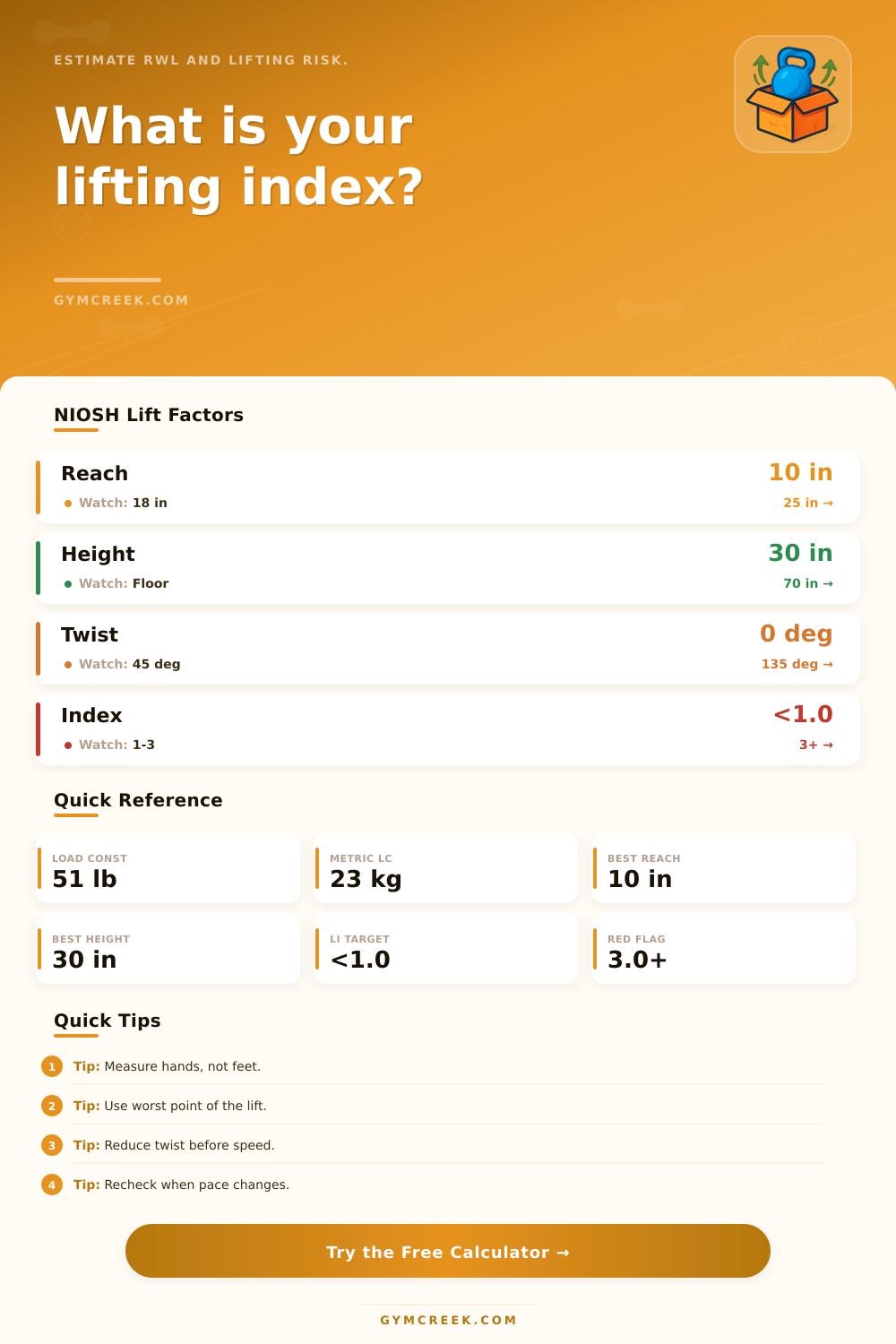
| Load constant | LC | 51 lb / 23 kg | All multipliers reduce from this baseline |
| Horizontal reach | HM | Hands about 10 in / 25 cm away | Farther hands sharply reduce capacity |
| Vertical height | VM | Hands near 30 in / 75 cm high | Floor or high shelf origins reduce capacity |
| Vertical travel | DM | Short controlled travel | Long travel distance lowers capacity |
| Asymmetry | AM | No torso twist | Rotation away from the lift line lowers capacity |
| Frequency | FM | Low lifts per minute | High frequency and long duration lower capacity |
| Coupling | CM | Good handles or secure grip | Poor grip is worse at low hand heights |
| LI result | Band | Meaning | Typical next check |
|---|---|---|---|
| Under 1.0 | Preferred screen | Load is at or below the RWL for the entered task | Verify measurements and task assumptions |
| 1.0 to 1.5 | Watch band | Some workers may face elevated physical demand | Look for simple reach, height, or frequency changes |
| 1.5 to 3.0 | Elevated band | Task likely needs redesign or added controls | Prioritize the weakest multiplier first |
| Over 3.0 | High concern | Load is far above the calculated RWL | Use engineering, handling, or workflow controls |
| Limiter | Common cause | Better direction | Measurement target |
|---|---|---|---|
| Reach | Load starts deep in a bin or pallet | Bring the object closer before lifting | Keep H near 10 in / 25 cm when practical |
| Height | Floor pickup or overhead shelf | Stage work near knuckle height | Move V toward 30 in / 75 cm |
| Travel | Floor-to-shoulder transfers | Reduce vertical lift distance | Shorten D before raising load weight |
| Twist | Feet fixed while torso rotates | Turn the body or reposition the destination | Keep A as close to 0 degrees as possible |
| Pace | Line speed or batch urgency | Lower lifts per minute or add recovery | Reclassify duration honestly |
| Coupling | No handles, slippery bags, awkward rims | Improve grip or container design | Upgrade poor to fair or good coupling |
| Formula | Inputs | Output | Boundary note |
|---|---|---|---|
| RWL = LC x HM x VM x DM x AM x FM x CM | Six task multipliers | Recommended weight limit | Applies to defined two-handed lifting assumptions |
| LI = Load / RWL | Actual load and RWL | Lifting index | Higher values mean greater physical demand |
| HM = 10 / H | Horizontal reach in inches | Reach multiplier | Metric mode uses equivalent 25 / H cm |
| VM = 1 - 0.0075 x |V - 30| | Origin hand height in inches | Height multiplier | Metric mode converts internally |
| DM = 0.82 + 1.8 / D | Vertical travel in inches | Travel multiplier | D is constrained to at least 10 in |
| AM = 1 - 0.0032 x A | Twist angle in degrees | Asymmetry multiplier | Angles above 135 degrees are outside normal use |
💡Tips
The lifting index can be used to determine the safety of a manual lifting task. The mismatch between the requirements of a lifting task and the physical strength of the worker can leads to manual handling injuries. The lifting index help to determine if there is a mismatch between the task and the individual’s strength.
The NIOSH lifting equation use a constant value of 51 pounds for the load. This value is the number of pounds that an average worker can lift under ideal conditions. Horizontal reach, vertical height at the origin, vertical travel distance, asymmetry, frequency, and coupling all can reduce the 51-pound figure.
How to Use the Lifting Index to Check Lift Safety
Horizontal reach is the distance from the ankles to the hands. Vertical height at the origin is the height at which a worker lift the object from the floor or overhead shelves. Vertical travel distance is the length that the object must be lifted vertically.
Asymmetry is the degree to which the worker twist the torso to lift the object. The frequency of lifting is how often an worker lift the object. Coupling refers to the quality of the grasp on the object.
If the coupling is poor, the worker will have to use more tension in the forearms and shoulders to lift the object. The lifting index calculator will calculate the weight limit for the worker after these measurements is entered into the calculator. The lifting index calculates the actual weight of the object that is being lifted divided by the calculated lifting weight limit for that worker.
If the result is less than 1, the load is within the safe limits of the NIOSH lifting equation. If the result between 1 and 3, some worker may feel the physical demand of the task. However, if the result is above 3, then the task is unsafe and can be redesigned to reduce the physical demand on the worker.
The lifting index can be improved by making changes to the manual lifting task. For instance, reducing the horizontal reach of the worker will often provide the most greatest improvement for the lifting index. However, other improvements can be made to the lifting task to improve the lifting index.
For instance, the frequency of the lifting tasks can be reduced to improve the lifting index. Another way to improve the lifting index is to adjust the height of the work surface to the worker. Ideally, work surfaces around 30 inches will allow the worker to lift with the strongest part of their lifting arc.
Another way to improve the lifting index is to reduce the frequency of the lifting tasks. This can be accomplished by shortening the shift of the worker or by allowing the workers to take regular and scheduled breaks to rest. One of the most common mistake when calculating the lifting index is to use the distance from the worker’s feet or from the edge of the box to measure the distance from the origin of the lift.
This value will provide the worker with an incorrect reading of the horizontal distance. Another common mistake is to use the best-case scenario geometry when calculating the lifting index. The worker should use the position of the object that will place the worker’s back in the greatest degree of demand.
The reference tables indicate the names of the multipliers that are used in the NIOSH lifting equation and the impact that each factor will have upon the calculated lifting limit. These reference tables can help to determine if the lifting limit is within the safe limits of the worker or if it is within the physical demands of the worker. These tables can assist in determining the lifting index and classifying the risk level of a manual lifting task.
However, the NIOSH lifting equation is a screening tool and isnt a medical diagnosis. The NIOSH lifting equation does not take into account the physical strength of the worker. Most manual lifting tasks will never meet the assumptions of the lifting equation.
The NIOSH lifting equation does not account for one-handed lifts, unstable boxes or loads, and tasks that require the lifting of a load by a team of workers. Any task that meets these qualifications will be flagged by the lifting index calculator to inform the worker of the fact that the result is only an approximation of the safety of the lifting task. The greatest value of the lifting index is the ability to see trade-offs in a lifting task that are invisible to the workers themselves.
For instance, changing the horizontal reach of the worker will impact the lifting index; however, the workers will be unable to see this impact without reviewing the measurements of the worker’s reach. The lifting index calculator will provide a mathematical comparison between the demands of the current lifting task and the worker’s capacity to handle those demands. If used regularly, the lifting index will change how the teams discusses the capacity of workers to perform lifting tasks.
Rather than stating that one load is too heavy for the worker, the discussions will change to stating that which multiplier is reducing the capacity of the worker to lift that load. By discussing these factors, the worker will be able to reduce the number of lifting tasks that are too demanding for the worker. These measured adjustments will be more likely to be successful than adjustments that are determined through feelings about the demands of the load.