Anaerobic Threshold Calculator
Estimate threshold heart rate, pace, power, and training zones from field-test data without turning your training log into a spreadsheet maze.
📌Presets
Presets load realistic field-test profiles and calculate immediately, so you can compare how age, max heart rate, pace, and power change the threshold picture.
⚙Calculator
Threshold snapshot
Enter your test data to estimate anaerobic threshold and practical zones.
📊Threshold Metrics
📑Reference Tables
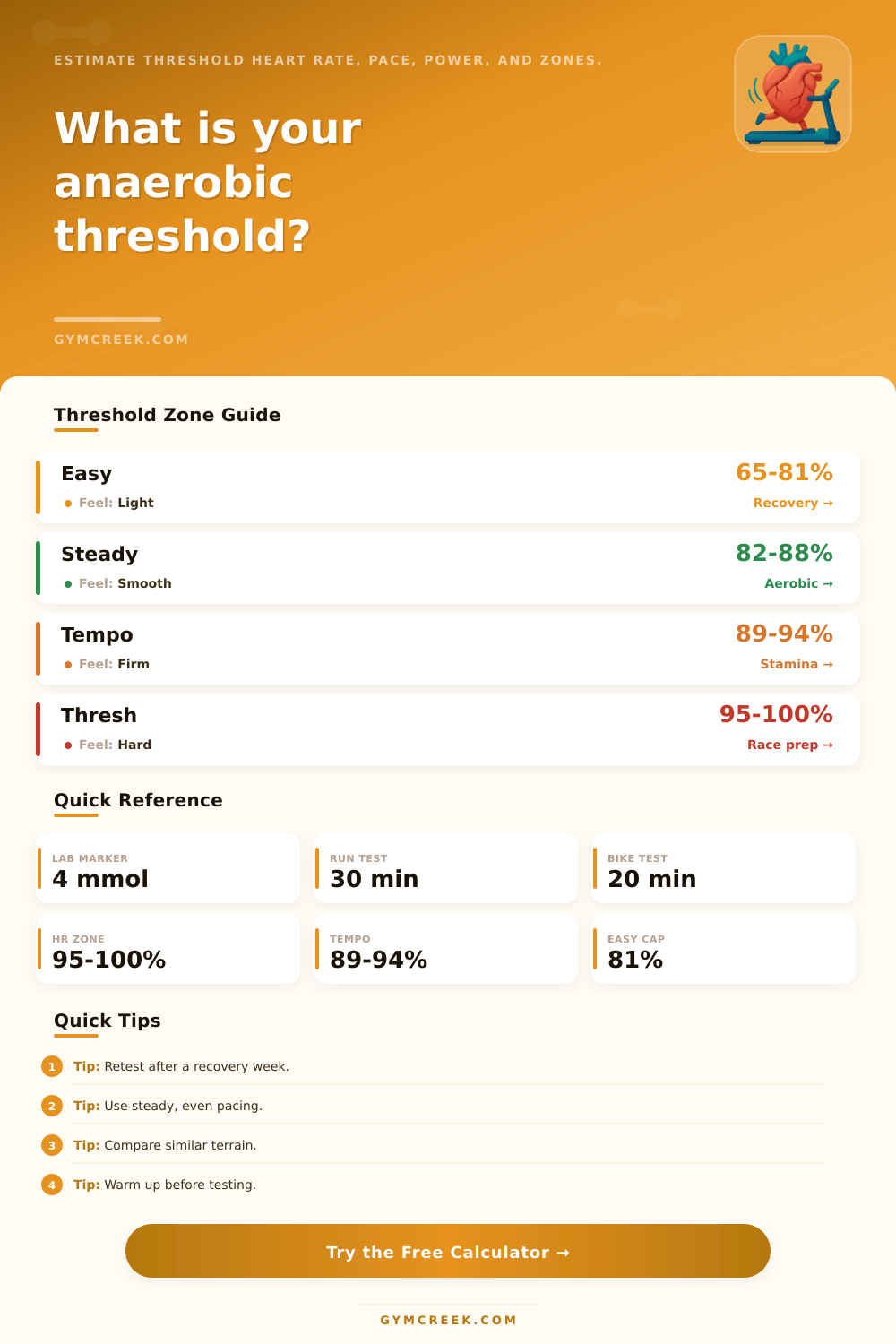
| Zone | % LTHR | Effort Cue | Common Use |
|---|---|---|---|
| Recovery | 65-81% | Light and relaxed | Easy days |
| Aerobic | 82-88% | Smooth breathing | Base work |
| Tempo | 89-94% | Firm but repeatable | Stamina |
| Threshold | 95-100% | Hard and controlled | Race prep |
| VO2 | 101-106% | Very hard | Short intervals |
| Test | Duration | Threshold Rule | Best For |
|---|---|---|---|
| 30-minute run | 30 min | Last 20 min HR | Running LTHR |
| 20-minute bike | 20 min | 95% of power | Cycling FTP |
| Lab lactate | Step test | About 4 mmol | Most precise |
| Recent race | 20-60 min | Race average | Race-specific check |
| Level | Typical % Max | Talk Test | Notes |
|---|---|---|---|
| Novice | 80-84% | Short phrases | Build gradually |
| Recreational | 84-88% | Brief phrases | Often variable |
| Trained | 88-92% | Few words | Stable pacing |
| Advanced | 90-94% | Minimal words | Strong durability |
| Elite | 92-96% | Not conversational | High economy |
| Formula | Variables | Output | Use When |
|---|---|---|---|
| Tanaka max HR | Age | Estimated max | No max test |
| LTHR zones | Threshold HR | HR bands | HR training |
| Power factor | Test watts | FTP estimate | Bike or row |
| Pace bands | Threshold pace | Run pace ranges | Run workouts |
💡Tips
The anaerobic thresholds is the point at which an individual’s body changes from an aerobic state to an anaerobic state. At the anaerobic threshold, an individuals body can no longer clear lactate from the blood from the rate that the body are producing the lactate. If an individual performs at a pace that exceed the anaerobic threshold, the lactate will accumulate within the body.
However, if an individual performs at a pace that is at or below the anaerobic threshold, the body can manage an amount of lactate present in the body. Knowing the anaerobic threshold of an individual is important in that the anaerobic threshold can allow individuals to plan their training session. For instance, with knowledge of their anaerobic threshold, individuals can better decide which training sessions will be easy sessions versus those that will be hard sessions.
What Is the Anaerobic Threshold and How to Find It
Without an understanding of the anaerobic threshold, individuals may perform training sessions that are too intensely to permit recovery from those sessions yet not intense enough to create any fitness benefit. One way of finding the anaerobic threshold of an individual is through the performance of a field test. Field tests are generally a means of estimating an individual’s anaerobic threshold.
One means of performing a field test is to perform a thirty-minute period of hard exercise or a twenty-minute time trial. You can use the average heart rate for the last twenty minutes of a thirty-minute performance test to estimate an individual’s anaerobic threshold. Additionally, measurements of the power that an individual can exert while performing on a bike or rowing machine can also help to estimate an individual’s anaerobic threshold.
These tests dont need to be performed perfectly, but they must be repeatable. For instance, each performance of such a field test should use the same terrain and warm-up to ensure repeatability of the tests. Repeatable field tests will allow individuals to compare their anaerobic threshold from one month to the next.
Various different inputs can be used to calculate an individual’s anaerobic threshold. One of the most useful inputs is the heart rate that is observed from one of the field tests. However, an estimate of the heart rate can be used if the individual has not performed any test in the past week.
Additionally, an individual’s resting heart rate and their maximum heart rate can also be used in the calculation to account for differences in each individual’s cardiac reserve. The athlete level of the individual is another important input in the calculation of their anaerobic threshold. Trained athlete will have different anaerobic threshold percentages of their maximum heart rate than novice athletes.
Additionally, the sport that is being performed can impact an individual’s anaerobic threshold percentage. For instance, running, cycling, and rowing all have different anaerobic thresholds. Test duration and effort can also be used as an input in the calculation of an individual’s anaerobic threshold.
Finally, other important inputs include the individual’s pace and power. The heart rate calculation will determine how hard an individual’s heart is working, but their pace will determine how fast they are moving, and the power input will determine the amount of work that they are performing on the bike or rowing machine. These three factors must be incorporated into the calculation when writing training workouts for individuals for the anaerobic threshold.
These workouts will include various different outputs that provide the individual with training zones based on their calculated anaerobic threshold. For instance, there will be a cap to the amount of effort that is required for recovery days. There will be a range for aerobic exercise.
There will be a tempo band for clearing lactate from the body of excess amounts. Finally, there will be a threshold zone for training of race-specific stamina. However, the area above the anaerobic threshold can also be used to perform training for high levels of intensity, but training sessions should not exist within this area for extended periods of time.
Various mistake can be made in the use of an individual’s anaerobic threshold. One of the most common mistake in utilizing the anaerobic threshold is treating the threshold as a fixed number. The anaerobic threshold is actualy not a fixed number for an individual; instead, it can change based off the fitness of the individual, the amount of fatigue of that individual, and the terrain that the individual is performing at the threshold.
Therefore, individual anaerobic thresholds should be tested after a recovery period. Additionally, individuals should not compare their anaerobic threshold if they are of different courses and weather condition; these factor will impact the threshold readings. Yet another mistake that can be made with individuals’ thresholds is to make every training session for an individual their anaerobic threshold session.
If every training session is at the anaerobic threshold, the difference between easy and hard training days will decrease; hence, training will be less effective for the individuals body. The anaerobic threshold can be expressed differently for different sports. For instance, an individual’s running threshold will have a different percentage of their maximum heart rate than cycling or rowing thresholds.
Therefore, individuals who wish to compete in triathlons should be aware of the differences between each of these percentages. A sport selector can be used to account for these differences in an individual’s threshold calculation. When an individual performs a field test to determine their anaerobic threshold, the individual should control for various factors that could influence their threshold.
For instance, the individual should warm up before performing the test. An individual should perform the test on a route or on a loop where even effort can be maintained. Additionally, individual should not begin the test at high levels of intensity; instead, fainting too fast at the start of the test could lead to the individual fading during the test.
Additionally, the last part of the test should feel firm and controlled. Should an individual find that their heart rate is increasing yet their pace or power is decreasing, that indicates the individual is becoming fatigued. Fatigue during the test could lead to inaccuracies in the measurement of their anaerobic threshold.
The calculation of an individual’s anaerobic threshold is essentially an estimate of that individual’s threshold. Therefore, an individual should use this calculated value to inform their training, but also check to see if the sessions feel as described by the calculated zones. For instance, if an individual feels that a tempo type session is as intense as a threshold session, those numbers should be adjusted.
Additionally, if easy runs feel to be harder than the easy cap for threshold, the individual should check their sleep and training load before making any adjustments to the threshold zones. Consistently using an individual’s anaerobic threshold calculation is the most important factor in utilizing the threshold. Once an individual has calculated their anaerobic threshold, they can write a training plan that details which type of sessions are easy sessions for that individual versus hard sessions for that individual.
Therefore, knowing the difference between the two type of sessions is the main benefit of finding an individual’s anaerobic threshold.