Marathon Training Calculator
Estimate a marathon build from your current base, target finish time, available weeks, weekly mileage, long run, and recovery profile.
1Runner Presets
Presets load realistic starting points, then recalculate mileage, long-run cap, pace zones, taper, and readiness.
2Calculator
Marathon readiness
Enter your current base to calculate the build.
3Marathon Benchmarks
4Reference Tables
| Build lane | Current base | Peak range | Long run range |
|---|---|---|---|
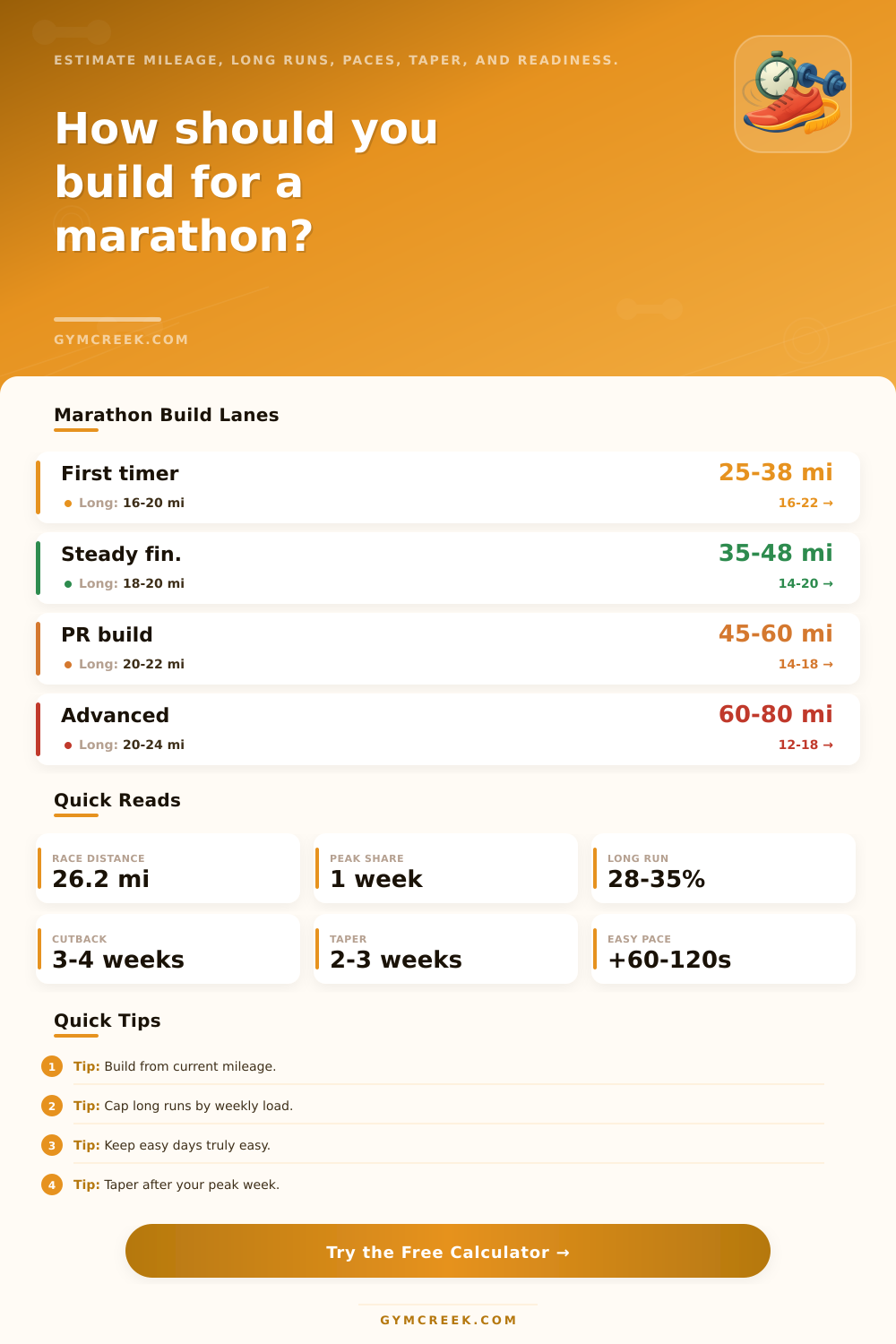
| First marathon | 15-25 mi per week | 25-38 mi per week | 16-20 mi |
| Steady finisher | 25-35 mi per week | 35-48 mi per week | 18-20 mi |
| Personal record | 35-50 mi per week | 45-60 mi per week | 20-22 mi |
| Advanced race build | 50+ mi per week | 60-80 mi per week | 20-24 mi |
| Pace zone | Formula from marathon pace | Purpose | Use frequency |
|---|---|---|---|
| Easy | MP plus 60-120 sec | Aerobic volume | Most runs |
| Long run | MP plus 45-105 sec | Durability | Weekly or near weekly |
| Marathon pace | Goal finish pace | Specific rhythm | Controlled blocks |
| Tempo | MP minus 15-35 sec | Threshold support | Limited hard days |
| Formula | Variables | Used for | Output |
|---|---|---|---|
| Mifflin-St Jeor | Sex, age, weight, height | BMR context | Daily kcal estimate |
| Progression cap | Base, weeks, recovery | Peak feasibility | Sustainable peak |
| Long-run ratio | Weekly peak and experience | Long run target | Distance cap |
| Marathon pace | Goal time divided by 26.2 | Pace zones | Min per distance |
5Practical Notes
Marathon training is not just about the total distance of a marathon but also about matching the physical work that you can do with the physical demands of a marathon. The training work must match the demands of a marathon because it depends on where the runner start from there current base. Many runners focus on the distance of a marathon and the peak mileage that they will run and how long that single run will be.
However, the peak mileage that a person can maintain and the distance of their longest single run only make sense with knowing their current weekly base mileage and how many week they have to race the marathon. Additionally, the distance of the longest single run a runner can maintain only makes sense with knowing their recovery and their goal finish time for the marathon. People should not seek the perfect training plan but one that fits in with the current life and running history of the runner.
Make a marathon training plan that fits you
Using the weekly mileage that a runner currently logs shows people how much of a distance a runners body can tolerate without breaking down. If an individual has been running twenty-five miles each week for a month, then it makes the most sense for them to increase their current twenty-five miles rather than a number that their nonrunning friend can maintain. The distance of the runners longest recent run is another starting point for marathon training.
This distance will show a runner how many miles they have spent in a single session of running. This is an important number to runners because it is more important than the target distance that another runner could post online. By using these three starting numbers, a runner can calculate how many miles they can grow to before the taper weeks of training for the marathon.
The number of weeks that a runner will have to train for the marathon will change the training plan. For example, if a runner has twenty-two weeks until the marathon, they will have more time to decrease their weekly mileage than a runner that has only fourteen week to train for the marathon. Additionally, the runner can provide another important number to include in training through the recovery margin.
The recovery margin will determine how much of a mileage increase that a runners body can tolerate. If a runner gets little sleep or has a high level of stress in there current life, their body will tolerate less mileage increase each week than a runner with a better recovery margin. This number will alter the training plan so that the runner does not overexert their body at peak marathon mileage.
A runners goal time for the marathon will also impact the training plan. If a runner wants to complete a marathon with a comfortable time, they could log fewer miles at peak mileage and keep their long runs at an easy pace. For those who want to break their personal record for the marathon, they will need to train to peak to a higher number of miles.
This goal will impact the distance of the easy runs and the tempo runs that the runner will complete during the marathon training cycle. These training ranges will help a runner to understand how much slower than there goal marathon pace that there easy miles need to be so that the other, harder runs has the intended effect on their running for the marathon. The number of days that a runner will train each week and the number of hard sessions that they can complete each week will dictate the sustainability of the training plan.
Most runners find that five days a week with two hard sessions each week is sustainable. Six or seven days with three hard sessions will work for those with strong recovery and easy miles. If a runner plans to have more hard sessions than their body can recover from in a week, they should of adjusted the training plan prior to beginning the training weeks.
The reference tables provide information for where these different starting points live for runners in training for their marathons. These tables are not rules for runners, but they do show the patterns of how many miles that a runner will hit in their peak mileage and long runs based off whether they are a first-time marathoner or have a base of forty miles a week for their current training. These tables show the training paths that many runners follow for marathons once they apply the training calculations to their current base mileage for running.
By calculating these training variables, a runner will be able to avoid the temptation to use another runners training plan. Based off the determination of their current mileage, longest run, recovery margin, goal time, training days, and hard sessions, a runner will be able to see if ten miles to their peak mileage will be feasible with the number of weeks that they have left until the marathon. Additionally, the runner will see whether their current long run for the week is close to the target that they will have for their marathon training or if they will need to increase the distance of their longest runs.
The taper phase for marathons will be a specific part of training because the goal will be to allow the training work that they have logged for the marathon to show up on race day. Most training plans will log a two or three-week taper phase for marathons. During this phase, the runner will have the sharpest drop in weekly mileage in the last seven to ten days of training.
The training plan will calculate these reduced mileage amounts for runners so that they are aware of what mileage they should log during the taper phase of training for their marathon. The exact mileage will be different for each runner based on their peak mileage, but the taper training will be the same for everyone in relation to their training plan. Although the training plan will account for as many variables as possible in the training plan calculations, there will always be a few that life will bring that will alter the training plan.
A work trip, a sick day, or poor sleep can all change a training plan. In these instances, the long runs and quality training sessions will be protected, but easy miles can be trimmed. A runner isnt just starting training over for the marathon but finding ways to adjust the remaining weeks of training around this new variable.
A runner should check their training plan against there actual miles run every three or four weeks. This will allow them to see if the long run seems to be too hard for the other miles that they ran that week. Additionally, if a runner finds that they have difficulty logging the same amount of weekly mileage, they can adjust the recovery period that they plan to use for their training.
The training plan can provide a runner with a snapshot of their training plan, but their body is the best source of information for their training plan. Overall, the training plan should feel like an extension of what they are already doing with their running so that the training plan and numbers work best for the individuals.