30-15 Intermittent Fitness Test VO2 Max Calculator
Estimate VO2 max from VIFT, age, sex, and body mass, then review absolute oxygen uptake, rating, heart-rate recovery, and training speed targets.
📌Presets
Presets load realistic 30-15 IFT profiles and recalculate immediately, including body mass, final VIFT, HR response, course, and surface context.
⚙Calculator
30-15 IFT VO2 max estimate
Enter a valid VIFT score to calculate the field-test estimate.
📊Fitness Metrics Grid
📑Reference Tables
| Formula part | Input | Coefficient | Meaning |
|---|---|---|---|
| Sex code | G | -2.15 x G | Male 1, female 2 |
| Age | A | -0.741 x A | Years term |
| Body mass | BM | -0.0357 x BM | Kilograms term |
| Speed | VIFT | +1.03 x VIFT | Final km/h score |
| Interaction | A x VIFT | +0.0586 x A x VIFT | Age-speed term |
| VIFT band | Men | Women | Common team-sport signal |
|---|---|---|---|
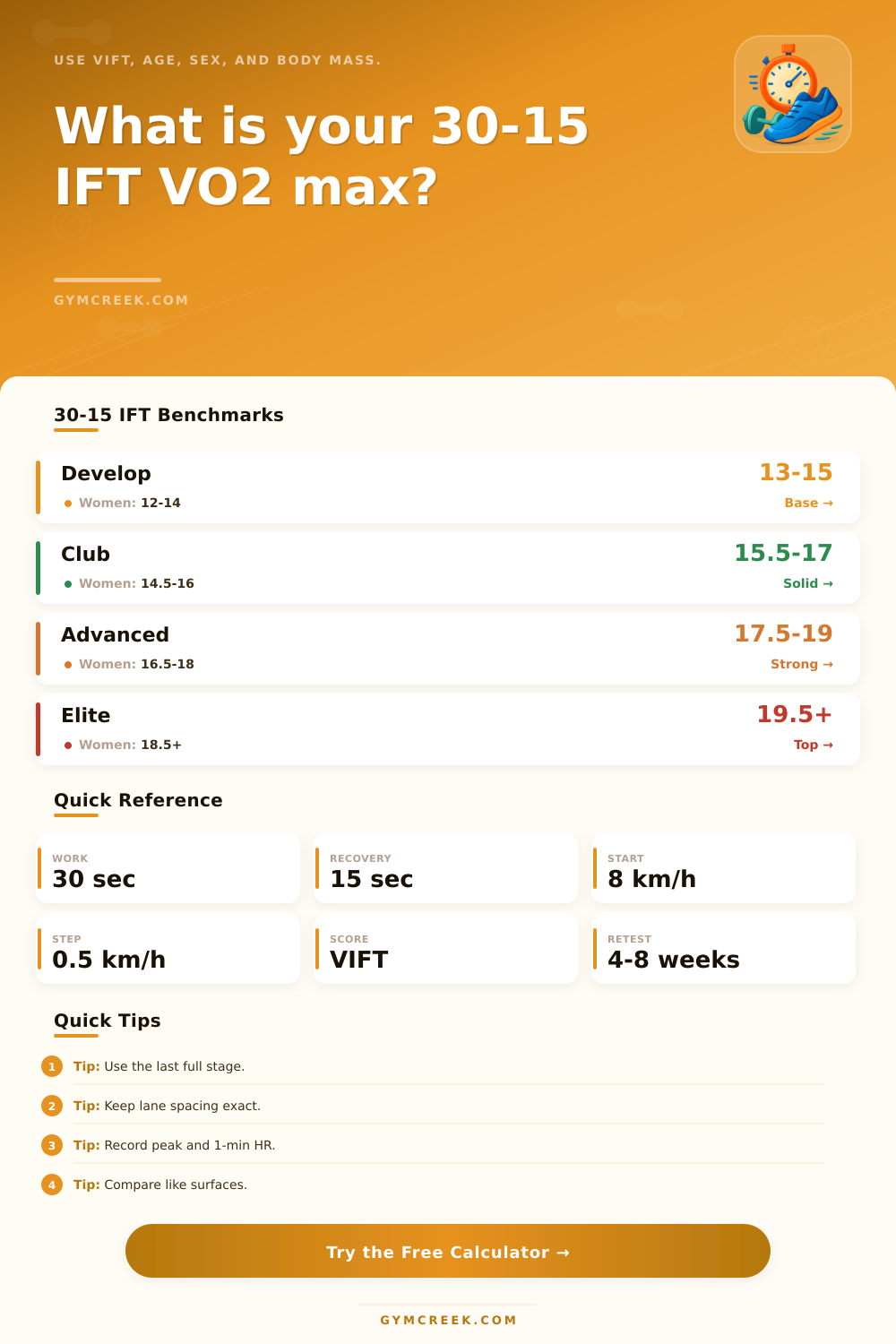
| Developing | 13.0-15.0 | 12.0-14.0 | Build aerobic base and repeatability |
| Club | 15.5-17.0 | 14.5-16.0 | Useful competitive conditioning |
| Advanced | 17.5-19.0 | 16.5-18.0 | Strong intermittent running profile |
| Elite | 19.5+ | 18.5+ | High-level repeat-effort capacity |
| Training target | Speed | Use | Note |
|---|---|---|---|
| 85% VIFT | Extensive | Re-entry and volume | Lower strain |
| 90% VIFT | Moderate | Aerobic repeatability | Good team average |
| 95% VIFT | Hard | High-intensity intervals | Watch fatigue |
| 100% VIFT | Maximal | Short severe bouts | Use sparingly |
| Protocol item | Standard | Record it | Why it matters |
|---|---|---|---|
| Work bout | 30 sec | Audio version | Controls speed exposure |
| Recovery | 15 sec | Passive or walk | Changes recovery load |
| Increment | 0.5 km/h | Final full stage | Defines VIFT score |
| Layout | 20-40 m | Lane length | Affects turns and pacing |
💡Tips
The 30-15 intermittent fitness test is used to determine how an athlete can perform repeated interval of high-intensity effort with very little time to recover between effort. The 30-15 intermittent fitness test is useful in that the protocol required of athletes during the test force their body to perform the same kind of burst of energy and rest periods that are required of athletes during their sports. The calculator is based upon an athlete’s final speed while performing the test, the athlete’s age, the athlete’s body mass, and the sex of the athlete.
Based off these parameters, the calculator provide an estimate for an athlete’s VO2 max.
The 30-15 intermittent fitness test requires athletes to run thirty meter at a designated speed, followed by a period of jogging or walking for fifteen meters. After this first round of running and walking, the speed increase by half a kilometer per hour, and the athlete must complete another round of running and walking. Each athlete will eventually reach a final speed that they can maintain for thirty meters during the last round of the test.
How the 30-15 Test Estimates VO2 Max
This speed is referred to as the VIFT (Velocity Interval Fitness Test) score for that athlete. The Buchheit model, which the calculator implements, use this VIFT score for athletes along with the athlete’s sex, age, body mass, and the interaction between those two variables to calculate an athlete’s VO2 max.
The equation that is implemented into the calculator accounts for how age can impact the performance of athletes during the 30-15 intermittent fitness test. For instance, the equation will indicate that the younger athlete that can reach the same VIFT score as an older athlete will have a more higher VO2 max. The interaction between age and performance is one of the variables in the equation that account for this difference in age.
Additionally, the equation also features a coefficient that lowers the VO2 max estimate for females to account for the differences in VO2 max between males and females. While these coefficient can be seen in the equation, athletes dont have to memorize them, as the calculator will calculate these values. Depending upon the level of athletes that are being evaluated with this tool, their VO2 max will provide coaches with information regarding the athlete’s conditioning for their sport.
For instance, a club-level soccer player may use this measurement to determine if their conditioning is at a level required to compete against other club-level soccer team member. Additionally, coaches may be able to use this information to set the training speeds for the athletes within their squad. Another parameter that may be used in interpreting the results of the test is the information regarding reference band for athletes.
These bands may include developing athletes, club athletes, advanced athletes, and elite athletes. These reference bands are used for both male and female athletes, though they are not strict cutoffs that determine whether an athlete possesses the conditioning required to perform at a certain level within their sport. In addition to the VIFT score for each athlete, information regarding their heart rate can help to provide additional information to athletes regarding their cardiovascular system.
Such data as an athlete’s peak heart rate, their one-minute recovery rate for the heart, and their resting heart rate can help to determine an athlete’s ability to recover from high-intensity effort. Furthermore, an athlete’s peak heart rate divided by the estimated maximum possible resting heart rate can help to indicate whether the athlete completed a truly maximal test while performing the 30-15 intermittent fitness test. Based upon the results of the 30-15 intermittent fitness test, athletes themselves can make training decision.
For instance, if an athlete calculates their VO2 max by the calculator, an athlete can use eighty-five, ninety, or ninety-five percent of their VIFT score to guide their training effort. Such percentages of an athlete’s VIFT score will allow for athletes to better plan their training session. Additionally, the calculator can compare an athlete’s VIFT score to a target speed for the athlete’s team.
Such comparison can help coaches and athletes during selection periods or return-to-play phase for injured athletes. Finally, the surface upon which the athlete performed the 30-15 intermittent fitness test and the layout of that area may impact the athlete’s VIFT score. For instance, a forty-meter shuttle on an indoor court will produce different result than running twenty meters on grass.
Thus, an athlete can use the calculator to note the length of the course and the quality of the surface upon which the athlete performed the test. Additionally, the altitude of the athlete’s location may be another variable that impact their VIFT score. For instance, athletes that live above one thousand meter may have different results from athletes that live at sea level.
These variables will not impact the VO2 max calculations of the athlete, but they may impact the VIFT score itself. Although the calculator will not fix error made during the determination of an athlete’s VIFT score, athletes are encouraged to note common error when performing this test. For instance, one common error is to use the speed of an athlete during any partial stage as their VIFT score.
Another common error is to change the audio file that is used during the 30-15 intermittent fitness test between stages. Additionally, athletes may perform the test on different surfaces without noting the change in the surface quality. These error the calculator cannot repair, but logging them will allow the athlete to make comparison between VIFT scores recorded over time.
The value of the 30-15 intermittent fitness test as a method to estimate the VO2 max is that it measures variable related to the efforts that athletes perform in their sports. Thus, a high VIFT score for an athlete indicates that they have high conditioning levels required to perform the effort required of team and court sports player. The calculator makes it easier for athletes to understand the relationship between an athlete’s VIFT score and their training program.
Thus, the calculator makes it easier for those athletes to use their VIFT score to make decisions regarding their training program.